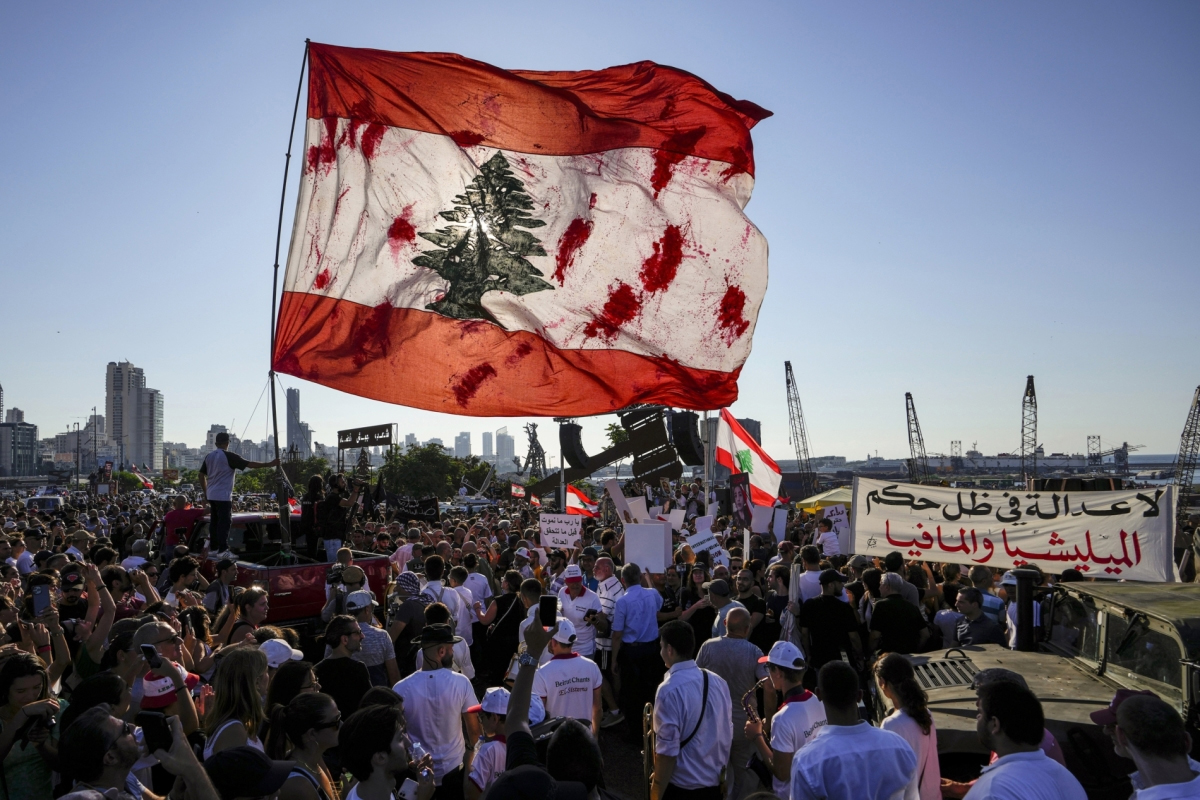
Art has played an influential role in making sense of the loss felt after the August 4 explosion. Tom Young’s “Strong Angels” and other paintings show a human dimension of the tragedy and its civilian heroes, who “join forces to lift the city’s grief,” writes Darine Houmani of Diffah Three (The New Arab). “Despite all its devastation, the August 4 explosion brought greater impetus to preserve our heritage and brought about a database of our historical buildings that hadn’t been done before,” states Mona Hallak, an architect, heritage activist, and director of the American University of Beirut’s Neighborhood Initiative, as cited in The New Arab. Several weighed in on the rebuilding efforts, including Lebanese architect Jad Tabet, who proposed “rehabilitation” rather than “reconstruction,” focusing on preserving the city’s existing social fabric and inhabitants alongside the architecture (for further reading on Jad Tabet and architectural heritage, see Al Jadid, Vol. 4, No, 25, Fall 1998; Vol. 5, No. 26, Winter 1999; and Vol. 24, No. 79, 2020). As art historian and gallery owner Andrée Sfeir-Semler says, “You need to nourish people with art and culture because that is what feeds their souls.”
French, Historical Memory, and Algeria's Linguistic Future
By Naomi Pham
In Algeria, the debate over whether French should be replaced by English has become increasingly entangled with broader geopolitical and ideological tensions, often overshadowing the country’s actual linguistic and educational needs. In his discussion of Algeria’s “language question,” Algerian novelist and author Waciny Laredj rejects both the demonization of French and the uncritical glorification of English, arguing instead for a pragmatic, historically informed, and educationally sound approach to multilingualism.* French remains deeply embedded in Algerian society, from everyday communication to education and professional life, making its complete removal an enormous and potentially disruptive undertaking. At the same time, Laredj challenges narratives that portray French solely as a colonial legacy, pointing to moments in which the language played an important role in intellectual, political, and liberation movements. The question facing Algeria is not simply whether French should be replaced by English, but whether such a transition is practical, historically conscious, and genuinely beneficial to the country and future generations.
Catastrophe and the Failure of Reason in Modern Arab Societies
By Naomi Pham
Across the Middle East and North Africa, superstition has long coexisted with religion, folklore, and everyday life. Beliefs surrounding the evil eye, divine curses, unseen forces, and supernatural causes for misfortune continue to shape how many people interpret disasters and hardship. While these traditions have deep historical roots, Algerian novelist and thinker Amin Zaoui argues in his essay, “When Natural Disasters Become a Breeding Ground for Superstition,” published in Independent Arabia, that their continued prominence carries consequences extending far beyond personal belief -- that is, superstition is not merely a harmless cultural practice but a force that can discourage critical thinking, perpetuate social injustice, and provide political authorities with a convenient escape from accountability.
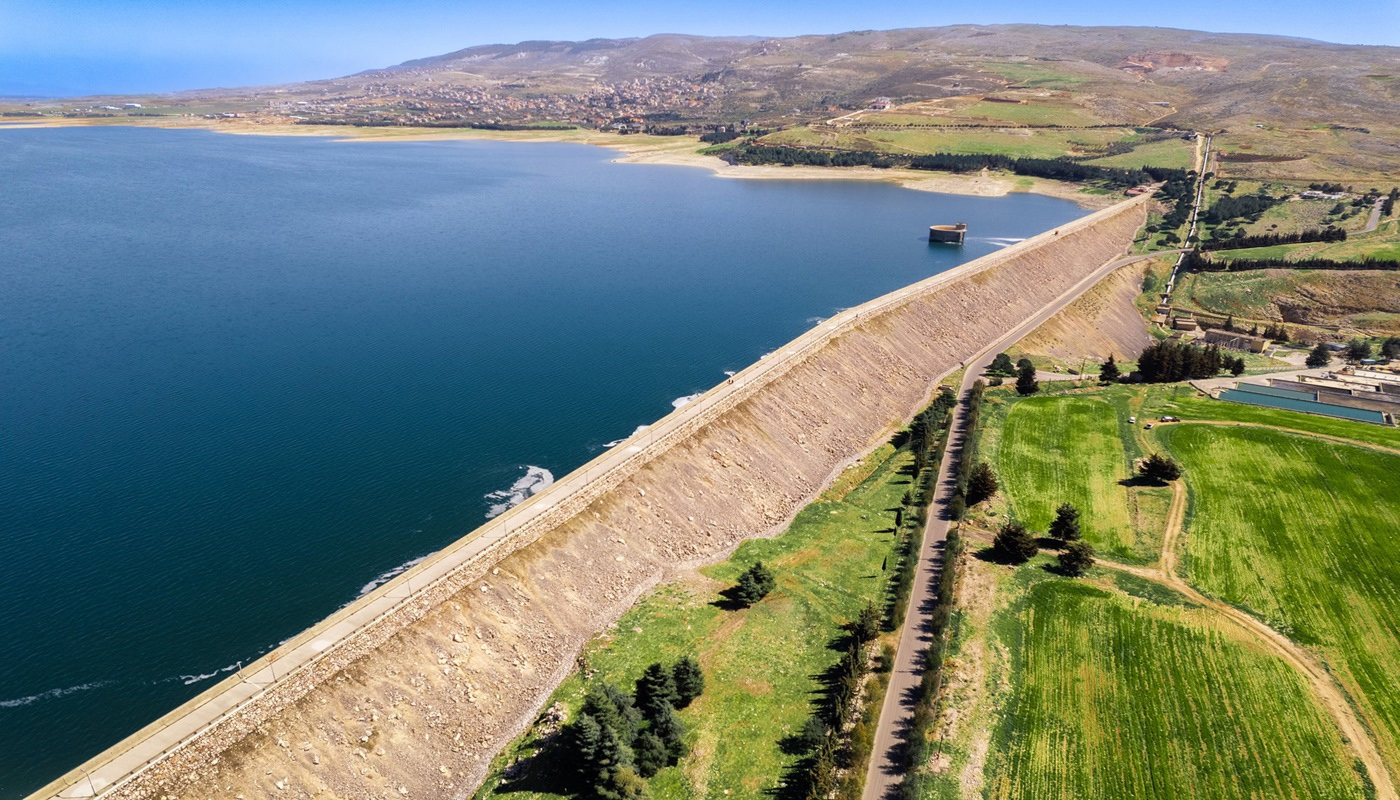
Lebanese people often say that just as Egypt is the gift of the Nile, Lebanon is the gift of the Litani. Rivers create the ideal conditions for the rise of great civilizations, a connection acknowledged since ancient times through the worship and reverence of rivers in Greece, Egypt, Mesopotamia, and across the wider world. From the creation of myths and the birth of numerous fertility deities to celebrations, festivals, and offering ceremonies, rivers have been central to the lives of the communities surrounding them. “As the presence of water is inextricably linked to the presence of life — and its absence to death — it is hardly surprising that rivers, waterways, and their basins have frequently ignited wars and bloody conflicts among humanity,” states Shawqi Bzeih in “The Litani River: Guardian of Memory and Legend, Ignored by Poets,” published in Asharq al-Awsat.
Public Art and the Preservation of Arab American History in New York
By Naomi Pham
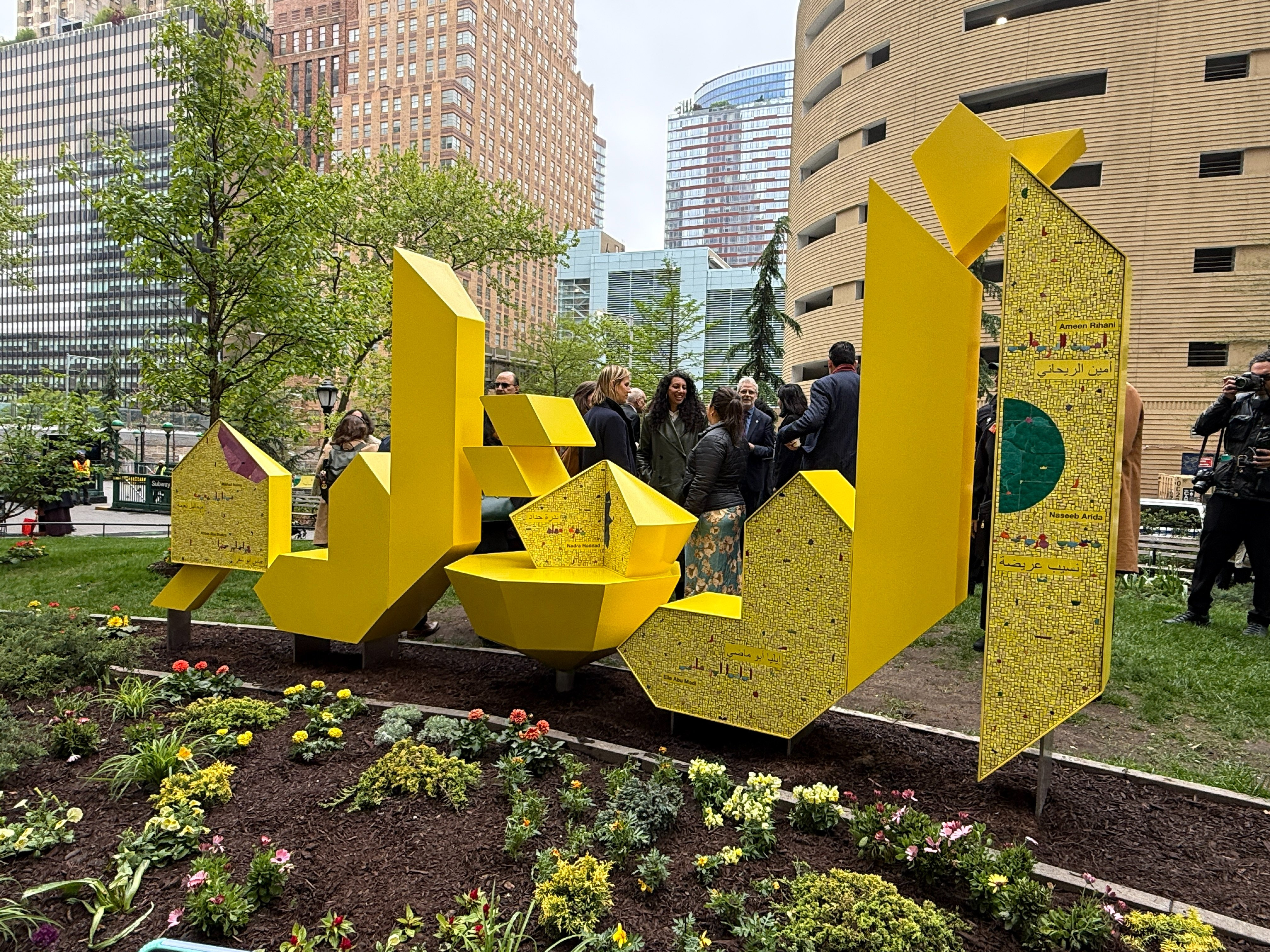
Just in time for the closing of Arab American Heritage Month, French-Moroccan artist Sara Ouhaddou in collaboration with NYC Parks, the Washington Street Historical Society, the New York City Department of Cultural Affairs, and funding by the Mellon Foundation, unveiled a vibrant art installation on April 30 that not only celebrates the history of its surrounding area, but stands imbued with the hopes of preserving the community’s legacy for years to come. With its permanent home at the Elizabeth H. Berger Plaza in the Financial District, Ouhaddou’s sculpture and mosaic installation, nearly a decade in the making, honors the memory of Manhattan’s Little Syria, which was completely demolished and its residents evicted in the 1940s to make way for the construction of the Brooklyn-Battery Tunnel. The unveiling was also organized in conjunction with a symposium at NYU’s Kevorkian Center, titled “Beyond Al-Qalam: Literary Rebellion and Visual Abstraction in Little Syria,” held on May 2, 2026, exploring the legacy of New York’s early Arab American writers.
How Arabia's Tribes Created a Common Language Without a Common State
By Naomi Pham
Arabic in the pre-Islamic era — or Jahiliyyah, the ‘age of ignorance’ — was a diverse continuum of spoken dialects and poetic language rather than a single unified language. The period encompasses the history of the Arabian Peninsula and surrounding regions prior to the spread of Islam in 610 CE, a time characterized by nomadic Bedouin tribes and a rich oral poetry tradition. Mustafa Attia Juma’s essay, “The Reality of Arabic in the Pre-Islamic Era,” explores the deep history of the Arabic language and the conditions that determined its purity.
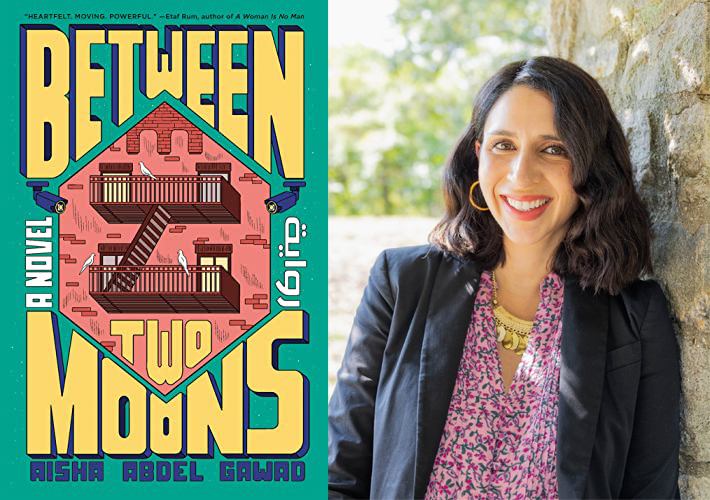
With her debut novel “Between Two Moons,” Aisha Abdel Gawad joins her Arab Anglophone sisters in writing: Isabella Hammad, Susan Abulhawa, Hala Aylan, Laila Lalami, and others.
Fifty Years of Debate Yield No Consensus Over Her Place on the Throne of New Arabic Poetry
By
Elie Chalala
Rarely do I open a cultural page in Arab newspapers, whether print or online, without catching wind of new discourse on modern poetry. Though I have never written poetry, the topic naturally draws my interest as an academic in political science, lecturing on debates between tradition and modernity for nearly a third of a century...Debates between traditional and new poetry shouldn’t be dismissed as simply Byzantine arguments. Such discourse indicates significant changes in the Arab world, including modernization and later globalization. Several critics have raised this discussion, the latest of which was in a column by Aref al-Saadi in Asharq Al Awsat, who writes, “I say this based on a slow study of our contemporary poetry and its trends, and I say it because it is the logical result of our willingness to read European literature and study the latest theories in philosophy, art, and psychology. In reality, those who want to combine modern culture with ancient traditions of poetry are like those living today in the clothes of the first century of immigration.” According to Saadi, there are two alternatives to discussing modernity and tradition: “Either we learn the theories, are influenced by them, and apply them, or we do not learn them at all. It may be useful for us to remember that the development in the arts and literature in a given era arises from the meeting of two or more nations.” Closed nations don’t produce anything new but merely repeat what their ancestors did.
Rarely do I open a cultural page in Arab newspapers, whether print or online, without catching wind of new discourse on modern poetry. Though I have never written poetry, the topic naturally draws my interest as an academic in political science, lecturing on debates between tradition and modernity for nearly a third of a century...Debates between traditional and new poetry shouldn’t be dismissed as simply Byzantine arguments.
For the ordinary reader, “Love Letters” is a short yet savorable book, with letters you can thumb through when drawn to thoughtful musings or aspirations to better oneself. For those interested in Gibran as either a literary giant or an artist, this collection of letters provides a nuanced narrative of his deep spiritual yearnings, dedication to his work, extended gentleness, and benevolent humor. This touching correspondence between these two seminal intellectuals weaves together their mundane concerns, from Ziadeh’s change of hairstyle to intimate emotional and spiritual revelations, as well as Gibran’s aesthetic reflections, adding an empathic human depth to further appreciate both his art and life as an artist.
For the ordinary reader, “Love Letters” is a short yet savorable book, with letters you can thumb through when drawn to thoughtful musings or aspirations to better oneself. For those interested in Gibran as either a literary giant or an artist, this collection of letters provides a nuanced narrative of his deep spiritual yearnings, dedication to his work, extended gentleness, and benevolent humor.
Arab American literature and how we define it remains central to the field’s discourse. Some scholars believe prior knowledge of Arab culture is essential to comprehending Arab American literature since it is an ethnic genre. Since the 20th century until the present, Arab Americans have strongly lobbied to classify Arab American studies as an ethnic field and draw a line between Middle East studies — which belongs to the area studies — and ethnic studies.
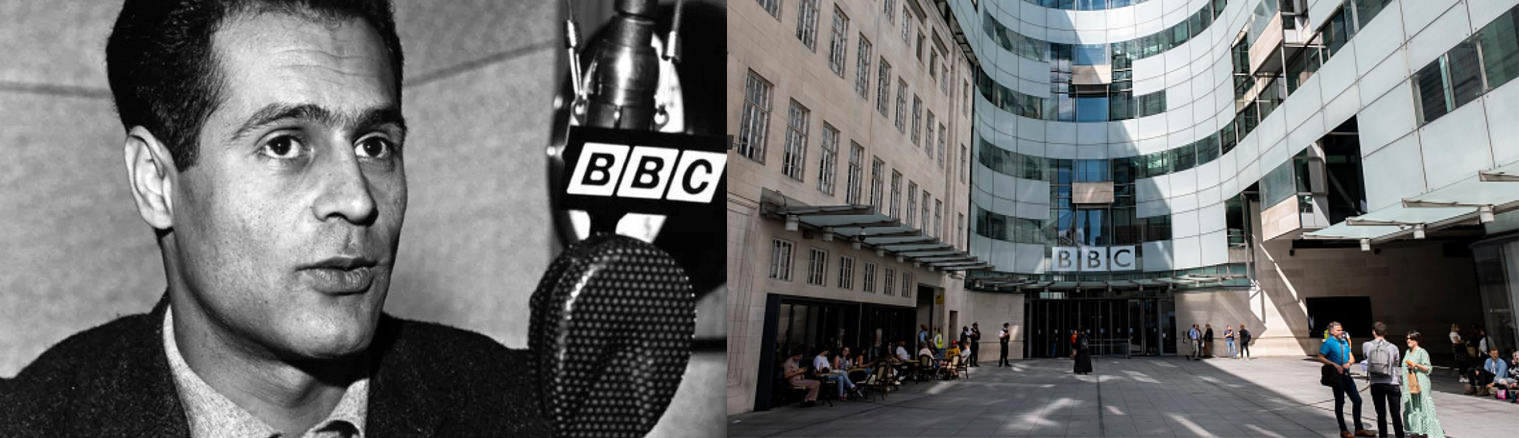
The demise of BBC Arabic closes a chapter in modern Arab history. This is not a romantic or idealistic lamentation. Any Arab student or scholar who lived through or part of the post-WWI era of the 20th century can easily recognize the association between BBC Arabic and major political events. The question becomes not who are the writers of history — it is a history written by the literate or middle classes as opposed to a popular history. How can scholars tell that BBC Arabic was part of the lives of the groups who have written about the contemporary history of the Arab world? We rely on two indicators: literacy and politicization. When I use the term history, I believe that most if not all those who wrote on the political history of the Arab world came from literate classes and were part of groups that cared for and even were engaged in politics. Those included pan-Arabists of the radical schools such as Nasserites and Bathists, conservatives, Islamists, and those moderate liberals opposed to socialists and communist groups.
The demise of BBC Arabic closes a chapter in modern Arab history. This is not a romantic or idealistic lamentation. Any Arab student or scholar who lived through or part of the post-WWI era of the 20th century can easily recognize the association between BBC Arabic and major political events. The question becomes not who are the writers of history — it is a history written by the literate or middle classes as opposed to a popular history.
For 44 years, Al Saqi Books has served as the beating heart of Arab culture for tourists, expatriates, and Arab readers in London — but after struggling to stay afloat amid a rocky economic climate both in the Middle East and at home in the United Kingdom, the independent bookstore recently announced its closure at the end of the month, just before the new year. Over the past decade, bookstores worldwide have been forced to shut their doors. Syria and Lebanon have faced closures due to economic and social crises (read more about the state of the Arab world’s publishing industry in Al Jadid, Vol. 25, Nos. 80-81, 2021 and Vol. 26, Nos. 82-83, 2022). The bookstore chain Borders was liquidated in 2011, and even Barnes & Noble has closed several of its locations. Independent bookstores have taken especially hard hits as the culture of reading shifts with technology, making it increasingly difficult to keep up with costs.
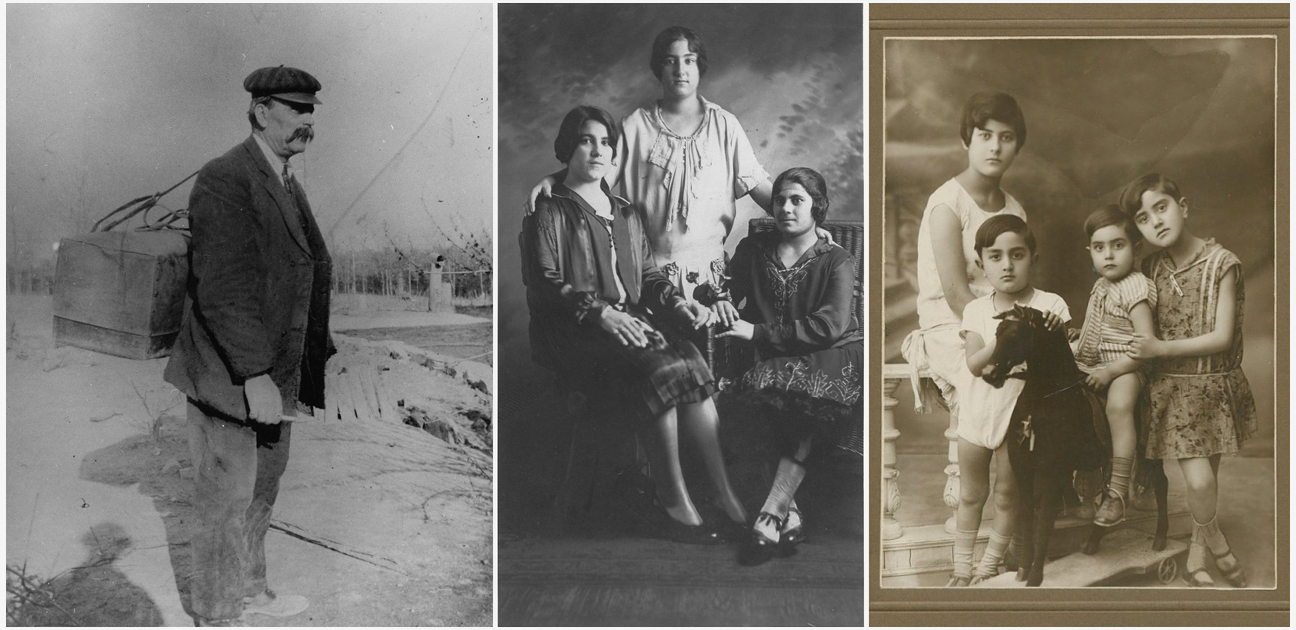
Like a picture captured in history, the iconic arched façade and intricate pilasters of Al Saqi Books have overlooked London’s Westbourne Grove Street for decades, welcoming patrons and everyday passersby on the street with an enticing array of books lining its display windows. A yellow and blue shop sign greets visitors, donning the bookstore’s logo: a man carrying a waterskin on his back, leaning down to pour water for two children.
Remembering A Courageous Writer: His Refusal of Censorship, of Exile, and of Silence
By
Elie Chalala and Naomi Pham
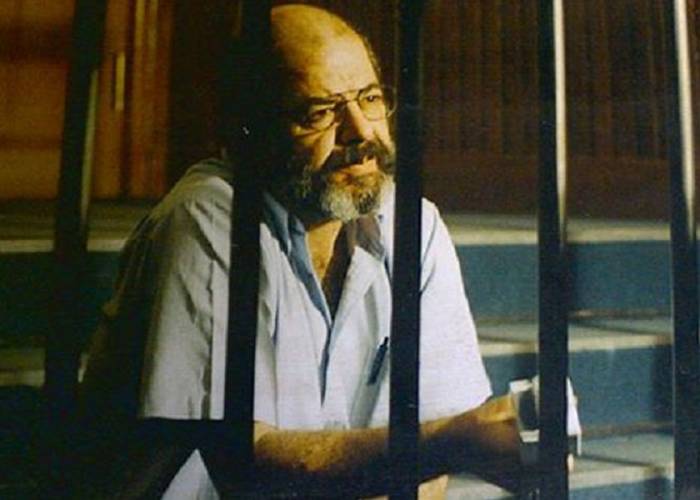
The late Syrian writer Ghassan al-Jibai (1952-2022) was known for his intellectual activities across various art forms, from theater to novels and poetry — but though his craft came in many forms, each harnessed his steadfast opposition to tyranny and oppression. His career as a theater director, dramatist, and writer suffered immensely under the Syrian regime.