
How Arab Generations Inherit the Traumas of the Past
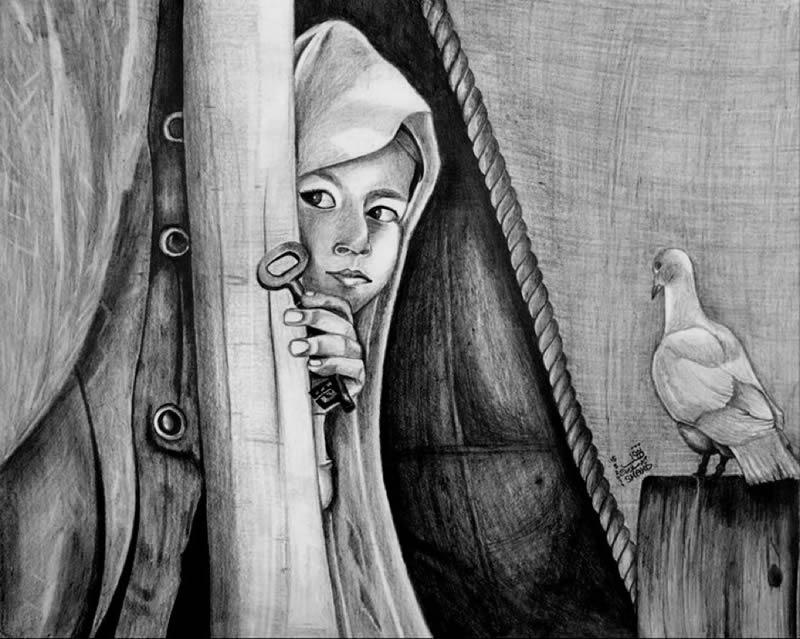
Illustration by Palestinian artist Shahd Abusalama.
Catastrophe, departure, return — such words carry strong connotations in the Arab world, reigniting distinct memories within many people and families. Stories of the past, of memories, have passed from parents' tongues to their children and grandchildren. “Can we remember other people’s memories?” asks American scholar Marianne Hirsch, author of “The Generation of Postmemory: Writing and Visual Culture After the Holocaust.” In her Al Araby article “Memories of Distant Lands,” Samar Yazbek revisits the theory of postmemory presented in Hirsch’s 2012 book.* Though “The Generation of Postmemory” discusses Hirsch’s influential concept of “postmemory” in relation to the Holocaust, academics and intellectuals have also applied her theory to Arab studies of displacement, catastrophe, and the inheritance of trauma. As Yazbek writes, Marianne Hirsch’s book is an investigation of how “subsequent generations relate to the catastrophes their parents and grandparents experienced.”
According to Hirsch, “postmemory” refers to a relationship to memories that one has not personally experienced but that has been formed through “bonds of kinship” — typically family — and narratives, images, gestures, and imagination, influenced by emotion, fear, and loss. Family memory is not always a coherent narrative, as not all memories are passed down with the same intensity. “An inherited past comprises elements that remain present, alongside others that are absent or less pressing,” states Yazbek, who adds that children may learn from their parents or grandparents about the specific details of one or many events while simultaneously remaining in the dark about other details, depending on what their parents wish or do not wish to share. Yazbek explains, “The point of this concept is not to suggest that children remember things they never experienced, but to understand how a past they did not live through becomes a force that shapes their present.”
Scholars apply the concept of postmemory to discussions on ongoing conflict across the Arab world. These conflicts include societies contending with the aftermath of war, struggling with displacement, migrants, and refugees, and the intergenerational continuity of loss of place. The Arab world’s reality is one constantly marred by war, so much so that a common narrative in Arab societies is that children grow up carrying their father’s memories before they are able to forge their own because their country keeps moving from one war to another.
What parents experience firsthand differs from what children imagine or infer about a past they did not live through. Temporal distance shapes lived experience; what parents recall from their past may diverge from what children imagine or infer about a past they did not experience. As Yazbek observes, parents’ memories are filtered by their experiences and responsibilities, while children interpret them through a present-centered lens.
Memory remains a complicated issue in Lebanon, where competing narratives and collective amnesia regarding the country’s violent past and 1975-1990 civil war result in memories of vastly different experiences depending on the person. Craig Larkin’s essay, “Beyond the War? The Lebanese Postmemory Experience,” published in the International Journal of Middle East Studies in 2010, examines Hirsch’s concept of postmemory through the lens of Lebanese youth who did not grow up experiencing the war themselves but whose lives have been deeply influenced by the narrative accounts of the events.** Larkin describes this generation of Lebanese as caught between “collective remembrance” and “social forgetting,” observing that “little attention has yet been given to how Lebanese youth are negotiating both the historic silences and private anguish of their nation’s bloody past. Academic research on Lebanese war memory has tended to privilege elite production and cultural agency, focusing on war-related literature, films, artistic installations, heritage disputes, rebuilding projects, and memory entrepreneurs rather than engaging critically with everyday processes of social transmission and internalization.”
Postmemory, he defines, is a “residual” type of memory that has not been personally experienced but is socially felt. He writes, “Members of the Lebanese postmemory generation reproduce, reimagine, or erase memory traces in order to identify and position themselves within contemporary Lebanese society.” Larkin interviews Lebanese youth whose relationship with war memory is a paradox, simultaneously “forgotten and remembered, incomprehensible yet the source of constant discussion, finished yet very much alive.” Rami, for example, has no personal memory of Lebanon’s civil war yet is conscious of the pain, suffering, and collective loss left in its wake. As Rami explains to Larkin, “The war may have officially ended in 1990, but the Lebanese were left in a timeless existence — they tried to make us forget what happened, when it happened, and why it happened! We lost ourselves in this process.” In Larkin’s words, the “overwhelming public discourse of forgetfulness and erasure has left his [Rami’s] generation dangerously “out of time” and “out of place,” bereft of a unifying national narrative and a cogent sense of self.”
Family identity is shaped by the transmission of — or omission of — family memories, especially among refugees and families living in exile. For Syrians, the refugee experience and great significance attached to “the return” opens a complex discussion on the intergenerational connection to place. For the older generation of Syrians who were forced to flee their homeland, the concept of return represents not only a physical return to one’s land but also a symbolic “restoration of a lost continuity between their past and their present,” writes Yazbek. This experience differs from that of their children, many of whom have built their entire lives away from their parents' birthplace. For these children, born in exile, the return signifies the severing of the life they’ve built and all they have known.
Natalie Budner’s article, ‘“I Want to Go Back to Syria; My Family Is There. I Miss Them. But I Cannot Be Selfish. My Daughters Were Raised Here in Türkiye”: Navigating Mixed Identities Following Conflict,” published in the special issue “Migration, Identity, and Nationalism in the Age of Globalization” of the Genealogy Journal, examines how postmemory shapes the perspective of the new generation.*** Budner observes families who chose not to pass the narratives of their traumatic experiences to their children, and how the absence of this transmission affects the younger generation’s sense of identity. In her words, “Without the stories and images of the past trauma, the new generation is protected from the violence their parents experienced but also lacks the context to understand the behaviors and mindset that they possess when making decisions.” She cites the case of Ali and his sister-in-law Zara, both of whom have deep ties to Syria and yearn to return, yet whose decisions must also take into account the lives of their children, who have established lives and identities in Turkey. Budner writes, “The adults remember Syria, they long for Syria, but they also understand the dangers of Syria. They have shielded their daughters from the trauma they experienced in Syria in hopes of creating a better life for them. However, this has contributed to their internal strife of identifying as Syrian or as Turk.”
The concept of postmemory has also been applied to studies of Palestinian displacement. The Palestinian experience is intrinsically tied to the inheritance of memory. Memories of the villages from which Palestinians were expelled remain with their children and grandchildren through stories, oftentimes so thoroughly detailed that descendants — although living in exile — may know the exact route to a home they have never seen, states Yazbek. She adds that memories of the Nakba go beyond familial nostalgia — “It is a memory of uprooting, inextricably linked to national rights…holding onto this memory cannot be reduced to a simple psychological attachment to the past.”
In her works on the subject, Hirsch distinguishes multiple forms of postmemory: familial postmemory, discussed in the previous examples, and affiliative postmemory, a connection to a past collective trauma formed through cultural, ethical, or peer ties rather than direct biological or familial descent. Dawid Grabowski’s study, “From Postmemory to Posts: Hirsch’s Concept in the Digital Age and the Case of the Gaza 2023 War on Instagram,” investigates how those without familial or geographical ties to Gaza or the Palestinian plight are able to engage in acts of remembrance, solidarity, and testimony through the digital and technological developments of the present era.**** According to Grabowski, “In the digital age, postmemory unfolds not only through familial transmission but also through networked and participatory forms of remembrance that entangle the present with the past.” As such, he continues, postmemory transcends a “simple act of inheritance” and operates as an active process of interpretation and creation. Grabowski argues that social media platforms such as Instagram and X, formerly known as Twitter, have broadened the scope to which memories and narratives reach, enabling Palestinians and solidarity networks to “circulate firsthand testimonies, live footage, and counter-narratives that challenge the editorial filters of mainstream journalism…individuals who were historically silenced now have the means to record, narrate, and circulate their own experiences.”
He continues, “In this sense, Instagram visualizes how postmemory operates differently in the Palestinian context. While Hirsch’s concept emerged from the study of the Holocaust — a horrific historical event transmitted through generational memory — the Palestinian experience resists closure. The catastrophe is not past but continuous; remembrance and witnessing are not acts of inheritance alone but of ongoing presence.”
Marianne Hirsch states in “The Connective Arts of Postmemory,” an updated essay on the subject published in 2019, that the “post” in “postmemory” is “not a concession simply to linear temporality or sequential logic. It signals the complex relationship between proximity and distance, overlaid with the multiple effects characterizing mediated acts of transfer…postmemory reflects an easy oscillation between continuity and rupture.”***** The Palestinian experience presents a unique case in the context of postmemory. Grabowski cites Ihab Saloul’s book, “Catastrophe and Exile in the Modern Palestinian Imagination: Telling Memories,” in which Saloul specifically addresses the “post” in “postmemory” in relation to Palestinian trauma. He explains that subsequent generations of Palestinians “do not have just postmemories of al-Nakba. Whereas the first generations of post-Nakba Palestinians have memories and experiences of the originating event of al-Nakba, second and third generations of post-Nakba Palestinians, although they have not experienced this originating moment (1948), are still “inside” the event itself, living the catastrophe every day.”
Since Hirsch’s first discussions of postmemory in 1992, the concept has greatly advanced understanding of the inheritance of trauma passed from generations that experienced catastrophe and crisis to those born after the events, especially in the context of Arab societies and their conflicts. The warnings Hirsch describes in her book, though centered on the Holocaust, apply to all bearing the weight of a memory that isn’t entirely their own — that the stories of earlier generations may overshadow the subsequent generation’s ability to narrate their own lives,” states Yazbek. Most importantly, she stresses the “necessity of acknowledging the distance between those who lived through a catastrophe and those who inherited its consequences — a distance that is as ethically significant as it is crucial for understanding memory itself.”
*Samar Yazbek’s essay, “Memories of Distant Lands,” was published in Arabic in Al Araby.
**Craig Larkin’s essay, “Beyond the War? The Lebanese Postmemory Experience,” was published in the International Journal of Middle East Studies, 2010.
***Natalie Budner’s essay, “I Want to Go Back to Syria; My Family Is There. I Miss Them. But I Cannot Be Selfish. My Daughters Were Raised Here in Türkiye”: Navigating Mixed Identities Following Conflict,” was published in the special issue of Genealogy Journal, “Migration, Identity, and Nationalism in the Age of Globalization.”
****Dawid Grabowski’s essay, ”From Postmemory to Posts: Hirsch’s Concept in the Digital Age and the Case of the Gaza 2023 War on Instagram,” was published in “Heritage, Memory and Conflict Journal,” Vol. 6, Issue 1, March 2026, Amsterdam University Press.
****Marianne Hirsch’s essay, “The Connective Arts of Postmemory,” was published in Analecta Política, Vol. 9, No. 16, 2019.
This article appeared in Inside Al Jadid Reports, No. 196, 2026.
Copyright © 2026 AL JADID MAGAZINE