
Women’s Aspirations and the Weight of Tradition
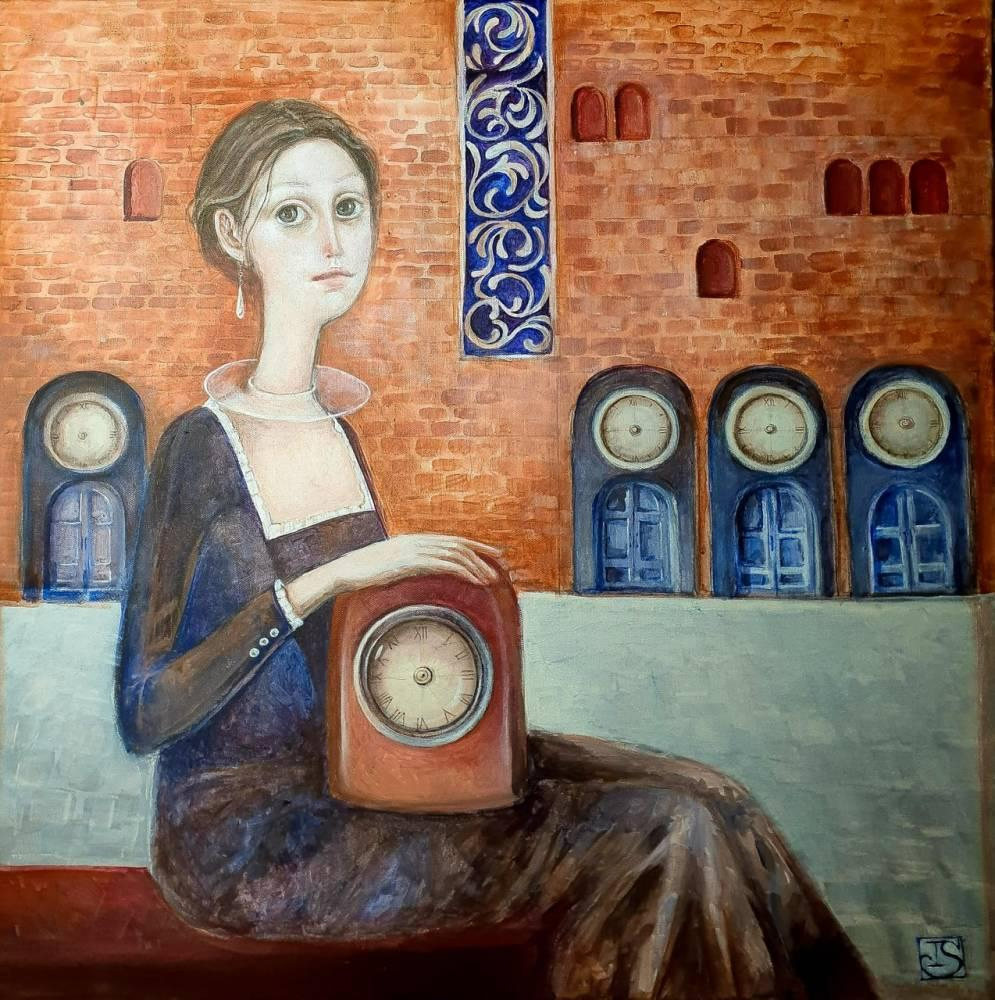
"The Gate" (2021) by Iulia Șchiopu.
The concept of “spinsterhood” feels like a dated, almost archaic term in today’s setting. In Western culture, the term's use has since been replaced by neutral designations like “single” or “unmarried,” an effort to leave its derogatory associations in the past. Historically, however, spinsterhood is a relatively modern phenomenon, with few, if any, instances in ancient times. In her Independent Arabia essay “Spinsterhood in Lebanon: A Dilemma of Age and Tradition,” Carine Eliane examines the prevalence of spinsterhood in Arab culture, specifically in Lebanon.*
The age at which one is deemed a spinster or bachelor has shifted throughout history, depending on the norms of those periods. Eliane cites Omnia Makki, a specialist in living cultural heritage, who explains that ‘spinsters’ are a somewhat modern concept, having not existed in the past, and are more prevalent in secular societies. There is little evidence of women remaining unmarried in records from Canaanite or Roman society, as well as in several religions such as paganism, Judaism, and Christianity. In the Roman case, being unwed was penalized and stigmatized under Emperor Augustus’ rule, as marriage and childbearing became a civic duty by law. Eliane adds that Christian teachings were “contingent upon establishing a family, procreating, and honoring one’s wife; the prospect of a woman remaining unmarried was not a standard consideration.”
The Western cultural reception to remaining unmarried or delaying marriage differed from that of the Arab world. In the modern era, Western customs and traditions surrounding remaining single at age 30 — for both men and women — are generally lighthearted and humorous pranks, with the economic necessity of marriage and the social stigmas attached to singlehood giving way to attitudes that celebrate personal autonomy and choice. Eliane cites numerous Western societies that uphold customs for singles that sound humorous or playful: in Germany, single men aged 30 and older must sweep public steps, while single women are tasked with cleaning door handles; in Denmark, there is a tradition of dousing unmarried people in cinnamon or pepper if they are still single at 25 and 30.
This experience is vastly different in the Arab world, where — in spite of some recent strides in women’s autonomy — a woman remaining unmarried is attached to negative stigmas. Unmarried women in Arab culture are often subjected to spiritual and religious practices to “resolve” their issue and ward off superstitious beliefs, with customs ranging from reciting prayers, spiritual healing, the use of incense, amulets, rituals, and seeking out charlatans, states Eliane. In certain cases, singlehood among Lebanese women is a matter of circumstantial conditions; some village traditions maintain a “pecking order,” meaning the younger daughter in a family cannot marry before her older sister, resulting in delayed marriages.
“In Arab culture, marriage is a turning point that bestows prestige, recognition, and societal approval on both partners, particularly the bride,” writes Karim Traboulsi in “All the Single Ladies: The Arab World’s ‘Spinster Revolution,”’ published in a 2019 New Arab article.** During harsh economic periods, early marriages are not uncommon. In a 2021 article published by Deutsche Welle, Catherine Schaer links the rise in child marriages to periods of economic hardship.*** As poverty levels rise, occurrences of child brides also increase. In especially hard times, fathers marry off their daughters to minimize their own responsibilities and anxieties, as a girl or woman becomes her husband’s economic responsibility after marriage. Schaer notes that each of the 18 recognized religious groups in Lebanon sets its own rules on the legal marriage age, ranging from 14 for Catholics to 18 for members of the Greek Orthodox Church.
This attitude has shifted in the modern day. According to Eliane, in today’s Lebanon, young women rarely marry before the age of 25, and even within traditional families, early marriage during adolescence no longer exists, especially since many organizations are actively working to prevent the marriage of minors. A statistic published in an article by the Turkish state-run news agency Anadolu Agency in February 2019 claimed that up to 85% of women in Lebanon are spinsters, citing unverified “Western studies” as the source. Though the article was dismissed as inaccurate, it effectively generated buzz on social media and in news outlets.
Several factors have led to changes in women's need for self-reliance. In some historic cases, the conditions of the time necessitated adaptation and change. The Great Famine in Lebanon from 1915 to 1918 made marriage and childbearing difficult, as men were conscripted into the army and women’s priorities shifted toward self-sufficiency and independence to “prove their capabilities,” in Eliane's words. They increasingly took up work in agriculture and the silk industry, becoming less concerned with starting families due to the difficulties of maintaining a household at the time. Economic factors also heavily influenced decisions of when to marry and have children. A man’s circumstances certainly played a role — his financial situation informed his readiness to marry, start a family, and secure a home. Many Lebanese men emigrated overseas in search of financial stability, leading to a high female-to-male ratio.
The delayed age of marriage and many Lebanese women’s decision to remain unmarried correlate with an emphasis on women’s goals for self-actualization and education. Marriage age trends have shifted with changing interests, and women are focusing on education and career advancement. The significance of marriage for a woman has altered somewhat; historically, marriage symbolically represented status, protection, and honor, reinforced by a patriarchal system and its values. The advent of the Industrial Revolution called for equality between men and women, a call bolstered by Western and Marxist ideologies. As a result, women gained access to education and the workforce, increasingly choosing to remain unmarried. Eliane writes, “Social openness increased, and rates of remaining unmarried rose — exacerbated by the mass emigration of young men.”
Eliane also suggests that the concept of “spinsterhood” in Lebanon emerged in response to the absence of state support. Young women played vital roles as caregivers for their elderly family members. According to Traboulsi, Dr. Hoda Rashad writes in a paper shared with The New Arab that these young women “are the main social security system for the elderly, sick, or disabled… [and] they provide economic refuge for children and youth, the unemployed, and other dependents,” where “parents are responsible for children well into those children’s adult lives, and children reciprocate by taking responsibility for the care of their aging parents.” She adds, “Marriage for Arabs is both an individual and family matter.” At the same time, concerns about the possible decline of birth rates that may ensue as a result of higher rates of singlehood among Lebanese women remain.
Modern values clash with the customs surrounding spinsterhood in the Arab world. Women are choosing their careers, education, and standards over expectations attached to their gender — but this comes at the price of immense social pressure, on both a cultural and social level, within a predominantly patriarchal society. As Dr. Rashad states, cited by Traboulsi, women are delaying marriage as “a calculated choice to address the incompatibility of the prevailing patriarchal marriage dynamics with increased female aspirations for autonomy and self-realization.” She explains that in their current state, most Arab legal systems discriminate against women in matters of marriage, divorce, nationality laws, and taxation, and that “the system sees women as only wives or mothers, rather than independent agents.”
The double standard in how unmarried women are treated as opposed to unmarried men comes down to even the verbiage used for each group; the word “bachelor,” used for unmarried men, generally bears positive cultural and social connotations, often associated with being independent, free, desirably eligible, and full of potential. Meanwhile, unmarried Arab women are called “spinsters,” or to be more exact, “aanis,” meaning ‘old maid.’ The phrase derives from older Arabic roots referring to “a branch that has withered and has become useless,” according to Traboulsi. For a woman in the Arab world, marriage status affects social standing, determines her worth, and even invites others to make judgments on her character, regardless of whether she desires it or not. Traboulsi cites a social media movement among Egyptian men dedicated to bullying single women under the banner of “Let Her Stay Spinster,” where men urged women to “lower their impossible standards and stop being so materialistic.”
Yet, despite the pushback, Arab women continue to assert themselves in a system that seems set on forcing them into servile, gendered roles. As Traboulsi succinctly sums up, “These women are not waiting for anyone to grant them their rights, but are bracing harassment, intimidation, and even imprisonment to force their oppressors to reverse systematic discrimination across the region, especially in laws relating to marriage, divorce, child custody, and inheritance. If there is a real societal problem arising from the collapse of the old marriage model, then this is part of the solution. If women feel laws and policies are fairer, then they will be less intimidated by the currently oppressive marriage bond.”
*Carine Eliane’s essay, “Spinsterhood in Lebanon: A Dilemma of Age and Tradition,” was published in Arabic in Independent Arabia.
**Karim Traboulsi’s essay, “All the Single Ladies: The Arab World’s ‘Spinster Revolution,”’ was published in The New Arab.
***Cathrin Schaer’s essay, “Child Marriages Increase in Lebanon in Pandemic,” was published in Deutsche Welle.
This article appeared in Inside Al Jadid Reports, No. 194, 2026.
Copyright © 2026 AL JADID MAGAZINE