
The Dramatic Imagination of Badr Shakir al-Sayyab
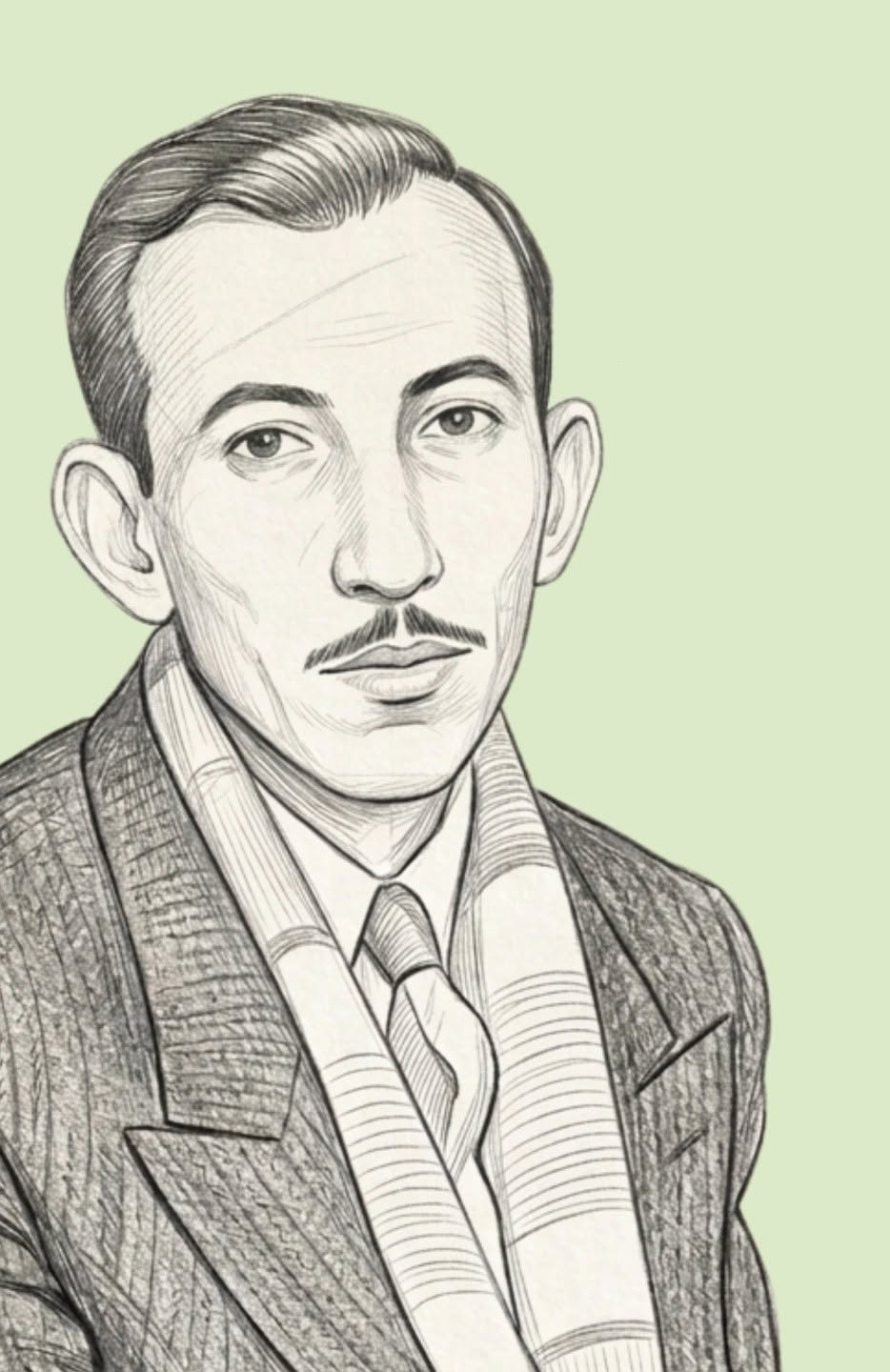
Iraqi poet Badr Shakir al-Sayyab.
The Centenary of the Pioneers Festival hosted at Al-Rashid Theater in Baghdad took place between October 1 and 3, 2026, featuring literary discussions, poetry readings, and music celebrating 100 years since the births of Iraqi poets Badr Shakir al-Sayyab, Abdul-Wahab al-Bayati, and Buland al-Haydari, all born in 1926, who contributed to modern Arabic poetry. This celebration follows the announcement that Badr Shakir al-Sayyab’s childhood home will be restored as a museum dedicated to his work. His granddaughter Dimah al-Kweder, an architect, has been hired to restore the home. Funded by the European Union, UNESCO, in partnership with Iraq’s Ministry of Culture, Tourism, and Antiquities, plans to transform the house into a cultural center and literary museum. Original rooms have been adapted for the new cultural center to serve as exhibition centers and to house a library and materials related to Sayyab’s work.
Badr Shakir al-Sayyab, born in 1926 in the village of Jaykur outside Basra, broke away from classical Arabic poetic tradition in his poetry. Known by many as the “father of modern Arabic poetry,” Sayyab is closely associated with the emergence of free verse and the modernization of Arabic poetry, alongside figures such as Nazik al-Malaika. However, his importance extends beyond his role in the modernist movement; his poetic style uniquely shifts from the Romantic lyricism used in his early poetry to the dramatic representation that distinguished his later works. In honor of the late Badr Shakir al-Sayyab’s 100th birthday, Awad Ali examines the dramatic and theatrical characteristics of the pioneering poet’s work.*
Sayyab’s poetry reflected the personal, physical, and political suffering he experienced, from which many of his works drew inspiration. In 1949, he was arrested and imprisoned for his political activism and ties to the Iraqi Communist Party. In 1953, Sayyab fled into exile in Iran and Kuwait to escape the political arrests following the 1952 Iraqi Intifada. According to Awad Ali, the poet’s lyrical voice was influenced by the turbulent political changes in Iraq, his experiences of imprisonment, exile, and persecution, as well as his struggles with illness, abject poverty, and awareness of death that defined the late years of his life leading up to his early death at the age of 38. Though his writing was greatly influenced by the immense suffering he experienced, Sayyab’s poems evolved into more than a space for self-expression; they became a stage on which competing forces encounter one another.
Theatrical and dramatic components are characteristic of Sayyab’s poetry. In Ali's words, the dramatic dimension of Sayyab’s poetry “deserves to be studied as a structural and aesthetic element rather than as a passing technique.” His writing was driven by conflict and characterized by multiple voices and personas, internal and external dialogue, and a progression of time. According to Ali, Sayyab experienced the world as a “perpetual state of contradiction.” His poetry frequently referenced fertility and barrenness, rain and drought, and life and death. He used mythology as a device to express the tragedy of contemporary Iraqi humanity, calling upon figures such as the Mesopotamian and Levantine fertility deity Tammuz, the Mesopotamian goddess of love, war, and fertility, Ishtar, Christ, and Oedipus. The poem “Cerberus in Babylon” is one such poem in which he uses symbolism and legend to create dramatic conflict, expressing the struggles between good and evil, life and death.
Sayyab’s poetry often dealt with conflicts of various proportions, from existential, social, and political to questions exploring the dichotomy between hope and despair. His poems confronted morality and responded to the “Iraqi tragedy” — poverty, repression, disappointment, coups, and upheaval — while expressing them in poetic drama. As Ali states, “He became compelled to dramatize his suffering, transforming it into a dramatic conflict in which the individual self became intertwined with the fate of the collective.” In his poetry, he expressed his experiences with illness, poverty, and persecution not merely as private experiences, but as vehicles for conveying the overarching Iraqi and human tragedy. In doing so, the individual body becomes a metaphor for the wounded nation. Sayyab’s poems about illness were especially vivid given that the poet used his own life as tragic material. In the words of Ali, “He [Sayyab] did not fall into directness or superficial lamentation. Instead, he elevated his suffering to the level of symbol. The diseased body became a symbol of a diseased homeland, while personal death became a metaphor for the death of a collective dream.”
Sayyab was well known for the fragmentation of the “single” or poetic voice in his poetry. Rather than speaking as himself, he spoke in many forms, from the voice of the peasant, the mother, the dead, the mythological god, and even the wounded homeland, never confining himself to the first person. This characteristic can be found in Sayyab’s famous poem, “The Rain Song.” The use of multiple characters and the intricate construction of scenes, movement, and the passage of time lent a theatrical quality to his poetry, which Ali describes as not merely narrated but almost visible and audible. The people of Iraq became tragic characters, authority manifested as a brutal force, and the poet became “both a witness to and a participant in the tragedy.”
Studying the dramatic and theatrical elements Sayyab employed in his writing remains an important means of archiving one of the poet’s many imprints on modern Arabic poetry. As Ali writes, “The dramatic mode in Sayyab’s poetry is not merely an artistic technique. It is a profound expression of the vision of a poet who lived through a troubled age and found that pure lyricism was insufficient to contain either his own suffering or the suffering of his people. He therefore turned to drama as the form best capable of representing conflict, contradiction, fracture, and waiting.”
*Awad Ali’s essay, “The Dramatic Dimension in the Poetry of Badr Shakir al-Sayyab,” was published in Arabic in The New Arab.
This article appeared in Inside Al Jadid Reports, No. 193, 2026.
Copyright © 2026 AL JADID MAGAZINE