
When Evidence Becomes an Exhibit
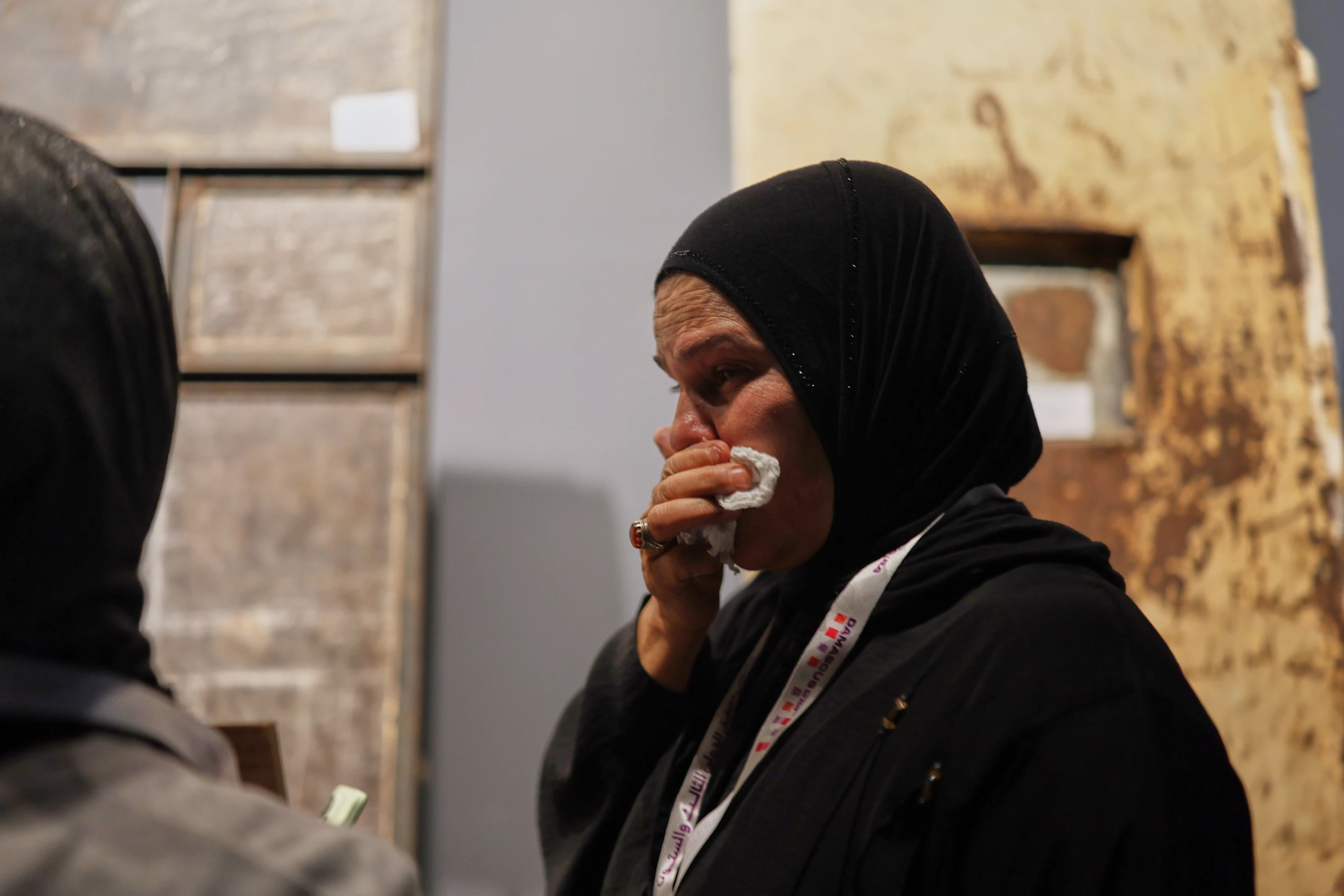
A woman becomes emotional while viewing a display from the “When the Walls Speak” exhibit at the Damascus International Fair on August 31, 2026. Photograph credit AP Photo/Ghaith Alsayed.
“Everything became visible. The prisons were opened. People entered them. Cells were photographed. Papers, clothes, remnants of beds, doors, and instruments of torture were collected. What had once been hidden was now placed before everyone’s eyes,” writes Sally Ali in her essay, “Should We ‘Eat Each Other’s Worries’?”, published in Al Modon.* Yet visibility does not necessarily constitute remembrance, nor does displaying the material remains of suffering mean that those who suffered have been cared for in the aftermath. The 63rd Damascus International Fair held in late August brought the horrors of Assad’s prisons out under open air for all to see. The exhibition “When the Walls Speak” was presented in the Interior Ministry’s pavilion. The exhibit included a reconstruction of a cell using real cell doors, detainees’ clothing, handcuffs and other restraints, and a chair used for torture — all items collected from the various prisons and security branches, including Military Security Branch 248, which operated under the Assad regime.
Sally Ali’s account of Lama Awad collapsing after recognizing her brother’s name, Anas, carved into a door from Sednaya Prison picks at splinters of this tension — that at the moment when private grief becomes a public spectacle, the exhibition’s purpose becomes difficult to separate from the suffering of the survivor. Awad’s reaction raises a more troubling question than whether the exhibition successfully stirs emotion: what happens to that grief once the cameras stop? In transforming the remnants of imprisonment and torture into objects of public memory, the exhibition risks treating survivors not as people living alongside an open-ended past, but as evidence of it, like historical objects belonging to an exhibit. It suggests that memory, simply by being displayed, has fulfilled its purpose. As Ali argues, there is a difference between a country that remembers its victims and one that knows how to live alongside them. Meaningful remembrance must extend beyond displaying the past to confronting the needs of those who continue to live with it.
The echoes of Syria’s painful past are far from gone. Memory, especially under the Assad regime, served as a tool of oppression and suffering. As Ali recalls, “We became accustomed to another form of memory during the Assad era. We were expected to forget, to remain silent about detainees, and to lower our voices when mentioning the names of those who had disappeared. Families learned how to live alongside the question, not how to answer it.” She emphasizes that Syria cannot build a future by “burying the evidence of crime,” adding, “We cannot ask victims to forget simply so that we can feel comfortable, nor can we erase Sednaya from memory because looking at it is painful.”
At the same time, the “When the Walls Speak” exhibition has drawn criticism for its questionable handling of the sensitive evidentiary articles on display. Samar Yazbek levels a pointedly sharp gaze at the exhibition in her essay, “Prisons and Museums,” published in The New Arab.** She denounces the use of the prison objects in the exhibit to “leverage their emotional impact on visitors” as inappropriate, especially to families of the victims. According to Yazbek, uncovering the fate of the disappeared should take top ethical and legal priority. This involves protecting archives, documenting evidence, cataloging the names etched onto cell walls and doors, and making this information available to the families and relevant authorities.
Yazbek points out the cruel irony in that the first news some families hear of their missing loved ones is as an exhibit on display, rather than from state institutions or organizations. In her words, “Families of the missing were not consulted on the pavilion’s design or the selection of its exhibits, nor were they given the opportunity to learn — prior to the public display — whether these items and the names carved upon them held information regarding their loved ones.” Finding the fates of the missing should take utmost priority for the sake of their families, who have been forced to live in what she describes as “a suspended time” where “absence is not yet final, yet the possibility of return never truly ends — with an impact that extended to the most intimate details of the home.” Decisions requiring legal or emotional certainty, such as marital status, the division of inheritance, and children’s guardianship, remain in limbo for these families.
Yazbek also addresses the issue of documentation — more precisely, the improper procedures used for items from prisons and security branches. She notes that the cell doors were taken to the exhibit without undergoing documentation or examination as potential evidence, adding, “The names carved into it, its original location, and its relationship to other parts of the detention facility could collectively help reconstruct the paths taken by detainees and shed light on their fates.” Removing objects before the documentation process was complete “dismantled the spatial relationships that gave them their evidentiary value.” In the words of Yazbek, “Syrian prisons require a judicial reckoning before they can enter the realm of museums; rushing to exhibit them implies drawing a curtain over a case that remains legally open, transforming the act of remembrance into a public ritual while the victims’ names still await documentation, their fates remain unrevealed, and the perpetrators’ culpability has yet to be proven.”
The act of remembrance and the actual care of those who have suffered are two separate matters. Sally Ali emphasizes that the archival of memory through documentation, exhibitions, photographs, museums, and public commemorations does not automatically constitute justice. While they may preserve evidence of the crime and prevent people from forgetting, they fail to help survivors live with what they remember.
"Ma biddi akul hammak" (ما بدي آكل همّك) — I don’t want to eat your worry. It is a Levantine Arabic idiom that figuratively means “I don’t want to be a burden to you.” To carry another’s burden means to accept that another person’s suffering has become, at least partly, one’s own responsibility. As Ali writes, “Memory can be justice. It can be documentation. It can be a guarantee against repetition. But it can also become another form of reproducing violence if we summon the victim back to her wound and then leave her alone once the scene is over.”
Ali approaches Syria’s scars: the people’s painful memories, and the important question of whether this new Syria — one free from Assad — is prepared to address the painful past as something more than a collective memory but rather a pain that people will continue to struggle with daily, into the present. This pain, she stresses, cannot be expected to resolve itself after the cameras turn off and those unaffected move on with their lives. She states that the new Syria must learn not merely how to remember its victims, but how to live alongside them, for “the question [is] no longer what we should remember about Assad’s prisons, but what we do to people when we return to them something they had spent years learning to live without.” She asks, “When memory returns to devour one of us from within, will we leave that person to carry the burden alone?” It is not enough to say “we will not forget,” writes Ali; “There is a difference between telling someone, “We will never forget what happened to you,” and, in practice, saying, “We will help you live after remembering it.” The first is an easy sentence. The second is a country-building project.”
“Perhaps the most difficult task facing the new Syria is to learn…to carry one another’s burdens,” states Ali. She fears that rather than remembering too much, Syria will remember too “comfortably,” that “we will place suffering in a designated space, illuminate it properly, write an appropriate explanation beneath it, photograph it, weep before it, and then leave reassured that we have not forgotten.” She clarifies, “The problem is not displaying the traces of crime. The problem arises when we assume that displaying suffering is the same thing as caring for those who lived through it. Between concealing memory and turning it into an exhibition lies an entire space called care. And I do not know whether we have entered that space yet.” Memory is a responsibility, not a performance. A nation cannot heal its history while neglecting the people who embody that history — and a Syria that builds museums for its past but cannot carry the living remnants of that past may change its doors without truly escaping the prison.
*Sally Ali’s essay, “Should We ‘Eat Each Other’s Worries’?”, was published in Arabic in Al Modon.
**Samar Yazbek’s essay, “Prisons and Museums,” was published in Arabic in Al Araby.
This article appeared in Inside Al Jadid Reports, No. 189, 2026.
Copyright © 2026 AL JADID MAGAZINE