
The Arab in the Turkish Imagination
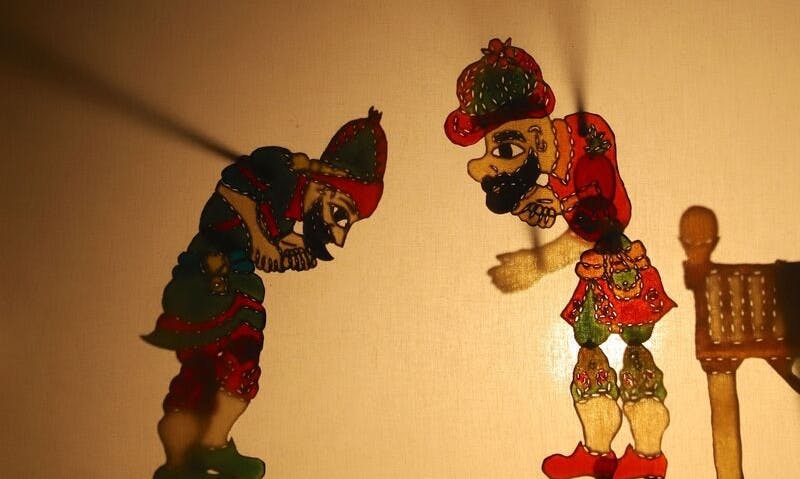
Turkish shadow puppetry known as “Karagöz.” The scene depicts the characters Hacivat (left) and Karagöz (right).
When Mustafa Kemal Atatürk founded the Turkish Republic in 1923, he embarked on an ambitious project to redefine what it meant to be Turkish. The new republic sought to reshape society at nearly every level, from language and clothing to its relationship with religion in public life. This reimagining of Turkish identity was constructed not only through ideals of the “new Turk,” but also through images of those who represented what the new Turk was not. The figure of the Arab emerged in Turkish imagination as the counter-image to the Turkish national character. Ilkim Büke Okyar traces the gradual transformation of the satirical portrayals of the Arab character in “Arabs in Turkish Political Cartoons, 1876-1950: National Self and Non-National Other.”
Representations of Arabs in Turkish visual culture evolved from the late Ottoman period into the early era of the Republic, increasingly positioning the Arab as the cultural and visual opposite of the modern Turkish citizen: the Bedouin against the urban Turk, the dark-skinned figure against the white Turk, and the colonized subject against a nation that imagined itself as newly liberated. Drawing on satirical publications such as Karagöz and Karikatür, as well as newspapers including Cumhuriyet, Okyar follows the image of the Arab stereotype from the early depictions in Karagöz (Turkish shadow puppetry) performances using leather puppet figurines to the print houses and lithographic illustrations of early republican Istanbul, revealing how political cartoons helped define Turkish national identity through the construction of a non-national “Other.” As Mohamad Alrabiuo observes in his review of the book, the irony lies in that the Turkish Republic, emerging from an Eastern empire that was defeated by European powers, uses the very same tools of European Orientalism to distance itself from the Arab East.* Europe portrayed the Ottoman as the “Oriental Turk” throughout the 19th century, while the new Turkish elite, in the process of redefining itself, “redirected that gaze toward the south,” writes Alrabiuo.
1923 was a turning point in how Arabs were depicted by the Turkish Republic. After the First World War and the Arab Revolt of 1916, the Arab character was transformed from “a familiar figure” into one associated with rebellion, betrayal, and dark skin. Manifestations of the Arab merchant character in Karagöz shadow theater gradually transformed; in the words of Okyar in the book, “Their [Arab] previously mocked but accepted image as part of a multiethnic society was not invaded by a despised, rebellious, treacherous, swarthy Arab stereotype that became an intuitive metaphor for every value against which the new republic wanted to define itself.” Turkish newspapers and cartoons throughout the 1920s depicted Arabs as allied with the Allies and as betrayers. The image of the keffiyeh and cloak came to signify the “other,” while associations with specific physical features in drawings — black skin, curly and unkempt hair, exaggeratedly broad noses and thick lips — were used to denote moral depravity.
Skin color factored heavily into political and social messaging. Arabs increasingly appeared in cartoons and drawings as dark-skinned, and by the 1930s onward, Turkish cartoons adopted the racial classifications that had become widespread in Europe, writes Alrabiuo. Okyar’s book presents a stark contrast between older Ottoman drawings of Arabs, in which the skin tones of Arabs and Turks were evenly matched, and those of the 1930s, in which Arabs appeared darker in comics. As Alrabiuo states, “Blackness in caricature acquired political and cultural meanings. It came to signify the colonized, the backward, and the primitive, while Turkey sought to place itself outside such classifications.”
Stereotypes and caricatures of Arabs were employed for political purposes. Arabs were drawn as hybrid characters with fewer human traits, in contrast to clearly defined Turk characters. Alrabiuo cites one segment in the book focused on the Syrian-Turkish conflict over the Sanjak of Alexandretta between 1936 and 1939. The Franco-Syrian Treaty of Independence, signed in September 1936, granted Syria independence from French rule and placed Antakya (Antioch) and İskenderun (Alexandretta), the two towns within the contested territories, under Syrian administration. Both regions rejoined Turkey in 1939 following a local referendum and political transition. However, as the ones who contested Turkey’s claim over the region, Syrian Arabs became a direct target of caricature. In drawings and cartoons touching on the conflict, the Turkish population was depicted as needing rescue while Syrian Arabs were depicted as “incapable of governing, cruel, or backward.”
Turkish cartoonists were intent on publicizing “the Arabs’ incapacity to exert rightful governance over the Turkish population due to their historically colonized status,” writes Okyar, who continues, “This rendering of the Arab stereotype differed from Turkish collective memory as seen in the traditional plots of the Karagöz theater. This new Arab dressed differently and looked different. The visually fabricated hybridity of this new Arab was not simply defined around the skin color, but around the cultural and social erosion caused by their cooperation with their colonizers.”
The book includes political cartoons drawn in 1936 by the republican-era cartoonist Necmi Riza in the satirical magazine Akbaba. The Syrian Arab frequently appeared as a “dark-skinned slave trader, standing, in Okyar’s words, ‘at the gates of civilization,”’ cites Alrabiuo. Riza’s cartoon “Slavery in the Twentieth Century” depicted an Arab trader negotiating with a French colonialist over two white enslaved girls, an intersection of symbols: the dark-skinned Arab, the Frenchman, and the Syrian trader presented as a participant in the slave trade. As Alrabiuo states, the Syrian was now endowed with “attributes of 'blackness” associated in the colonial imagination with slavery, while simultaneously embodying the image of the cruel colonizer and slave trader.” As Okyar writes in the book, “Rıza fictionalizes the power and exploitation exercised over those colonized Arab communities. The entire series presents a social and historical context that displays different modes of exclusion, inferiority, subordination, and exploitation linked to a racial element.”
Okyar’s examination of Turkish political cartoons demonstrates that the construction of Turkish national identity in the early Republic depended not only on defining what the “new Turk” should be, but also on defining who could not belong to that identity. The transformation of the Arab figure from a familiar and accepted member of Ottoman society into a racialized symbol of backwardness, betrayal, colonial dependence, and primitiveness reflected the Republic’s broader effort to distance itself from its Ottoman and Eastern past. Through exaggerated physical features, darker skin, traditional clothing, and associations with slavery and foreign domination, political cartoons turned the Arab into a visual embodiment of everything the new Turkish nation sought to reject. In attempting to distinguish itself from the “Oriental” East, the Turkish Republic adopted racial and Orientalist ideas that had largely developed within European colonial discourse. The caricature of the Arab, therefore, was more than a stereotype; it was a tool through which Turkish identity was imagined, negotiated, and separated from an unwanted past. “Arabs in Turkish Political Cartoons, 1876–1950” shows how visual culture can participate in nation-building by transforming perceptions of an “Other” into a defining mirror for the national self.
*Mohamad Alrabiuo’s essay, “From Karagöz to Atatürk: How the Image of the Arab Changed in Turkey,” was published in Arabic in Al Quds Al Arabi.
This article appeared in Inside Al Jadid Reports, No. 188, 2026.
Copyright © 2026 AL JADID MAGAZINE