
Oum Kulthoum and the Search for a Cultural Scapegoat
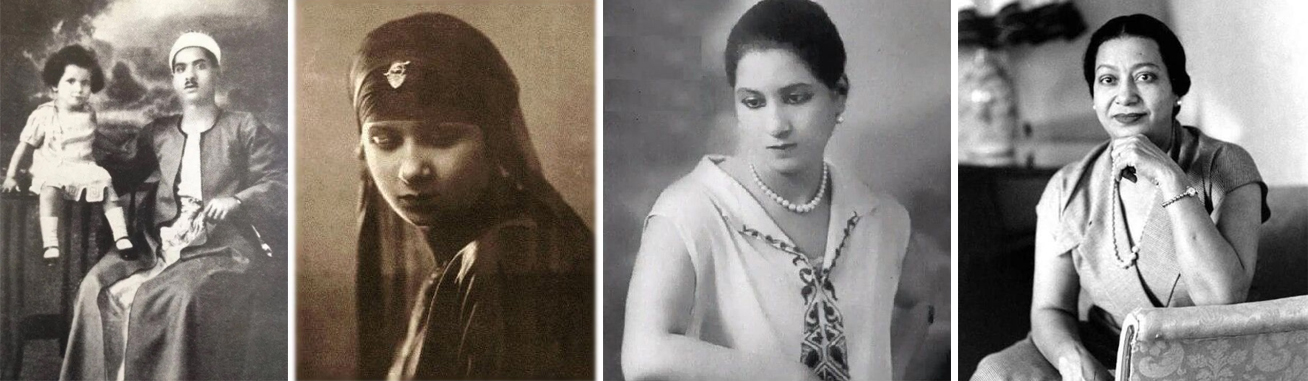
A young Oum Kulthoum with her father and portraits of Oum Kulthoum throughout various stages of her life.
Oum Kulthoum was more than a singer; she stood as a cultural institution whose voice defined Egyptian and Arab identity, making her an emblem of a national cultural conception. After the June 1967 defeat, she became a prime target not just for criticism of an individual artist but for an attack on the broader cultural vision she symbolized. Her immense popularity created a paradox: the more powerful her cultural presence, the more vulnerable she became as a scapegoat when a society sought someone to blame.
After national catastrophe, societies seek a simple, recognizable culprit rather than facing a complex web of political, military, and institutional failures. The question “How did this happen?” often becomes “Who should we blame?” and the search for responsibility expands from the military and political establishment into culture, portraying musicians, poets, and singers as contributors to national weakness. Many students of Arab politics, Egyptians and Lebanese like myself in the 1960s, especially after the 1967 Arab defeat, recall a strong intellectual wave of “self-criticisms” led by secular, leftist, and Islamic intellectuals. This wave attracted Arab youth and appealed to the frustrations and resentment at the magnitude of the defeat of the Egyptian, Syrian, and Jordanian armies. A portion of the restless youth rejected the narrative of the pre-1967 order, political and cultural, including literature, poetry, and music.
I recall the debate about Oum Kulthoum's impact on the 1967 defeat, a memory shaped by articles and journalistic exchanges that echoed the radical leftist voices of youth in Egypt and Lebanon. Reeling from the shock of the defeat, many struggled to pinpoint its cause. A discourse emerged that the loss was not caused merely by shortcomings in planning, weaponry, and administration, but also the “product of a culture that had produced a complacent people,” one that was detached from seriousness and preoccupied with entertainment, writes Hassan Madan in The New Arab.* As this sentiment took flight, Oum Kulthoum — whose massive cultural presence and iconic voice were synonymous with Egyptian and Arab identity — became the most obvious target.
Oum Kulthoum has long been celebrated as the “Star of the East” and “The Voice of Egypt,” her fame reaching across the Arab world and representing Arab unity. Political rivals, whether leftist or right-wing, military coup leaders or their opponents, would set aside their disputes to listen to her scheduled weekly concerts held every Thursday. However, the singer’s treatment by the Left and Islamist groups took a sharp turn following the defeat of June 1967. After the Six-Day War, Oum Kulthoum could no longer simply be regarded as the singer of Egypt’s triumphant national imagination. Oum Kulthoum held a significant role in the Nasserist state; Nasser gave her political legitimacy, while Oum Kulthoum gave emotional and cultural legitimacy to Nasser’s Egypt, Arab unity, and socialism. The shock of the Arab defeat opened many eyes: her enormous popularity as part of the ideological culture of Nasserism — beautiful art and national pride — potentially concealed political repression and economic or military failures.
Many leftists and Islamists blamed Oum Kulthoum’s music for creating a complacent, distracted, and corrupt society disconnected from reality. Leftists criticized Oum Kulthoum’s music and style for their traditional and romanticized nature, which they considered “incompatible with the reality of the Arab revolution,” Al Jazeera states.** She adhered to traditional styles, failing to adapt to new poetry and music styles that emerged in the revolutionary era. According to Al Jazeera, leftists also considered Oum Kulthoum “reactionary” because of her status as the singer for Arab kings and the elite.
Egyptian leftist poet Naguib Surur believed Oum Kulthoum’s sentimental, romantic songs “stupefied” the Arab peoples, according to Ali al-Muqri in Al Majalla.*** Some newspapers claimed that musicians and poets belonging to earlier generations were the cause of the defeat. One leftist newspaper, cited by Hassan Madan, writes: “We must acknowledge that our Eastern art is one of the causes of the setback. In other countries, art awakens minds and souls, sharpens awareness, and stimulates perception. But here, if we think deeply about it, we find it perpetuating indifference and superficiality. How can a people prepare for war if they insist on staying awake until four in the morning listening to a female singer on the radio?”
More and more fingers began to point at Oum Kulthoum as the cause of the defeat. A column titled “A Free Forum” written by one of the leaders of the Egyptian left went as far as accusing the singer of being the “opium of the people,” with many citing the spike in price of hashish and narcotics and rise in alcohol consumption on the days of her monthly concerts. Islamists claimed she was the reason Arabs fell into a trance-like stupor, distracted from their preparations for battle against the Zionists, as stated by Al Jazeera.
The Left’s view of Oum Kulthoum emerged in TV series and books. Leftist writer Osama Anwar Okasha’s TV series “Layali El Helmeya” dedicated an episode to one of Oum Kulthoum’s early songs, “Ansak.” The episode featured a debate among a radical leftist group that condemned Oum Kulthoum’s music, arguing that it “dulled the Arab consciousness and was out of step with the era’s revolutionary transformations. Egyptian writer Mahmoud El-Saadani cites an argument produced by a radical leftist in his book “Musafer ‘aka al-Raseef” (Traveler on the Sidewalk) that claimed Oum Kulthoum was responsible for the “stupor in which Egyptians lived” and that her music painted an idyllic, romanticized depiction of reality that was discrepant from the harsh conditions the people actually lived in, according to Al Jazeera. Her art was frequently likened to an opiate that numbs the people from reality.
The claim that Oum Kulthoum’s music functioned as “the opium of the people” frames art as potentially anesthetizing society and dulling critical thought. In the words of Hassan Madan, Oum Kulthoum was “pained to find herself the target of an unjust campaign that reduced the matter to the notion that beautiful music was merely a means of drugging the masses and distracting them from the great issues confronting them.” In response, the singer embarked on artistic tours throughout Egypt and abroad in efforts to restore morale and rebuild confidence after the defeat. She used her voice, accused of fostering passiveness, as a force for national recovery.
However, her actions earned her even more backlash from some groups. Islamist poet Yusuf al-Azm criticized her decision to organize concerts in Arab and Western capitals and donate the proceeds to the Egyptian war effort. Azem described these concerts as “a new form of sedation for Arabs reeling under the weight of defeat,” as cited in Al Jazeera. He condemned concerts featuring songs of romance and passion at a time when “the nation was still licking the wounds of the most humiliating defeat in its history, the blood of martyrs had not yet dried, and grief lingered in the homes of victims and the missing, as well as in refugee camps.”
Does music truly induce passivity, or does it preserve consciousness, memory, and emotional resilience? If Oum Kulthoum’s art had simply anesthetized the public, why did that same voice become so useful in awakening national morale after the catastrophe? The very voice that was accused of making Arabs passive was tasked with making them resilient after 1967. That same voice — which, before the war, was associated with national confidence — became an instrument of national recovery. Art can evoke both happiness and sorrow simultaneously by resonating with memories, dreams, and collective experiences. It shapes memory and identity while also eliciting emotional contrasts — joyful moments alongside distress — without being the sole cause of political outcomes. Despite the harsh criticism directed at her, Oum Kulthoum wielded her voice as a powerful instrument of resilience, turning earlier criticisms on their heads and helping support the nation's revival. Perhaps as a testament to her efforts, her reputation as a legendary singer has not wavered in the nearly 60 years since the June 1967 defeat.
The debate over Oum Kulthoum after the defeat of June 1967 was never really a debate about a singer. It was a debate about the political function of culture itself. To her admirers, Oum Kulthoum represented the emotional unity and cultural strength of the Arab world; to her critics, her extraordinary popularity symbolized a society distracted from the demands of modernity and political struggle. Yet the irony of 1967 was that the voice accused of turning the people into spectators became one of the principal voices called upon to restore their morale. Oum Kulthoum could not prevent the 1967 defeat. But perhaps that was precisely the point: art does not necessarily prevent catastrophe; sometimes its political task begins after catastrophe, when a defeated people must recover the ability to remember who they are.
This article appeared in Inside Al Jadid Reports, No. 186, 2026.
Copyright © 2026 AL JADID MAGAZINE