
Rethinking the Death Penalty in Syria and Lebanon
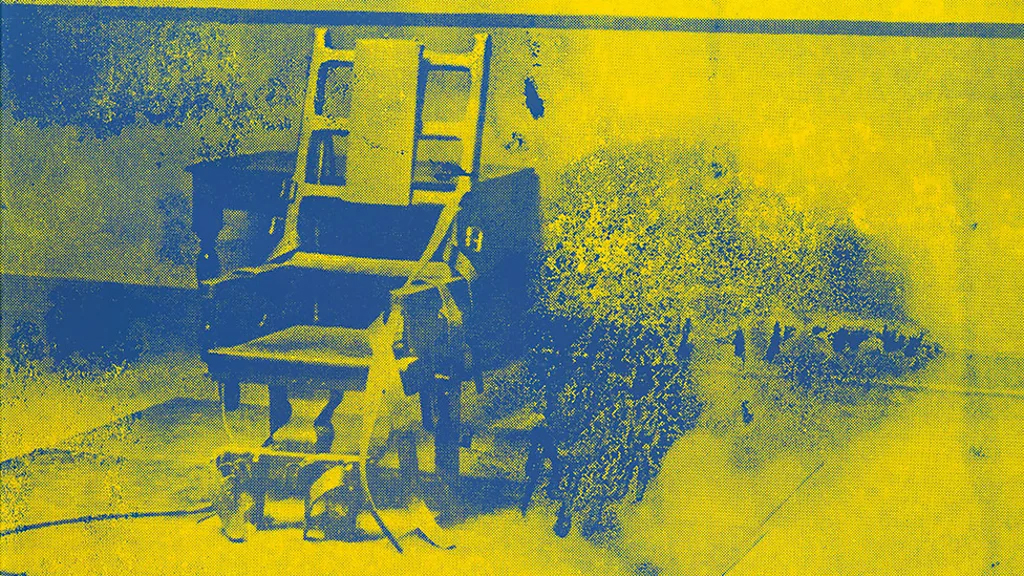
“Electric Chair (F. & S. II.74)” (1971) by Andy Warhol.
“A state is not tested when it tries someone who is widely loved. It is tested when it tries someone whom most of the country despises,” writes Sally Ali in her essay, “On One Day, Beirut Abolishes and Damascus Executes.”* This observation is particularly relevant to the recent death penalty decisions in Syria and Lebanon, where the question of punishment has become inseparable from the question of state governance. On August 11, the Damascus Criminal Court sentenced former Syrian president Bashar al-Assad, his brother Maher al-Assad, cousin Atef Najib, former Defense Minister Fahd Jassem al-Freij, and five other former regime officials to death, a ruling that raises broader questions about what kind of government Syria will establish in the aftermath of the Assad regime. On the same day, Lebanon’s parliament approved the abolition of the death penalty, a decision that Marwan Harb argues may carry little meaning for Lebanese citizens unless the state can also address its political and social failures.** Together, the contrasting decisions in Syria and Lebanon demonstrate how the death penalty can serve not merely as a form of punishment, but as a measure of a state’s commitment to justice, accountability, and legitimate governance.
Amnesty International has objected to the Syrian death sentences but does not object to holding the officials of the former regime accountable. Although Amnesty International has consistently documented and condemned abuses committed under the Assad regime and supports holding its officials accountable, it nevertheless opposed the death sentences on principle, arguing that even the perpetrators of the gravest crimes should not be executed.
Now, Syria must confront an important question that weighs heavily on the country's future: Does justice require the gallows? As Sally Ali writes, “Perhaps it was easy for Syria to bring down Bashar al-Assad. What is harder is learning how to try him without inheriting his logic.” The decision to sentence Bashar al-Assad and former regime officials to death bears many implications. Ali discusses the difference between executing these officials instead of putting them on trial, noting that the former “raises a question about the nature of the state we seek to build after the fall of the regime.” Trying Bashar al-Assad and other former regime officials through the judicial system, she states, is symbolic of the state beginning to reclaim the law from the authority that monopolized it for decades.
Ali makes a distinction between revenge, which she equates to the ruling to execute Assad without trial, and justice, which would involve trying him and others in court. She writes, “Revenge wants the matter to end. Justice wants to understand it. Revenge seeks to make the perpetrator pay the price. Justice seeks to determine responsibility, document the crime, vindicate the victim, and prevent repetition.” Ali emphasizes that this moment in history is crucial for a country emerging from decades of authoritarian oppression; in her words, when a new state is trying the head of the regime that once ruled it, punishment ceases to concern only the convicted individual; it “becomes part of the state’s definition of itself. Does it wish to declare that the era of political killing is over, or that killing becomes legitimate when the killer is now on the other side of the defendant’s cage?” She states, “The justice we seek for victims need not necessarily be killing carried out in their name.”
According to Ali, the death penalty will not address the important questions that remain unanswered. She warns that the danger of turning to capital punishment and execution is that “Syria might reduce all justice to his [Bashar al-Assad’s] fate — turning his execution into a comforting conclusion to a long and painful chapter while leaving the more important questions unanswered.” These questions include how the regime’s institutions functioned, who participated, gave the orders, financed it, and concealed its crimes. Most importantly, who can guarantee that the same system will not return under new names?
On the other side of the equation, Lebanon’s ruling on the same day to abolish the death penalty similarly fails to address important questions and crucial needs. Marwan Harb analyzes the irony lying beneath the surface of the Lebanese state’s claim to value life. As he frankly puts it, “Lebanese people die, and the country carries on as though nothing has happened.”
Lebanon’s ruling on the death sentence represents a clear stance on capital punishment: that the state acknowledges the protection of life is “the foundation, purpose, and source of legitimacy of government. The state, in its most fundamental sense, was not created to grant human beings their right to life, but to safeguard a right that precedes it and to prevent an individual’s life from becoming hostage to force, chance, or neglect,” states Harb. Yet this ruling also presents an underlying paradox given that the Lebanese state has not previously or consistently made the protection of life its political priority. In the words of Harb, the abolition of the death penalty in Lebanon is better described as “a suspended moral symbol hovering above a reality that contradicts it.”
The Lebanese state has failed its people in many ways, including but not limited to neglecting to address unsafe roads and infrastructure, inadequate medical facilities and services, pollution, and its absent government. Survival has become a privilege, while staying alive is an individual skill rather than a right guaranteed by the state, he writes. Harb makes a distinction between a state that refrains from killing its citizens and a state that commits itself to protecting their lives, suggesting that Lebanon as it currently stands falls under the first category. As he aptly puts it, "It is the right [the right to life] not to have one’s death become the predictable consequence of known negligence, a danger left unattended, or an institution that knows but does nothing — or an official who sees disaster approaching and then contents himself with explaining it after it has occurred."
Harb goes as far as discussing the Lebanese state’s hand in the death of its people, or what he refers to as a ‘silent’ execution. While the state may be abolishing the death penalty, its ineptitude and negligence leverages a guillotine over all Lebanese lives — an execution that he explains is not imposed by a judicial sentence, but slowly produced through the accumulation of things that, taken individually, may seem bearable but over time are a death sentence in and of itself: “a little pollution, a little poverty, a little fear, a little neglect, a little collapse of public services.” He does not shy away from criticisms of the Lebanese state, which he describes as “a state that refuses to kill a human being by judicial decision, yet tolerates death through negligence; a state that rejects the gallows in principle, yet turns a blind eye to silent executions produced by corruption, recklessness, and dereliction of duty."
If the Lebanese state truly intends to stand behind its claims of safeguarding the right to life, it must turn its attention to the institutional shortcomings affecting the lives of its citizens — budget and spending priorities, urban planning, traffic regulation, food and environment oversight, the management of hospitals and schools, and decisions of war and peace. Though Syria and Lebanon’s rulings on August 11 seemed paradoxical, the two countries must confront difficult questions about state governance.
*Sally Ali’s essay, “On One Day, Beirut Abolishes and Damascus Executes,” was published in Arabic in Al Modon.
**Marwan Harb’s essay, “Execution Without a Sentence,” was published in Arabic in Al Modon.
This article appeared in Inside Al Jadid Reports, No. 185, 2026.
Copyright © 2026 AL JADID MAGAZINE