
August 4 and the Collapse of Lebanon's Last Illusion
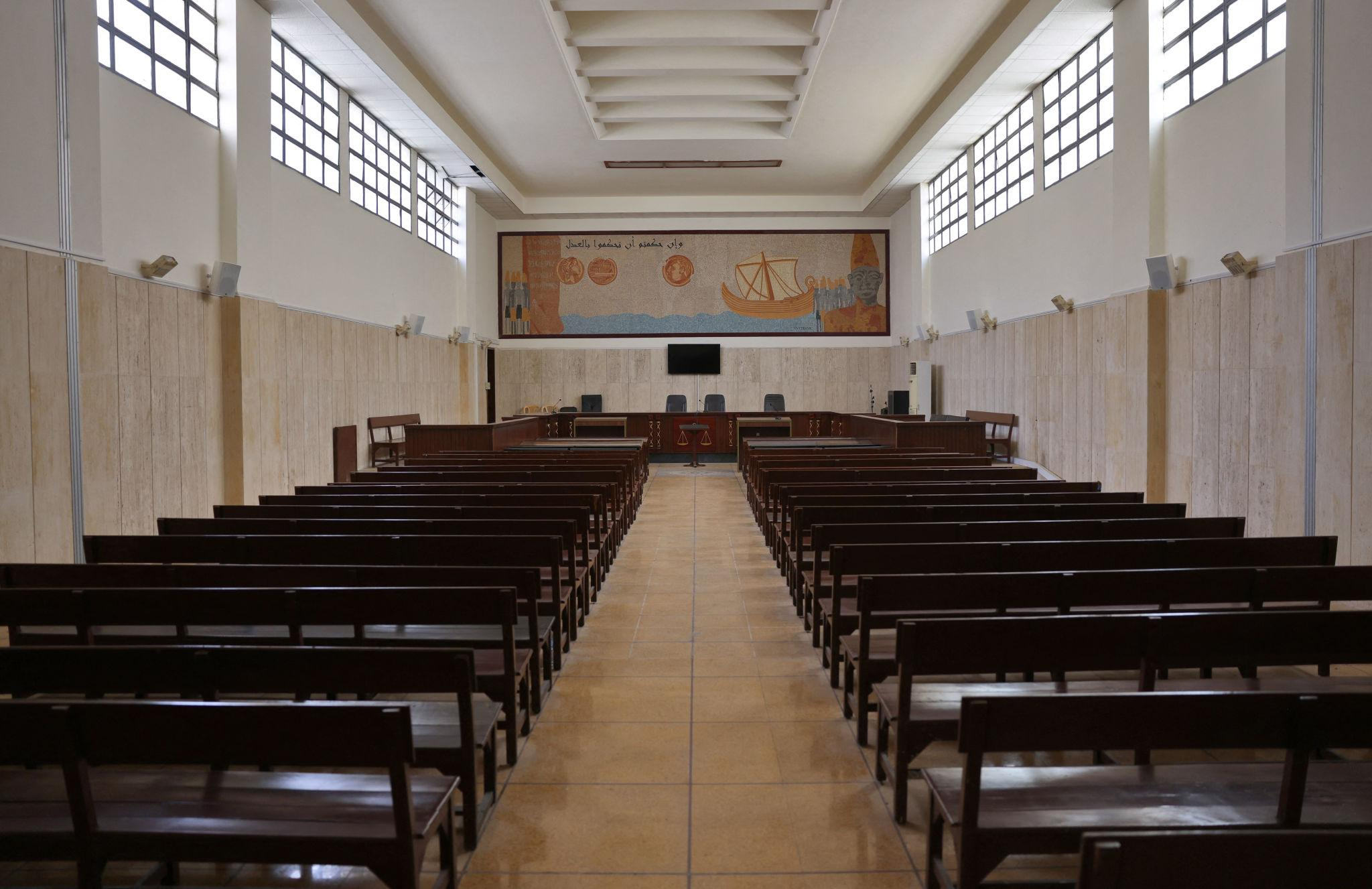
An empty courtroom at the Beirut Palace of Justice, photographed by Joseph Eid.
The Beirut Port explosion was not simply a tragic accident, but a catastrophe enabled by years of political negligence and institutional complacency. On August 4, 2020, 2,750 tonnes of ammonium nitrate stored in Hangar 12 alongside fireworks exploded, killing at least 218 people, injuring roughly 7,000, and displacing approximately 300,000 more. Yet in the six years since the blast, efforts to hold those responsible accountable have been repeatedly obstructed, leaving justice suspended and the victims without closure. Rather than focusing solely on the explosion itself, Sally Ali in her essay, “August 4 and the Insolence of Crime,” examines the political structure that allowed such dangerous conditions to persist and, more importantly, the system that has survived largely unchanged in its aftermath.* The question is not simply whether justice has yet to arrive, but whether the greater danger lies in the state’s ability to endure six entire years after a crime that should have fundamentally transformed it.
Anguish and unrest spiraled in the immediate aftermath of the August 4 explosion. With the level of destruction and death left in its wake, the crime could not be overlooked in any way. Yet, to this day, such a visible crime continues to be treated as if it is invisible. Accountability remains in limbo, and punishment appears to have been buried under the rubble. In the words of Ali, “And therein lies the cruelest paradox of August 4: the crime did not need to be discovered; it only needed those responsible to be held accountable.” The problem was not only the crime itself, but the political environment that enabled its occurrence and allowed it to “disappear into a tunnel of waiting,” she writes.
Sally Ali’s essay touches on the paradox that the Beirut Port explosion and its aftermath holds evident: that as visible and massive as the crime was — to the extent that all were aware of it — no accountability was held. The physical evidence that was everywhere, from the destroyed streets, wounded bodies, devastated homes, and grieving families, was simply swept under the rug with the march of time. The responsible parties behind the port explosion are an open secret, known to all, yet no punishment has been doled out.
The normalization of catastrophe allows corrupt political systems to maintain their control, and the state lets the problem fester long enough for people to forget or get used to it. August 4 revealed the Lebanese state’s failure not only to prevent catastrophes but also to handle the aftermath. As Ali states, “When procrastination becomes a method of governance, delay itself becomes part of the crime.” Time, she explains, serves as a political tool, and does not heal all wounds as is often said. The port explosion has remained an open wound for the people. In all this time, the state has not offered any answers or shown any inclination towards justice, leaving the case suspended to the point that people have accepted that no one will be held accountable for the explosion.
Ali references Albert Camus’s “The Plague,” pointing to the underlying message of the novel: that the most dangerous aspect of a catastrophe is not only its occurrence, but “the moment when society begins to adapt to it — when the exception becomes routine, and when what was unthinkable yesterday becomes part of everyday life,” states Ali. She continues, “It revealed that the problem lay not only in the crime itself, but in the political environment that allowed it to happen and then allowed it to disappear into a tunnel of waiting.” To thrive, political systems do not necessarily need to erase traumatic memories, but merely normalize them. Time is not a “healer of all wounds,” but a mechanism for political exhaustion that makes society more malleable, more accustomed to ‘evil’ and what should remain intolerable. The August 4 explosion thus becomes a case study in how societies can be gradually trained to coexist with the unacceptable. In her words, “Each passing year means that the initial anger subsides, that society is drawn into new crises, and that the victims find themselves facing a protracted struggle no less painful than the moment of the explosion itself. Not because the truth has become less important, but because everyday life forces people to keep moving across the rubble…This is how some regimes prevail: they do not deny the catastrophe; they simply wait until the catastrophe becomes part of the landscape.”
The port explosion illustrates another paradox: Lebanon’s illusion of national unity. Ali suggests that the only time the country experiences unity is in moments of tragedy. This is seen most visibly in the immediate aftermath of the explosion, when survivors and victims cast aside any differences in aid to one another. On a more gruesome level, Ali points out that the Lebanese were united by one other aspect: that the explosion was indiscriminate in its victims, uncaring of sect or creed in its devastation. On August 4, Lebanon briefly transcended its sectarian divisions, producing a rare sense of common citizenship. However, this moment failed to become a political turning point, and that glimpse of unity dissolved in the face of the country’s political system, which eventually reproduced itself and absorbed even the catastrophe that might have brought about its transformation.
The Beirut Port explosion reveals a tragedy that extends far beyond the deaths, injuries, and destruction caused by the blast. As Ali argues, the catastrophe did not become a moment of renewal because Lebanon’s political system proved more capable of surviving than society was of transforming its anger into meaningful change. The deeper tragedy is that the conditions surrounding the explosion were not hidden — they were visible, yet the system responsible remained beyond the reach of accountability. In this sense, the greater the crime and the greater the public scandal, the greater the political system’s ability to absorb and outlast them. August 4 demonstrates how some crimes can persist without concealment, remaining unmistakably visible to everyone while political structures prevent anyone from effectively holding those responsible to account. What makes the Beirut Port explosion so devastating, then, is not only that such a disaster occurred, but that the system that allowed it to happen was powerful enough to endure even after the truth became impossible to ignore.
*Sally Ali’s essay, “August 4 and the Insolence of Crime,” was published in Arabic in Al Modon.
This article appeared in Inside Al Jadid Reports, No. 183, 2026.
Copyright © 2026 AL JADID MAGAZINE