
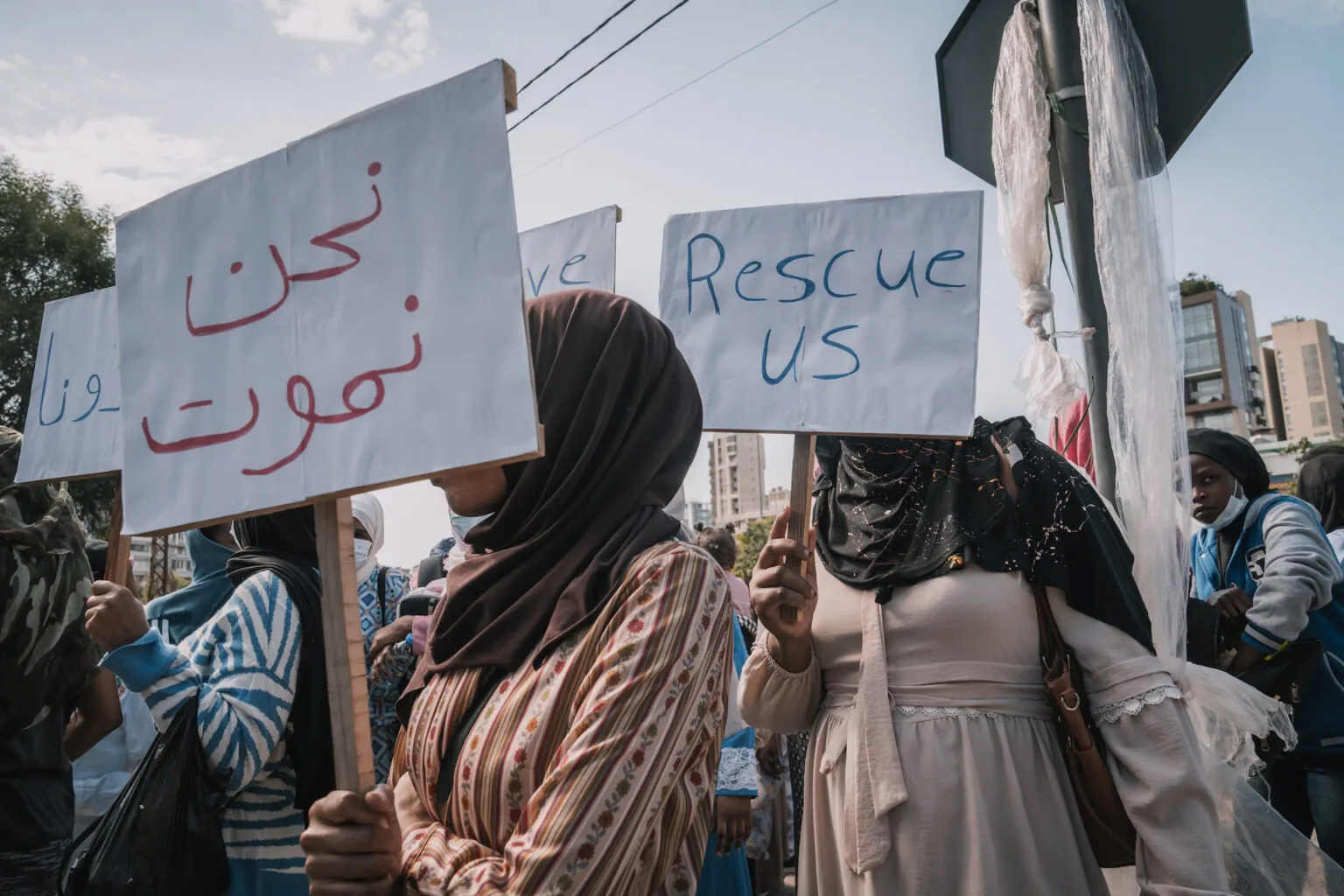
About 100 women, children, and men protest on Nov. 4, 2024 outside the UNHCR headquarters in southern Beirut demanding assistance to evacuate Lebanon. Photograph by Raghed Waked.
“I love those who panic,
those who are not logical,
at least, not ‘as they should’;
those who, with their chains,
so as not to inconvenience others,
make them ring.”
In 1977, Anne Sylvestre sang of those about whom no songs are written: the inhabitants of the shadows and of life’s latent possibilities, those who lie on the edges of existence, falling without a sound, unnoticed by anyone. Songs often celebrate love and victory, passing right over them.
In times of war, the stories of these parias* — people pushed to the fringes of the social landscape — multiply without ever garnering a headline, a brief news report, or a photograph. Some of these stories remain suspended at the city’s margins: in guard rooms, in temporary apartments, in bodies that do not know where they will sleep. Bodies that do not beg, that do not ask. Perhaps they have grown accustomed to having no right to ask. These are not the heroes of the evening news broadcasts, nor even their victims. They are what we might call, without over-romanticization, the “little people.”
…
In a neighborhood outside Beirut, a Sudanese building guard stands at the entrance. Perhaps he is waiting for something, or asking some god whether he can bear this burden. His face is familiar to the building’s residents, as is his name. But his story — his stories — remain devoid of any real significance.
He lives in the doorkeeper’s room, a space measuring four by four meters. A single bed sits in the room, which also serves as a sofa. Members of his family have arrived — former workers in Beirut who suddenly lost their jobs in an area whose residents were all forced to evacuate. They retreated to the only place left to them.
The place he guards has become their temporary shelter. The small room is no longer enough, yet it has become something akin to a temporary homeland — albeit a somewhat improvised and incredibly fragile one.
Perhaps the Sudanese guard now feels that he is no longer responsible only for cleaning the building and collecting the trash, but for the bodies of his family members, for feeding and sheltering them. He knows full well that the building’s owners will soon begin to bristle at these bodies, whose presence here is something they will never get used to.
Elsewhere, at the same historical moment, a domestic worker who left her country 15 years ago to work for a well-off family finds herself abandoned when they flee the war. A domestic worker without a home.
In the early days of the war, she lived with friends in Beirut — a modest life, but stable enough to truly be called a life. Then the place grew crowded with other domestic workers from across Lebanon who had fled to live together, hoping to share what food they could and to find some measure of hope.
She walked from Beirut to Dekwaneh. A friend who lives in a side room in a building under construction told her there was no space. She walked again, deciding to spend each night in a different friend’s home. She packed her life into a single suitcase. Her existence became temporary even in its most intimate form: sleep.
In a third place, a Syrian construction worker visits a landfill at night, searching for items to use or perhaps sell. He once worked in the city, building homes he never dreamed of inhabiting. He lost his job, like hundreds of others, because war, in its destruction and the death it spreads, imposes another burden no less brutal: the loss of livelihood.
For this worker, returning to Syria is not an option. Quite simply, nothing awaits him there — no house, no family, no future. He is stranded here, yet does not belong here. Two countries, and yet neither of which holds any promise for him.
…
These stories are not exceptions, but an unseen norm — or the norm we choose not to see. In times of war, violence is not distributed equally; it intensifies where life is already fragile. One might think of this through what is called “structural violence”: a form of violence that manifests as an entire system that excludes, marginalizes, and exposes certain bodies more than others to danger.
Within this structure, some possess safety nets: family, a home, another residence, or financial resources. Others have nothing but themselves. For them, war ceases to be an exceptional event and becomes an extension of a life already vacillating on a thin wire. And if their balance falters, they fall onto unforgiving asphalt.
This has never merely been a question of a poor class or what some prefer to call the “less fortunate” (as though softening the term could rectify systemic injustice). It is a question of the disposability of human beings — the ease with which one can be left alone. A concept that can be explained through Judith Butler’s idea of the unequal distribution of grievability: whose life is considered grievable, and who can disappear without anyone noticing.
…
Yet despite all this, something persists. Something small, but stubborn.
The guard who opens his space to his family,
the female friends who distribute sleep amongst one another;
the Syrian worker who prefers rummaging through garbage to begging on the sidewalk…
They do not name what they do. They do not think of it as resistance. It is simply a daily determination to keep going.
Perhaps these are the very people to whom Anne Sylvestre sings: “Les gens qui doutent.”
Those who do not know how to be “as they should,” and who do not wait for anyone to notice them. This insistence, despite the absence of any guarantee, takes the form of solidarity that does not announce itself, does not seek heroism, and does not dream of being mentioned in a report or preserved in an archive. This insistence is what keeps life possible.
(*) Parias: A term used to refer to those who are socially marginalized or excluded. It derives from the word “pariah,” historically linked to the caste system in India, and was later adopted in European literature (as in Victor Hugo) to designate individuals situated outside social recognition.
Translated from the Arabic by Al Jadid.
Rita Barotta’s essay, “A Life to Be Mourned... And a Life That Vanishes, Unnoticed by Anyone,” was published in Arabic in Al Modon. The Arabic version of the article appeared originally in the Beirut-based Al Modon Magazine. The English version of this article is published by Al Jadid Magazine with permission from the author and Al Modon.
This article appeared in Inside Al Jadid Reports, No. 182, 2026.
Copyright © 2026 AL JADID MAGAZINE