
Southern Lebanon’s Christian Villages and the Fragile Politics of Neutrality
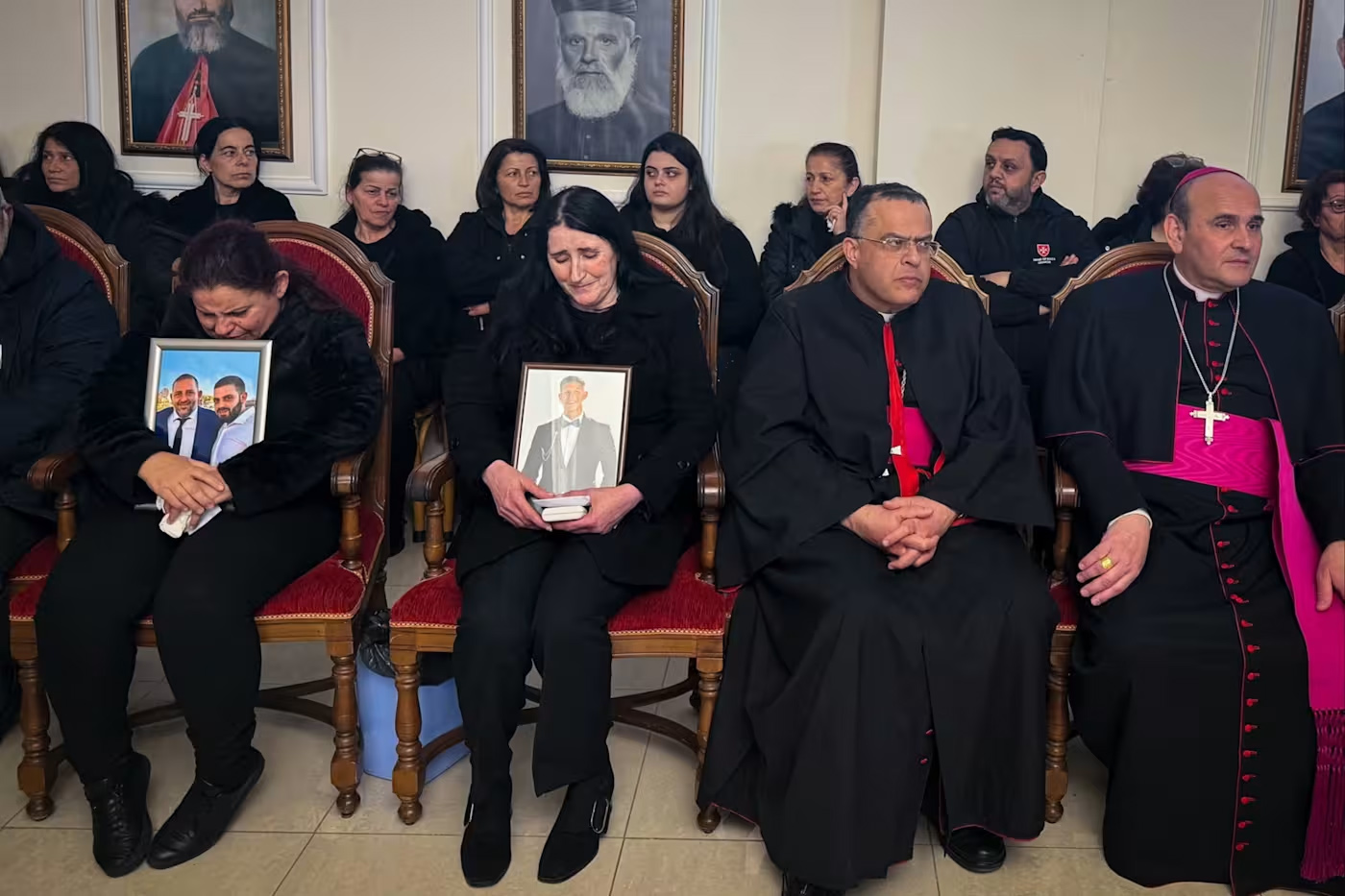
Relatives receive condolences for three men killed by an Israeli air strike in the southern Lebanese Christian border village of Ain Ebel. Photograph credit Dylan Collins/AFP/Getty Images.
Witnessing the displacement of hundreds of thousands from their homes in Southern Lebanon, one cannot help but wonder what has steeled the resolve of those who choose to remain — why do the residents of Southern Lebanon’s Christian villages choose to stay, in spite of the looming dangers, rather than leave their homes for safety, as most Shiite civilians have done? The distinction, according to Rula al-Hussein’s Al Modon essay, “A Tense Christian Resistance, and a Tragic Shiite Exodus,” boils down to differing levels of risk and the uncertain reassurance of returning.*
Approximately 1.2 million from southern Lebanon — encompassing the Southern Suburbs and the Bekaa Valley — have been displaced. Attitudes regarding withdrawing from the south vary between the Christian and Shiite communities. Hussein characterizes the Christian attitude as immobile, particularly steadfast, in contrast to Shiite groups who, for the most part, withdrew without resistance under the threat of attacks, joining the displaced. She identifies the reason as the differing levels of risk each group faces in the current predicament. Hussein suggests that Shiite villages are more likely to be targeted by Israeli forces due to inferred connections to Hezbollah, which she explains plays a “protector” role to Shiite communities. In her words, “Hezbollah’s fighters are the sons of these villages; their homes are the fighters’ homes, their land the fighters’ land.”
According to Hussein, the Christian villages, which generally have an ambivalent stance towards Hezbollah, do not have the same pretext that would warrant their becoming Israel’s targets. This is because “they are, in effect, orphans within Lebanon’s sectarian equation. Their refusal to leave does not mean they do not fear for their lives; rather, it reflects their confidence that their villages lack the “pretext” for attack, and that they are therefore safe from airstrikes and ground invasion,” writes Hussein, who clarifies that Christian communities in Lebanon are outside the dominant circuits of power and mobilization, while Shiite communities are integrated into Hezbollah’s project, placing their villages at a higher prioritization for being attacked. Residents of the Christian border villages in southern Lebanon often view themselves as separate from the Palestinian-Israeli conflict. The residents of these towns — numbering around 30,000 — have resolved themselves to remain in their villages despite the volatile security situation.
Furthermore, this duality “complicates the notion of occupation or intrusion,” according to Hussein. In Shiite homes, Hezbollah fighters are not “invaders,” while in the Christian imagination, leaving their homes poses a risk of invasion on two fronts, from both Hezbollah and Israel. She writes, “One might say that when Hezbollah fighters enter Shiite homes, they do not leave behind a sense that they are intruders — even if the homeowner is not a supporter of the party. Christians, however, feel that if they were to leave their homes, they would be facing not one but two potential invasions.”
Christian villages along the southern Lebanese border strive to implement precautionary measures to mitigate risks to their residents, manage displacement, and ensure stability and essential services for the population as the conflict between Israel and Hezbollah escalates, reports Sobhi Amhaz in Asharq al-Awsat.** Despite the repeated wars that have tormented southern Lebanon, residents of numerous Christian villages have historically remained steadfast and attached to their land, among them Al-Qlaiaa, Deir Mimas, Burj Al-Muluk, Jdeideh Marjeyoun, Rachaiya Al-Fukhar, Rmeich, Ain Ebel, Debel, Al-Qawzah, and Alma Al-Shaab.
Despite repeated warnings from the Israeli army to evacuate, Hanna al-Ameel, mayor of the southern town of Rmeish, explains that these residents have chosen to remain because “this war is not ours; evacuating our towns would expose them to destruction and occupation. We are peaceful towns, and our priority is preserving our land,” cites Faiza Diab in Al Majalla.*** A parish priest from the town of Alma al-Shaab who preferred to remain anonymous told Asharq al-Awsat, as cited by Paula Astih: “We held our ground throughout 2024 before being forced to leave when missiles struck us. We returned to find 90 percent of our homes destroyed. Today, approximately 250 people remain in the town, undeterred by the warnings.” He adds, “We have no connection to this war. We are peaceful people; we have never borne arms, nor will we, and we want the Lebanese Army to protect us.”****
Displays of their dedication and attachment to the land have produced various powerful images, especially in Alma al-Shaab in the Tyre district, where residents gathered at the Church of Our Lady and rang bells in defiance of the military order to flee, chanting slogans affirming their determination to remain in their homes. With a population of roughly 3,000 — of which the majority are Maronite Christians — and fewer than 100 houses, many of the village’s residents had emigrated during the Civil War, leaving their homes abandoned. Though its remaining residents expressed resilience, inhabitants were ultimately forced to flee after the village suffered several casualties.
According to Hussein, Christian residents have chosen to remain in their homes due to the lack of a broader political project to protect them, as well as a fear of permanent displacement. Though Shiite communities experience displacement, this displacement is accompanied by a narrative of resistance and victory, as well as assurances of an eventual return. Christians, on the other hand, having witnessed past wars and conflicts, have maintained their “steadfastness” out of fear of irreversible loss.
Vatican Foreign Minister Paul Gallagher spoke on the losses Christian villages have sustained, as cited in Al Majalla: “Today, we live amidst terrifying sounds — airstrikes, shelling, and at times, interceptor missiles falling both within the town and on its outskirts. Yet, we will not abandon our land. The reality we face today is one we have lived with since the late 1960s; we have experienced far more periods of war than of peace.” Christian villages have suffered significant damage throughout history yet chose not to flee, notably during the July 2006 conflict between Hezbollah and Israel, the “Gaza Support Front” of October 8, 2023, and the hostilities of September 2024 as some recent examples. The towns of Arqoub, Kafr Shuba, Shebaa, and Kafr Hamam were subjected to widespread destruction in the 2024 war. Hezbollah had military bases in these towns, which resulted in severe damage to hundreds of homes, along with displacement, economic losses, and suffering that they have yet to recover from.
Gallagher continues, reaffirming his stance on neutrality: “That is why we say: enough with wars. We simply want to live safely in our homes and on our land, without continuing to pay the price for conflicts that do not concern us — conflicts for whose consequences no one has the right to hold us accountable. Our losses are immense, particularly given that ours is an agricultural town; over the past three years, we have cultivated only about 40 percent of our land, as most of it lies outside the residential zone. Over the past three years, the olive harvest has been halted, and tobacco cultivation has dropped to just 40-50 percent of its usual levels. Today, economic activity stands at no more than 30 percent of what it once was.”
For many, financial strain factors into the decision to stay. Joseph Suleiman, a resident of Ain Ebel, explains in Asharq al-Awsat that the townspeople’s financial situation has become dire due to the halt in all business activities. He states that some families left during the early days of the war but returned because they could no longer afford rent, adding that “while some food aid is being provided to families, the real challenge lies in securing and paying for other essential services — such as private generator subscriptions, internet, heating, and more.”
Interestingly, some Sunni villages have chosen to follow the Christian example to remain: Qassem al-Qadiri, head of the union of municipalities and mayor of Kfar Shuba, states in an interview with Al Majalla: "In this war, we decided to learn from our Druze and Christian neighbors; we decided to remain on our land, having suffered repeatedly from wars and displacement. Every time we left, our towns turned into open arenas for destruction — as if we were doing the warring parties a favor. Our absence creates a vacuum that the conflicting forces fill; thus, by fleeing, we indirectly contribute to the destruction of our homes, lands, and crops," cites Faiza Diab in Al Majalla.
As Rula al-Hussein states, “What the Christian villagers are doing today is what all villagers wish they could do: hold on to their land, homes, animals, sky, and sea. They benefit from what they have upheld over the years — namely, preventing Hezbollah from establishing a presence in or beneath their villages, from taking them over without accountability, under the cover of divine sanction, support, and revenge, as it has done elsewhere, with the devastating consequences that followed…They have chosen the state as their option, fortified by the fact that nothing in or beneath their land justifies Israeli aggression.”
In the words of Marwan Harb in his essay, “Rmeish, Debel, and Ain Ebel: The Last Guardians of the Idea of Homeland,” published in Al Modon, those who remained had the option of leaving, but chose not to — “they stayed because home is not a hotel one simply checks out of. Because leaving the South is not merely a relocation; it is an uprooting. They stayed because, at times, dignity takes the form of remaining precisely where one is expected to flee.”***** Harb adds, “A homeland is not merely what is proclaimed in official statements, but rather that which is defended through the very act of staying. Belonging is not measured by songs, but rather by a person’s capacity to say, “I am here,” even when staying comes at a steep cost.”
As Hussein states, the difference between Christian and Shiite attitudes is shaped by Hezbollah’s presence, which influences both Israeli targeting logic and local perceptions of safety. This leaves civilians caught between a militant actor that acts decisively and a state that withdraws. Citizens who chose the state to protect them find it absent in moments of crisis. This sense of inadequacy is punctuated by the empty promises of the state and Lebanese army, which had previously claimed to have cleared the south of the Litani river of Hezbollah’s armaments. These reports were proven false and inaccurate, undermining trust in the state’s word and credibility.
Marwan Harb similarly paints a harsh picture of the Lebanese state in his essay, describing the withdrawal of Lebanese soldiers from the South as the civilians remain to fend for themselves. Though institutional and armed, the state recedes, leaving the unprotected citizens in their communities — a dynamic that Harb explains reflects Lebanon’s transformation into a divided country, where some withdraw and others are left behind; in this case, the Christians — “unprotected citizens” — remain while the Shiites leave.
Harb goes on to discuss the failure of the Lebanese state in relation to ‘orphanhood.’ He writes, “Orphanhood, as a structural condition, is not merely an emotional state but a systemic condition in which the state’s absence is both permanent and foundational to political life. When citizens experience abandonment as a normative governance, it implies that abandonment is not an anomaly but a standard mode of governance, in which protection collapses, trust erodes, and citizenship is reduced to exposure without guarantees.”
Harb critiques the romanticization of resilience by framing heroism as coerced endurance, which loses moral legitimacy when not freely chosen. This ethical reversal shifts the focus from celebrating steadfastness to examining structural failures that demand endurance. He suggests that those who remain are not only victims but also witnesses — and “not only witnesses but also accusers” — whose presence exposes the falsity of national unity and the gap between rhetoric and lived reality. They become a “moral inconvenience” in that “their endurance destabilizes dominant narratives,” states Harb.
The Lebanese Army’s withdrawal symbolizes a rupture between the state and its citizens, in which those who remain do so out of attachment to land and identity, their presence becoming a form of ethical resistance. However, this resilience is tragic when imposed; Lebanon is depicted as a country fractured between a retreating state and enduring citizens, or, in the words of Harb, as an “institutionalized abandonment.”
Christian villages have not been unscathed by the war for their choice to remain. As the war stretches on, the outlook for the remaining Christian villages has shifted, despite their neutrality. The recent Israeli shelling of several border towns, including Alma al-Shaab and Al-Qulayaa, resulted in the deaths of an Al-Qulayaa priest, Pierre al-Ra’i, and a civilian, along with countless injured civilians. On March 8, an Israeli drone strike killed Sami Ghafari, a resident of Alma al-Shaab, after he refused to leave the village despite evacuation warnings, forcing the remaining families within the village to flee under the escort of a UNIFIL contingent in southern Lebanon, reports Kamel Jaber in Independent Arabia.****** Israel has also killed three young men from the town of Ain Ebel identified as George Khreish, Elie Atallah Dahrouj, and Shadi Ammar, who were targeted by a drone while installing an internet network on the roof of a building, states Jaber. Al-Qawzah, a Maronite Christian village situated a few hundred meters from the Israeli border, has been reduced to ruins after recent clashes between the Israeli army and Hezbollah fighters, resulting in its destruction.
As the number of displaced residents increases, there has also been a rise in sectarian hostility and negative sentiment towards the displaced. Christian villages have become especially fearful of any involvement with either side of the conflict. Middle East Online reports that some Christian villages are hesitant to shelter displaced people arriving in their areas out of fear they may be linked to Hezbollah, causing renewed concerns of sectarian divisions.******* Middle East Online notes that, initially, the Christian majority village of Marjeyoun opened its schools and church as a shelter for those fleeing because they “wanted to uphold local traditions of neighborliness, knowing those fleeing the escalating Israeli offensive had nowhere else to go.” After several incidents, however, this welcoming attitude evaporated: two Marjeyoun residents — a teacher and police officer — were killed on the village’s outskirts by Israeli drone strikes targeting a Shiite man riding a motorcycle, and in another incident, a displaced person reportedly fired into the air and threatened those in charge after being asked to move elsewhere. As Philip al-Aqlah tells Middle East Online, “Now, barriers are going up, and fears are mounting, because no one knows where we are headed."
Towns sheltering displaced residents have also received threats from the Israeli army. Rmeish Mayor Hanna El-Amil revealed that several local residents received calls from Israel demanding the removal of displaced persons from the neighboring villages and towns of Bint Jbeil, Hanin, and Aitaroun, threatening that failure to comply would force everyone — including the residents of Rmeish — to leave, states Saad Elias in Al Quds Al Arabi.********
In a meeting with Maronite Patriarch Cardinal Mar Bechara Boutros al-Rahi, the US Ambassador to Lebanon stated that Washington had “secured an Israeli commitment not to target Christian towns in the south, provided that operatives from political factions did not enter them,” writes Asrar Chbaro in Al-Hurra.********* However, the Israeli military went on to target a cell inside a southern Christian village after detecting entry into its premises. In the words of Chbaro, “The incident served as a stark reminder to residents that 'neutralization' is not an absolute guarantee and that a single security breach could instantly transform the town from an exempted zone into a potential target.”
A statement by Prime Minister Benjamin Netanyahu claims that Christian border villages have asked to join Israel “because we protect them from Hezbollah extremists,” but this statement was quickly denied by local officials in those villages. Chbaro reports, “The municipalities affirmed that the residents of these border villages remain committed to the Lebanese state and its legitimacy, having never wavered from this stance despite the difficult circumstances imposed by Israeli aggression. They emphasized that the residents of these Christian border villages take pride in their national identity, remain dedicated to Lebanon as their homeland, and reject any attempts to misrepresent their positions or exploit their suffering to serve agendas unrelated to them.” The statement adds that since the outbreak of the war, these villages have been “eager to coordinate with Lebanese authorities, spiritual leaders, and international bodies to keep humanitarian corridors open, thereby ensuring continued communication with the rest of Lebanon, state institutions, and legitimate state agencies.”
Aql Naddaf, the mayor of the southern Lebanese village of Debel, told Al-Hurra that Netanyahu’s remarks were "an attempt to incite discord," stressing that residents of the border villages "remain committed to the Lebanese state and had called for the Lebanese Army to remain in the area, though security conditions prevented this."
While hoping for an end to the conflict as soon as possible, Imad Lallous, Mayor of the village of Ain Ibil in South Lebanon, states, "This war was imposed on us — just as it was on all the towns and people of the South. Whether we support it or not, the decision is not ours; it is the reality we have lived with since birth. What we want and hope for today is for the war to end — sooner rather than later — and for us to return to our normal lives."
*Rula al-Hussein’s essay, “A Tense Christian Resistance, and a Tragic Shiite Exodus,” was published in Arabic in Al Modon.
**Sobhi Amhaz’s essay, “Christians in Southern Lebanon Begin Organizing Their Return to Their Villages After the Killing of a Priest,” was published in Arabic in Asharq al-Awsat.
***Faiza Diab’s essay, “Christian and Sunni Villages in Southern Lebanon... Standing Firm on the Brink of Disaster,” was published in Arabic in Al Majalla.
****Paula Astih’s essay, “Lebanon: Christians in Border Villages Refuse to Leave Their Homes,” was published in Arabic in Asharq al-Awsat.
*****Marwan Harb’s essay, “Rmeish, Debel, and Ain Ebel: The Last Guardians of the Idea of Homeland,” was published in Arabic in Al Modon.
******Kamel Jaber’s essay, “From Neutrality to Targeting... What Is Happening in the Christian Villages of Southern Lebanon?” was published in Arabic in Independent Arabia.
*******“Christian Villages Refuse to Resettle Displaced People From Hezbollah Strongholds” was published in Arabic in Middle East Online.
*******Saad Elias’ essay, “The Israeli Army Demands the Evacuation of Displaced Shiites From Rmeish and Christian Villages in Southern Lebanon Under Fire,” was published in Arabic in Al Quds Al Arabi.
********Asrar Chbaro’s essay, “Christians of Southern Lebanon: Villages Besieged Between Shelling and “Mechanism” Permits,” was published in Arabic in Al-Hurra.
This article appeared in Inside Al Jadid Reports, No. 180, 2026.
Copyright © 2026 AL JADID MAGAZINE