
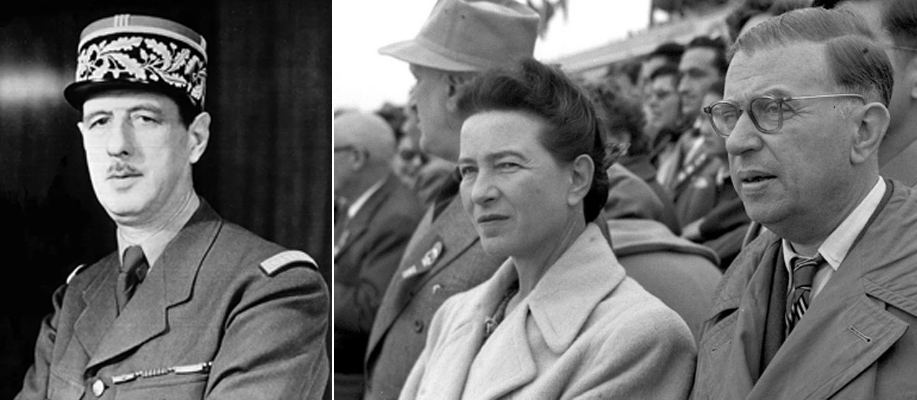
From left to right: Former President of France Charles de Gaulle, and French philosophers Simone de Beauvoir and Jean-Paul Sartre.
A prolific writer and leader of existential philosophy, Jean-Paul Sartre held a dominant position in 20th-century French intellectual life. Throughout his life, however, Sartre faced significant backlash — even danger — over his opinions. In his essay “Does Algeria Believe in Sartre?”, Algerian writer Said Khatibi describes the danger that Jean-Paul Sartre faced for merely expressing his opinion.* Sartre, despite not being a criminal, murderer, or outlaw, faced the wrath of the French public for expressing his thoughts as a writer and philosopher. This comes as a surprise considering the influence and renown attached to his name from a modern standpoint, a present in which he is celebrated for his contributions in shaping humanity’s intellectual history during the first half of the 20th century.
Sartre wrote in a mood of urgency, during a time of tense political context. After a failed military coup in April 1961 by officers who opposed French President Charles de Gaulle’s plan to withdraw from Algeria, France appeared on the precipice of civil war. The atmosphere leading up to this moment had strongly influenced Sartre’s position on race and colonialism in his 1960 book “Critique of Dialectical Reason.” Writing from a position of hiding, Sartre sent his work week by week, with little to no time to review and revise it. The writer also openly published articles in Les Temps modernes expressing his position on colonialism, though as the political climate worsened, he was forced to do so while effectively in hiding.
The right-wing OAS (Organisation armée secrète) bombed Sartre’s apartment on rue Bonaparte in Paris twice, first in July 1961 and the second time in January 1962, with one attempt nearly killing his mother. He was also targeted by pro-colonial demonstrations, which raised the cry ‘fusillez Sartre,’ or ‘send Sartre to the firing squad,’ according to Oliver Gloag in “Sartre Against Imperialism,” published in the Tribune Magazine.** A state-led counter-campaign banned Sartre’s works from French radio and television.
One might wonder: how did Sartre become the target of such extreme hostility? In the words of Khatibi, “He [Sartre] reached that point because of his writings — because he expressed an opinion. He was subjected to a public trial simply because he wrote, and because his writings defended Algeria during the colonial era, defended the Algerian people and their right to dignity and independence. He denounced the colonial machinery, dismantled its ideological foundations…and called upon Algerians to take up arms against colonial rule.” Khatibi commends Sartre for his commitment to the Algerian cause as the country faced one of the most sensitive issues in French domestic politics. Through his journalistic writing, he revealed and exposed the abuses and torture carried out by the colonial authorities in Algeria, which led to the journal being banned on multiple occasions. Because of this, Khatibi upholds Sartre as one of the fighters in Algeria’s war of liberation. Sartre treated the Algerian war less as a historical episode than as a test of universal ethics. His greatness lies not in defending Algeria as Algeria, but in defending justice wherever it is found — an argument that transcends nationalism.
Struggling against public enmity, Sartre was fortunate to secure the powerful support of the President of France, Charles de Gaulle, who at the time was also the subject of controversy for his decision to withdraw from Algeria. Sartre and De Gaulle’s dynamic may best be remembered by De Gaulle’s famous words in 1961, in which the French president defended Sartre, “You don’t arrest Voltaire.” His statement struck a chord, like a pledge reminding the crowds that to imprison thinkers, writers, or intellectuals for expressing views differing from the state’s is to go against the spirit of France. Khatibi notes that in likening Sartre to Voltaire, De Gaulle affirmed that opinions should be answered with opinions; arguments with arguments — not with imprisonment, intimidation, or fear.
Khatibi’s essay reiterates an underlying liberal argument: the true measure of a democratic state lies not in the treatment of those who agree with it, but in its protection of those who dissent. Sartre was an advocate of intellectual freedom over popularity and fame. The intellectual — doubly symbolic of the state’s moral conscience — is responsible for challenging the state’s immorality, questioning prevailing narratives, siding with the oppressed, and, to carry out these tasks, accepting personal risks. From this understanding of the intellectual’s role, Sartre’s position on colonialism, race, and imperialism may be viewed as a standard for all intellectuals. Yet, many intellectuals have remained silent on the wars conducted by their government and by foreign governments, often due to threats against their lives and livelihoods. In Syria, for example, some intellectuals and artists have paid the price with their lives. The late Syrian singer Ibrahim Qashoush, whom I wrote about in the feature essay “Silencing the Singer” in this magazine, was murdered by Assad’s Shabiha, his vocal cords removed as a political statement to permanently silence him from uttering “Erhal Ya Bashar” (Bashar Get Out) again.***
De Gaulle’s iconic “You don’t arrest Voltaire” declaration and France’s attitude demonstrate Western democracy at its most enlightening. Protecting opposition is a democratic principle, and safeguarding Sartre’s right to speak out is a prime example. Khatibi brims with praise for De Gaulle, writing, “For France to imprison a writer would have contradicted its own values — especially when his only offense was his unwavering commitment to defending the oppressed and supporting the freedom of the Algerian people,” adding that De Gaulle effectively preserved the spirit of the French Republic by siding with reason.
Perhaps the article’s most emotionally effective passage is its description of the writer as armed only with his conscience, writing, and principles. In the words of Khatibi, “A writer is defenseless. He possesses neither political fangs nor a party to protect him. He has no devoted followers because he does not entice others with false promises. He carries no weapon and serves no foreign interests. He possesses only his conscience, his pen, and his principles.” Unlike politicians, writers have no army, party, wealth, or coercive power; their only weapon is language.
The article leaves readers wondering who between Sartre and De Gaulle is ultimately more influential. However, Khatibi positions both as equally critical figures, though he especially praises De Gaulle for his political restraint, as power becomes respectable when not used for retaliation. In short, De Gaulle exercised enlightened statesmanship.
“At times, what embarrasses those in power is not opposition itself, but the individual who insists on principles while exposing their mistakes,” writes Khatibi, continuing that “Charles de Gaulle understood that crowds are driven by emotion, whereas the writer follows the traces of the future. The writer seeks to move his country forward rather than leave it imprisoned in the past.” Majority opinion in relation to the truth is not widely discussed; more often, the minority upholds the truth, though it is often persecuted. One need only look at election results in countries under dictatorships like Iraq and Syria: the ruler, or elite, often secures a near-absolute majority.
It is no novelty that crowds can be mistaken. We need not rewind history very far, whether in Europe or the Middle East, to discover the disastrous consequences of majority decisions. The only places where majorities can be tamed are democracies, but this assumption has been challenged by historical cases. The Nazis came to power through a majority of votes, even though the country had democratic institutions. At the same time, numerous examples exist of intellectuals swimming against the current of the majority, such as major Western philosophers like John Stuart Mill, who defended minority opinion, or Hannah Arendt, who was skeptical of both majority and minority opinions, to name a few.
Khatibi’s underlying argument maintains that democratic societies should defend freedom of expression even when opinions are unpopular, highlighting Charles de Gaulle’s restraint in not imprisoning Sartre as a test of the nation’s moral foundations and of the protection of writers and thinkers. He transforms a historical anecdote into a timeless meditation on democracy, rendered in persuasive, accessible prose that blends history and ethics. Sartre is effective not as a saint or pure philosopher, but as an intellectual willing to bear his convictions. Khatibi’s main limitation is his simplification of a complex moment, omitting the political ambiguities surrounding Sartre’s support for revolutionary violence and idealizing De Gaulle. This selective focus, however, reinforces its central moral message as an opinion piece.
*Said Khatibi’s essay, “Does Algeria Believe in Sartre?”, was published in Arabic in Al-Quds Al-Arabi.
**Oliver Gloag’s essay, “Sartre Against Imperialism,” was published in the Tribune Magazine.
***Elie Chalala’s essay, “Silencing the Singer,” was published in Al Jadid Magazine, Vol. 16, No. 63, 2010. To read the full article, click on the link below:
This article appeared in Inside Al Jadid Reports, No. 178, 2026.
Copyright © 2026 AL JADID MAGAZINE