
Lebanon’s River of Memory and Conflict
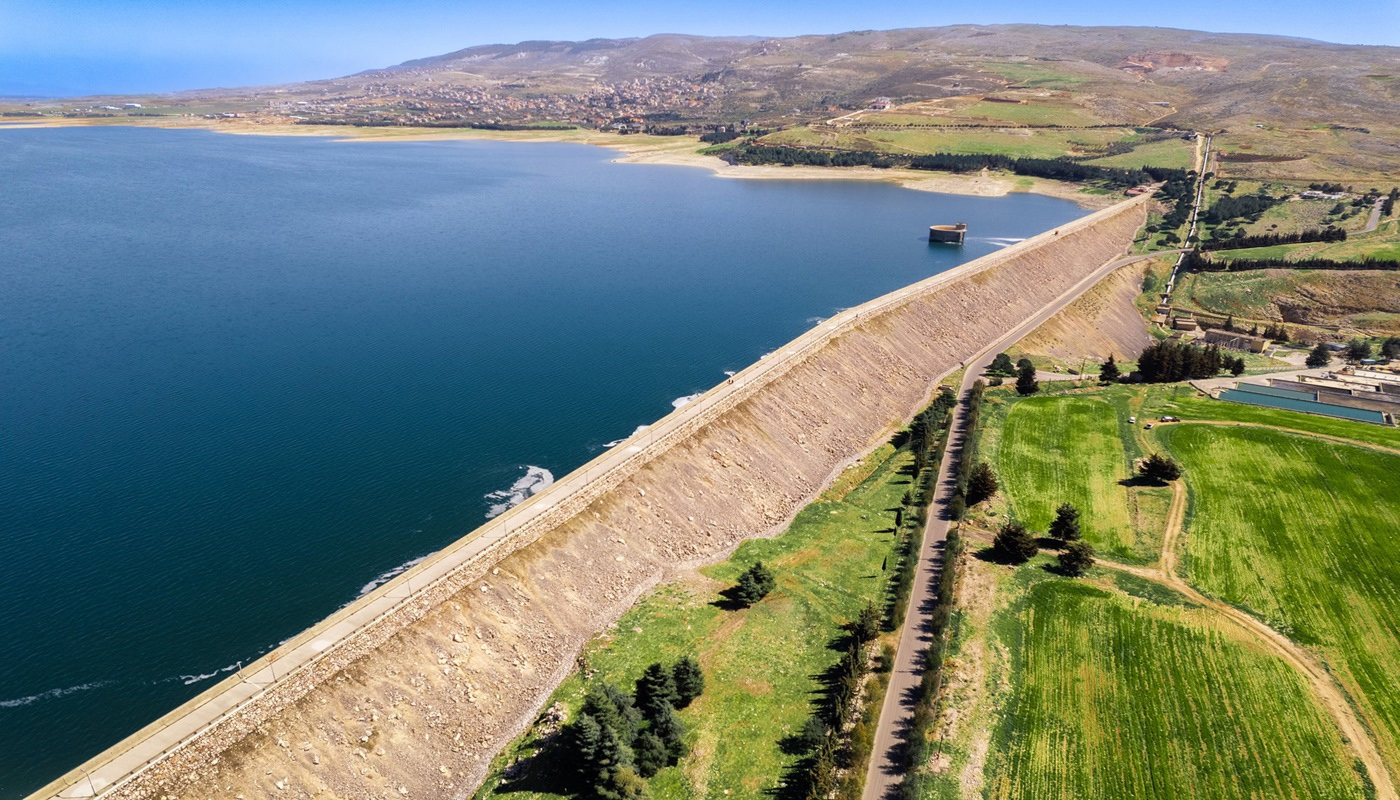
Lake Qaraoun created by Qaroun Dam on the Litani River.
Lebanese people often say that just as Egypt is the gift of the Nile, Lebanon is the gift of the Litani. Rivers create the ideal conditions for the rise of great civilizations, a connection acknowledged since ancient times through the worship and reverence of rivers in Greece, Egypt, Mesopotamia, and across the wider world. From the creation of myths and the birth of numerous fertility deities to celebrations, festivals, and offering ceremonies, rivers have been central to the lives of the communities surrounding them. “As the presence of water is inextricably linked to the presence of life — and its absence to death — it is hardly surprising that rivers, waterways, and their basins have frequently ignited wars and bloody conflicts among humanity,” states Shawqi Bzeih in “The Litani River: Guardian of Memory and Legend, Ignored by Poets,” published in Asharq al-Awsat.*
Rivers are essential to making the land habitable, providing food and water for civilizations and shaping migration patterns that ultimately defined national borders. The Litani River is the longest river to flow entirely within Lebanon, drawing water from the Al-Allaiq Spring west of Baalbek and carrying it to the Mediterranean north of Tyre. The final stretch of the river toward the Mediterranean Sea is locally referred to as the Qasimiyah River. Historically rooted in Semitic mythology, the river’s name is associated with the seven-headed serpent Lotan (or Litanu) of Ugaritic mythology, while in Classical Greek and Roman texts it was called Leontes or the River of Lions.
Numerous literary works involve rivers: Mikhail Sholokhov’s “And Quiet Flows the Don,” Joseph Conrad’s “Heart of Darkness,” Naguib Mahfouz’s “Adrift on the Nile,” Jules Verne’s “The Giant Raft,” and Elif Shafak’s “There Are Rivers in the Sky.” Shawqi Bzeih explores the presence of rivers in poetry. Rivers, he states, have “fueled the imaginations of poets and creative minds, providing a rich source of metaphors.” He explains that this is due to “their remarkable ability to reconcile the collective need for a shared history with the individual need to imbue memory with secrets.”
Bzeih is particularly interested in the Litani River, arguing that although the river is shorter, narrower, and has less volume than other rivers worldwide, it plays no less important a role in the lives of the people living beside it. On a geopolitical level, it “has been a focal point of constant contention among rival international powers,” especially after the collapse of the Ottoman Empire when the southern borders of Greater Lebanon shifted beyond the river’s banks under the French Mandate. The Litani River plays a significant role in the Lebanese economy, providing irrigation water, contributing to hydroelectric power generation through the Qaraoun Dam and lake, and supplying water to food-processing plants and agricultural towns along the riverbank. The river is the primary source of drinking and irrigation water for 263 towns. In the words of Bzeih, “Its contribution to the lives of the farmers dwelling along its banks has varied: irrigating parched lands, generating electricity, and imbuing love stories with the necessary atmosphere of shade and romantic melancholy…It is the river around which wars have raged…and every drop of its water has been consecrated by the blood of the Southerners, as well as by their tears, the sweat of their brows, and the anguish of their weary hearts.”
For all its contributions, however, the Litani does not garner as much attention from poets and writers as similar rivers worldwide. Some examples exist, including the poem “No Day Like Ours on the Banks of the Lita” (the name of the river at the time) by the Abbasid poet Abd al-Muhsin al-Suri. The Australian author and veteran Shawn O’Leary’s poem “Shell Shock” memorializes the devastating battles fought along the banks of the Litani River in 1941 during the Second World War.
Though it hasn’t received as much global attention as other rivers may have, the communities surrounding the Litani River have celebrated it in writing. Between the 19th and 20th centuries, the people of Jabal Amel settled along the river. Wadi al-Hujair, a valley along the river, was where the people of Jabal Amel pledged their allegiance to Faisal I as King during a conference in 1920, bringing the river's cultural significance to maps. As Bzeih notes, “The valley became a cherished haunt for poets and their admirers, as well as a regular setting for literary and intellectual debates, and for gatherings marked by tea, conviviality, and spirited conversation.” Many writers from the region have referenced the features and imagery of the river in writing. Some poems include works by Ali Mahmoud al-Amin and Shiite scholar and jurist Al-Sayyed Mohsen al-Amin.
In 1949, the United Nations Economic Survey Mission for the Middle East, widely known as the Clapp Mission, chaired by Gordon R. Clapp, identified the Litani River as key to Lebanon's future, as cited by Abdel Tawwab Barakat in The New Arab.** The river encompasses 33% of the country’s agricultural land, and the region has a population in which 75% work in agriculture, livestock farming, beekeeping, and fishing. Barakat adds that data from the Lebanese Ministry of Agriculture finds that the southern river basin produces 97% of the country’s citrus fruits, 95% of its bananas, and 91% of its olives.
Unfortunately, concerns over the river’s exploitation and pollution have risen, especially in recent years. The agricultural land surrounding the basin has been damaged by the Israeli army. According to Barakat, the Israeli army has destroyed 7,000 hectares of olive groves and bulldozed 11,000 hectares of orange, lemon, banana, and grape orchards, as well as protected crops through the use of phosphorus bombs and explosives. Facilities for food products such as vegetables, fruit, meat, dairy, olive and carob presses, as well as centers for cooling, collecting, and storing agricultural produce south of the Litani River were also destroyed. Livestock were not spared; Barakat cites the destruction of approximately 2 million head of livestock and poultry, 30,000 beehives, and fish farms containing around 2,000 tons of fish. UN organizations estimated agricultural losses in the south at over $530 million, noting the loss of harvests across 56,000 hectares due to farmers’ displacement and inability to access their land, reports Barakat.
The Litani River has also suffered immensely from exploitation and pollution. The river has been a dumping ground for chemical waste from factories along its banks, making it a carrier of diseases and pollutants that harm not only wildlife but also the health of communities relying on its water. Wastewater from agricultural and animal-product processing facilities — including cheese factories, canneries, sanitary paper plants, sugar refineries, poultry farms, and slaughterhouses — as well as the excessive use of pesticides and fertilizers and unregulated sewage networks contributes to water contamination. A report by the Jordanian journalist Dania al-Maaytah entitled “Litani River Pollution Linked to Rising Cancer Rates: ‘Political Reasons’ Hinder Necessary Studies,” published by the Sustainable Sanitation Alliance (SuSanA), states that in 2018, 79 unlicensed industrial facilities responsible for polluting the river were shut down, and 72 licensed facilities received warnings.*** Regulation efforts were implemented by the Litani River National Authority in cooperation with the Lebanese Ministry of Industry and Trade. However, despite the allocation of approximately $400 million for the river’s cleanup, the work was never carried out, and the river continues to deteriorate.
Maaytah cites an interview with Dr. Sami Alawiyah, head of the Litani River National Authority, who explains that despite dozens of legal warnings issued to factories dumping waste into the river, “these warnings yielded no results,” and the factories continue to pollute the Litani River. Alawiyah notes that the Authority does not possess precise studies regarding the link between pollution and the prevalence of cancer in the areas surrounding the river, and that the American University had plans to conduct detailed research on the subject but was “prevented from carrying out the study for political reasons.”
Then and now, politics plays a heavy hand not only in the management and preservation of the river but also in the conflicts waged over it. The river’s name is closely associated with the 1978 Operation Litani (codenamed so by Israel), which was the first major Israeli invasion of southern Lebanon. On a geopolitical level, the area south of the Litani River holds strategic significance because it contains military sites and infrastructure established by Hezbollah near Israel’s northern border, making it a frequent site for clashes between the two sides. A 2024 report published by the International Center for Strategic Studies notes that the demographic composition of this region — where 75% of the population is Shiite — factors into Hezbollah’s insistence on staying in the region and its refusal to withdraw north of the river.
At the same time, the river has also been contested over for its resources. In 1954, American engineer John Cotton devised a plan to dig a 100-kilometer canal to redirect the Litani River through its valleys into Israel. In 1982, Israel invaded Lebanon and declared the establishment of a ‘security zone’ in the south, which it occupied for 18 years. “Israeli strategists continue to view the Litani River not merely as a strategic buffer — preventing Hezbollah fighters from deploying near the border and threatening northern Israeli settlements…but also as a potential long-term source of water for Israel,” writes Barakat in The New Arab. According to an article by Roy Abou Zeid in An-Nahar, the Litani River “embodies an intense geopolitical struggle in which the boundaries of legal sovereignty intersect with the limits of the state’s actual capacity.”**** The article suggests that the river’s status is indicative of more than its natural features, posing the question: “Is sovereignty in Lebanon absolute, or merely nominal — eroding whenever it comes into contact with geography and local and regional actors?”
Though the Litani River runs entirely within Lebanon, an internal division between the upper basin in the Bekaa and the lower basin in southern Lebanon points to disparities in management, control, and use, Abou Zeid suggests. Dr. Sami Alawiyah states that “the upper basin has become detached from the lower basin in terms of water sources, quality, and quantities.” This, writes Abou Zeid, reveals the structural reality that the river is a fragmented structure shaped by policies, usage patterns, and institutional legacies — a fragmentation that is far from natural but rather “political-administrative.” This structure is distributed across three levels: the Lebanese State is the legal owner of the resource, yet with limited executive capacity; the “mini-state” represented by Hezbollah, which exerts influence on the ground across the social and security landscape; and the regional Israeli actor, which serves as a cross-border security factor that redefines the strategic environment of the South, explains Abou Zeid, who surmises: “Ultimately, the Litani River transcends the status of a mere water, environmental, or even security dossier. It reveals a deeper issue concerning the very nature of the Lebanese state: a state that possesses the geography legally yet lacks full functional control over it.”
*Shawqi Bzeih’s essay, “The Litani River... Guardian of Memory and Legend, Ignored by Poets,” was published in Arabic in Asharq al-Awsat.
**Abdel Tawwab Barakat’s essay, “Israel's Ambitions Regarding the Waters of the Litani River,” was published in Arabic in The New Arab.
***”Dania al-Maaytah’s essay, “Litani River Pollution Linked to Rising Cancer Rates: ‘Political Reasons’ Hinder Necessary Studies,” was published in Arabic on the Sustainable Sanitation Alliance (SuSanA) website.
****Roy Abou Zeid’s essay, “The Litani River in Southern Lebanon: Incomplete Sovereignty in a Geography of Conflict,” was published in Arabic in An-Nahar.
This article appeared in Inside Al Jadid Reports, No. 177, 2026.
Copyright © 2026 AL JADID MAGAZINE