
The Unspoken Crisis of Syrian Abductions
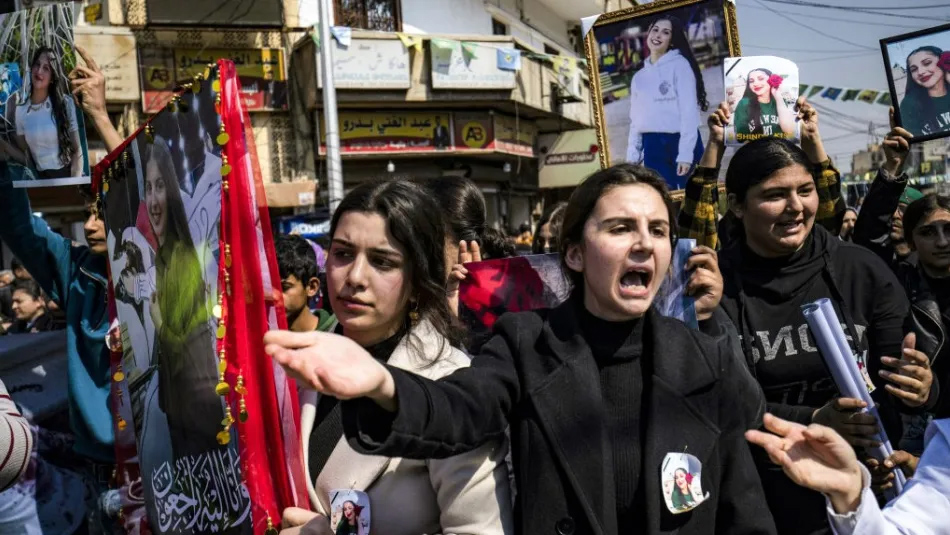
Widespread protests on the abduction of Syrian women. Photograph credit Getty Images.
The Syrian Ministry of Interior is reportedly following the case of a woman identifying herself as Walaa al-Mahmoud, whose story recently sparked media attention after she posted a video online accusing a security official in Jableh of abducting and assaulting her. She alleges that the security apparatus had colluded with the official by detaining her and facilitating the assault, as cited by Omar Qaddour in Al Modon*. Shortly after Mahmoud’s testimony, local social media pages in the city of Salamiyah reported the disappearance of a young woman named Ghazal al-Hajj, who disappeared on her way to the market.
Scenes coming from Syria are not unlike those described in dystopian films or novels: women’s bodies reduced to collateral, to tools, killed or disappeared at the whims of authorities and power struggles. This is the absurd horror that has become the Syrian reality, as described in Samar Yazbek’s “The Body is a Hostage,” published in The New Arab on August 26, 2025**. She finds many similarities to dystopian fantasies like “The Handmaid’s Tale,” where “women with blurred faces become symbols in a harsh theater.” She writes, “But we are not in a dystopian fantasy; we are in Syria, where drama is written in blood.”
The situation in Sweida remains not just alarming, but infuriating. The Syrian Observatory for Human Rights (SOHR) reported 293 cases of Druze women kidnapped; of this number, 42 were released, two were detained in Adra Prison in Damascus without trial or clear charges, 14 women were killed after being abducted, and 235 women’s whereabouts were still unknown at the time of Yazbek’s essay in August 2025. According to her findings, Yazbek adds that 33 other women from villages along the Syrian coast also disappeared, vanishing into obscurity “from which only imaginary screams can be heard.”
Women's bodies have been leveraged as tools of authority, their agency stripped. The very fact that violence and abduction have become commonplace is a symptom of a failed state, writes Yazbek. Complacent silence is the compliance that enables the crime to continue. In her words, “These are areas of silence that will expand the longer the absence continues. The story is no longer about a fleeting kidnapping, but rather expresses an entire structure fueled by fear, transforming women into symbols in a conflict that transcends them.” Kidnapping, she explains, has become politics conducted through representation — something far more dangerous than a criminal offense. Syrian women’s bodies have become ‘maps of conflict,’ their lives manipulated in shows of power and control. “When a Druze woman is forced to wear the hijab at the moment of her release, it is no longer about a piece of cloth in a ceremonial encounter; it is the confiscation of choice itself, and the rejection of cultural plurality,” states Yazbek. “Every kidnapped woman becomes a new border drawn on her flesh, a silent statement that the authorities are capable of reengineering society through its most fragile points.”
Yazbek especially criticizes the silence surrounding the exploitation of women’s bodies. Feminist organizations that once called for revolution and freedom in the early days of the revolution are silent in the face of today’s horrific violations. She writes, “Their silence is not neutrality; it is participation in the production of the invisible. What is not named does not exist, and thus, silence becomes an accomplice to the crime, allowing the authorities and factions to extend their control without accountability.”
Abduction is used as a direct expression of authority. By failing to hold responsible parties accountable, the state enables violence. In the words of Yazbek, “The so-called 'state' here is a specter that legitimizes chaos and transforms it into a system of government, an entity based on absence rather than presence, on hostages rather than citizens. Every missing woman is not merely a victim; she is a document proving that the social contract has been shattered.”
These crimes will continue so long as women’s bodies continue to be weaponized in power struggles. Yazbek explains: “When the state is built on kidnapping, it becomes a vast prison whose keys are managed through threats and humiliation…In this structure, the body is not merely individual, but the body of a group. Every missing woman is a fragment from the collective memory, and every suspended absence is the consolidation of a new authority over an open void. The continuation of the phenomenon does not threaten a specific sect, but rather portends the transformation of kidnapping into a permanent structure for governing society.”
Yazbek expressed in another essay published in October 2025, “Stop the Kidnapping of Women in Syria,” that “when a person is abducted because of their sectarian affiliation, the target is not just the individual, but rather the last remaining symbols of shared belonging. Abducting a woman from a particular group simply because of her religious identity effectively means declaring that group isolated, stripping it of its right to safety, and informing it that it is ‘expendable.”’*** She adds, “Confronting kidnapping is not merely about seeking justice for victims or alleviating their suffering, but rather a national and political act aimed at rebuilding what little trust remains among Syrians. No national reconciliation can be achieved in an environment where some citizens see themselves as constant targets of kidnapping or collective punishment through various means.”
A UN investigation reports a death toll of around 1,400 people in northwestern Syria following the outbreak of sectarian violence in March 2025. Since the publication of Yazbek’s essays, investigations by numerous groups into the kidnappings of Alawite women have yielded alarming testimonials. A New York Times investigation published by Ben Hubbard on April 3, 2026, counters the claims by the Syrian government denying the targeted kidnappings of Alawite women and girls.**** The investigation was based on interviews with dozens of Alawites, either those directly affected by the kidnappings or their relatives, who shared their stories. The Times' report verified the kidnappings of 13 Alawite women and girls, as well as one man and one boy.
Alongside its own report, the Times cites findings from both Amnesty International, which stated in July 2025 that it had credible reports of 36 kidnappings and documented eight cases, and a UN commission in August 2025 that documented six cases of kidnappings along with reports of dozens more still under investigation. However, even though many know about the ongoing abduction of women and girls, the kidnapping cases remain difficult to confirm, as victims and families are too scared to talk, explains Hubbard. For this reason, those who disclosed their experiences with the Times remain anonymous. Nour al-Din Baba, the Interior Ministry spokesman, stated in an interview that he could not respond to The Times’ findings unless The Times provided the names of the cases it had verified, which The Times declined to do.
Many continue to criticize the government’s attitude and handling of the abduction cases, suggesting that the “government failed to take their cases seriously,” in the words of Hubbard. Rima Flihan, executive director of the Syrian Feminist Lobby, a nonprofit organization tracking the kidnapping cases, tells the Times: "They are more shaming the women than seeing them as survivors." Families that reported their cases have been met with security personnel who accused the missing victims of using drugs or running away with their boyfriends; others, whose missing family members returned, were told to lie about what happened.
Batoul Yazbek’s words still ring true: “When violence is normalized, it becomes part of the fabric of daily life. When kidnapping becomes commonplace, it becomes a tool of governance equivalent to a constitution. That's why silence today is not an option, but a betrayal. A betrayal of the future of all women, and a betrayal of an entire society being reshaped by violence.”
*Omar Qaddour’s essay, “About Ghazal and Walaa, and the Issue of Kidnapped Alawite Women,” was published in Arabic in Al Modon.
**Samar Yazbek’s essay, “The Body is a Hostage,” was published in Arabic in The New Arab.
***Samar Yazbek’s essay, “Stop the Kidnapping of Women in Syria,” was published in Arabic in The New Arab.
****Ben Hubbard’s essay, “In Syria, Kidnappings of Women and Girls Fuel a Minority Group’s Fears,” was published in the New York Times.
This article appeared in Inside Al Jadid Reports, No. 176, 2026.
Copyright © 2026 AL JADID MAGAZINE