
Public Art and the Preservation of Arab American History in New York
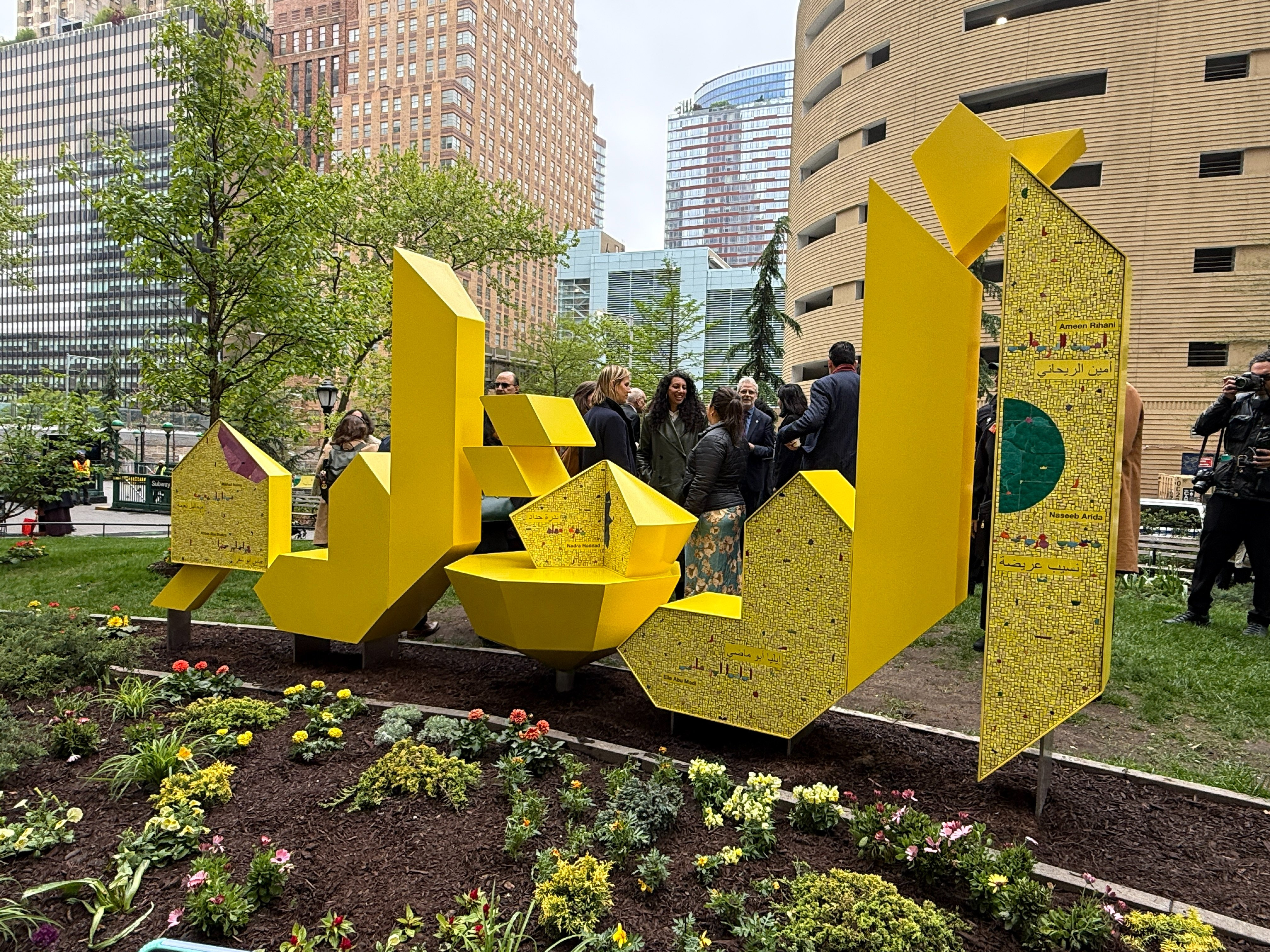
Unveiling of Sara Ouhaddou’s sculpture, “Al-Qalam,” on April 30, 2026. Photograph by the NYC Department of Cultural Affairs.
Just in time for the closing of Arab American Heritage Month, French-Moroccan artist Sara Ouhaddou in collaboration with NYC Parks, the Washington Street Historical Society, the New York City Department of Cultural Affairs, and funding by the Mellon Foundation, unveiled a vibrant art installation on April 30 that not only celebrates the history of its surrounding area, but stands imbued with the hopes of preserving the community’s legacy for years to come. With its permanent home at the Elizabeth H. Berger Plaza in the Financial District, Ouhaddou’s sculpture and mosaic installation, nearly a decade in the making, honors the memory of Manhattan’s Little Syria, which was completely demolished and its residents evicted in the 1940s to make way for the construction of the Brooklyn-Battery Tunnel. The unveiling was also organized in conjunction with a symposium at NYU’s Kevorkian Center, titled “Beyond Al-Qalam: Literary Rebellion and Visual Abstraction in Little Syria,” held on May 2, 2026, exploring the legacy of New York’s early Arab American writers.
In 2017, Sara Ouhaddou was selected through a competition run by New York’s Department of Cultural Affairs to create artwork for the plaza. The Washington Street Historical Society, under the leadership of Dr. Linda Jacobs, sponsored the design, fabrication, and installation of the artworks. The art installation, titled “Al-Qalam: Poets in the Park,” includes a large sculpture and mosaic panel backrests for two existing park benches located south of the sculpture. Sitting at approximately 19 feet long and 7 feet high, the sculpture has finally come to life in an eye-catching arrangement of abstract lettering using an alphabet Ouhaddou personally invented to spell out “Al-Qalam,” meaning ‘the pen,’ in reference to the Pen League (Al-Rabita Al-Qalamiyya). Along the surface of the sculpture are the names of nine members of the Pen League, also written in her abstract alphabet.
Originally founded in 1916 by Nasib Arida and Abd al-Masih Haddad and then restructured by its new leader, Gibran Khalil Gibran, in 1920, the Pen League and Mahjar (émigré) writers played important roles in revolutionizing and modernizing Arab literature. Considered the first Association of Arab American Writers, its membership included Gibran Khalil Gibran, Ameen Rihani, Mikhail Naimy, Elia Abu Madi, Nasib Arida, and Rashid Ayyoub, among others. The two curved mosaic panels serving as new backrests on the park’s existing benches feature excerpts from works by Elia Abu Madi, Nasib Arida, Gibran Khalil Gibran, Nadra Haddad, Mikhail Naimy, Ameen Rihani, Abbas Abu Shaqra, Afifa Karam, and Agabia Maalouf. Though not members of the all-male Pen League, Afifa Karam and Agabia Maalouf are also represented as important figures in the literary community, as Ouhaddou writes in the project outline presented at the Public Design Commission meeting on August 14, 2023. The texts on the mosaic are rendered in Ouhaddou’s abstract alphabet, paying tribute to the poets of the Pen League and the history of Manhattan’s Arab American community.
Born in 1986 and currently living and working between France and Morocco, artist Sara Ouhaddou finds particular interest in the Arabic language. In proposals for the project released in 2023, she described the concept behind her intended design as “an abstract alphabet at the crossroads between the literary Arabic alphabet and Islamic geometry,” adding that “the level of abstraction also embraces the philosophy of calligraphy, which is not read, but felt.” The final product was an abstract alphabet that melds Arabic and the geometries of Islamic architecture while engaging the complex conversation of translation. Ouhaddou explains to Isa Farfan in an interview for the online arts magazine Hyperallergic that her mosaics nod to the literary and cultural translation that the immigrant writers of the Pen League performed upon their arrival in New York City.* She states, “ The idea is to understand, for people who come from a different language, what it feels like to be confronted with another language that you don’t even know, that is not part of your life…When [Little Syria’s writers] arrived in America, they had this huge question of translation…The question was, ‘Do we continue in Arabic? Or do we translate [our work] into English and share and make it available to others?”
Just as the Mahjar writers did in the past, Ouhaddou approached similar questions while creating “Al-Qalam.” She said at the unveiling of the installation, as quoted in Gothamist, a New York City-centric blog operated by New York Public Radio, “This community was one of the first that really questioned the idea of translation, and it's a core question when you're an immigrant: translating the culture you come from…So very quickly I asked myself, ‘OK, now this young generation, us from the diaspora, how will we translate everything we inherited?’ And so this is how I came up with the idea of creating my own alphabet, abstracts, impossible to read, really thinking of the future and thinking of being in the legacy of the poets, legacy of the artists that were here.”**
Manhattan’s Little Syria, also known as the Syrian Quarter, was once home to an estimated 1,500 to 3,000 immigrants from Greater Syria, which encompasses present-day Syria, Lebanon, Palestine, and Jordan, throughout the late 19th century to the early 20th century. Drawn to the economic opportunities brought by the neighborhood’s proximity to the docks, these immigrants established a community on the west side of Lower Manhattan on Washington Street and Rector Street. All residents were displaced from the area by the 1940s when the construction of the Brooklyn-Battery Tunnel called for the district’s demolition. However, Little Syria’s population was already in decline before the construction, as immigrants typically settled in the neighborhood temporarily before eventually relocating to other established communities, such as Atlantic Avenue in Brooklyn.
While not much physically remains of Little Syria today, its legacy lies in the ripples it created in Arab writing and literature globally as the birthplace of the first Arab American publications, the modernization of Arabic script for print, and the renowned Pen League. The first Arabic-language newspaper in the States, “Kawkab America” (The Star of America), was founded by brothers Nageeb and Abraham Arbeely in 1892 and published in both Arabic and English. Other influential publications quickly emerged: “Al-Hoda,” founded in 1898 by Naoum Anthony Mokarzel, was the first Arabic-language newspaper to use Arabic-character linotype rather than hand typesetting. “Mir’at al-Gharb” (Mirror of the West) was founded by Najeeb Diab in 1899. Syrian and Lebanese writers and poets began to publish their works in newspapers and eventually produced poetry books, novels, and the literary magazine Al-Funoon (The Arts), founded in 1913 by Nasib Arida.
Ouhaddou’s “Al-Qalam” celebrates the rich history of Little Syria and the community's feats. Visitors can not only admire the park’s newly installed art, but also directly interact with the texts featured along the benches. Washington Street Historical Society (WSHS) has created an augmented reality app that allows visitors to hear and read excerpts in both Arabic and English, along with information about the writers. WSHS is dedicated to fostering education and awareness about the history of Arab migration to the Syrian Quarter. The non-profit organization has promoted education activities and actively works to preserve the surviving historic buildings on the street — the St. George Syrian Catholic Church, the Downtown Community House, and a tenement building.
In the words of NYC Parks Commissioner Tricia Shimamura, “Our public spaces, and our monuments in particular, tell the story of our city, celebrating our shared achievements and elevating elements of our history that have been forgotten or ignored. This monument to the Little Syria community, and the incredible literary contributions that have been made here, are a beautiful reminder that our city has always been shaped by tremendous diversity, perseverance, and creativity.” The unveiling of Sarah Ouhaddou’s “Al-Qalam,” a project almost a decade in the making, stands as a testament to the enduring legacy of Arab American history in New York that continues to invite discussion, education, and celebration.
*Isa Farfan’s essay, “Historic Monument Honors New York’s First Arabic-Speaking Community,” was published in the online arts magazine Hyperallergic.
**Catalina Gonella’s essay, “Financial District gets a colorful monument honoring its roots as ‘Little Syria,’ was published in the Gothamist.
This article appeared in Inside Al Jadid Reports, No. 175, 2026.
Copyright © 2026 AL JADID MAGAZINE