
‘Ziyyah’ Transforms Village Ritual Into a Meditation on Memory, Coexistence, and the Recurring Wounds of Lebanon
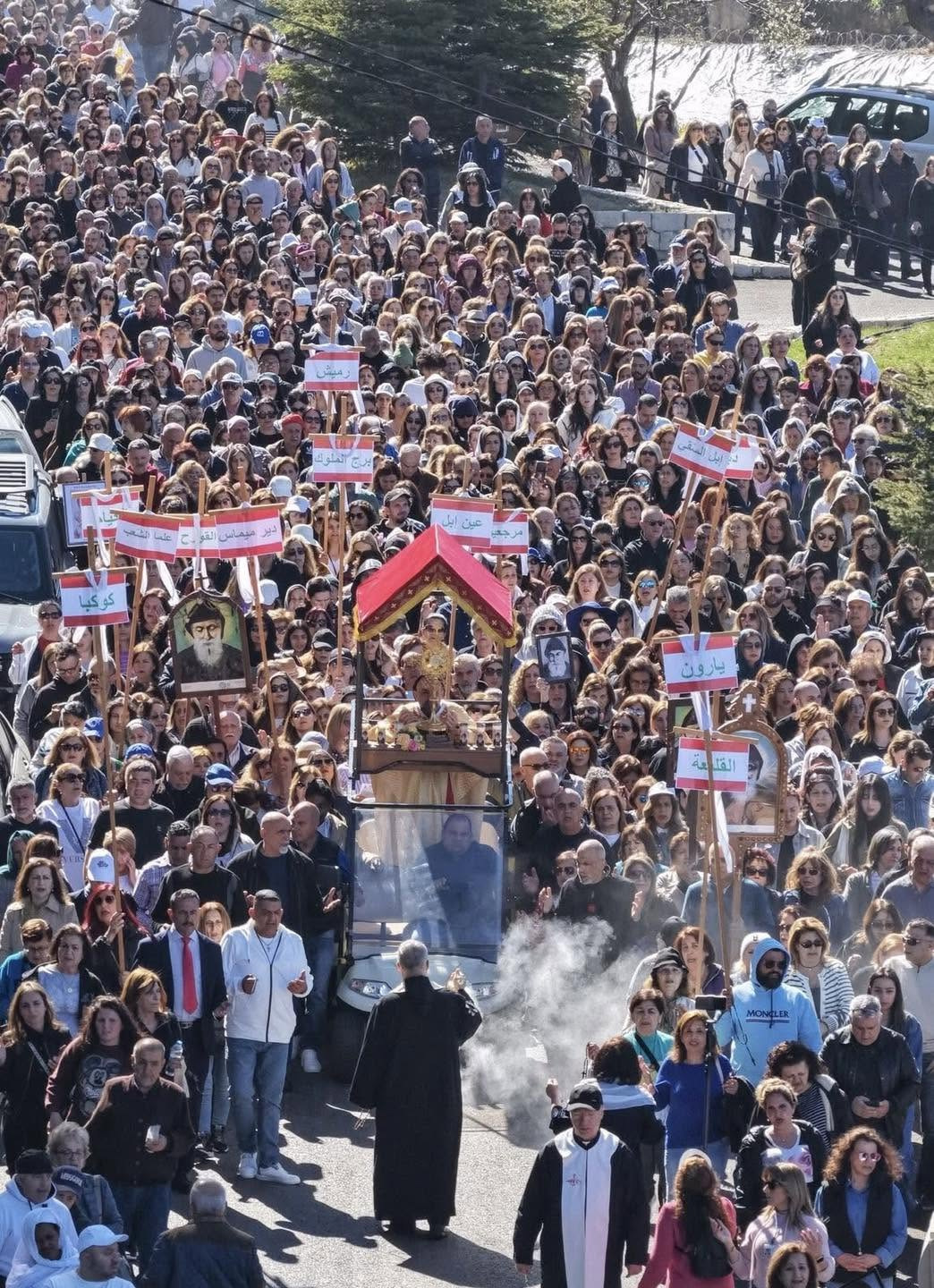
The Saint Charbel Procession held every month on the 22nd at the Saint Maron Monastery in Annaya, Lebanon. People from the South carry crosses bearing the names of their suffering villages. Photograph credit Instagram.
Lebanese novelist and critic Mounir El Hayek’s novel “Ziyyah” (Al-Rafidain Publishing House, 2025) tells a story that transcends time — two time periods, separated by a century, yet facing similar tribulations. Set in a fictionalized version of the town of Qabb Elias, the author’s very own hometown, the characters’ lives unfold in a story that intertwines history with a twist of magical realism. Through discussions of shared rituals, “Ziyyah” touches on love, legends, and community in the face of injustice.
In 1916, under Ottoman rule, the town of Qabb Elias, located in the Beqaa Valley, was caught between two disasters. The “yellow wind” epidemic and famine sweeping across Mount Lebanon bring death, while feuding authorities leave residents on edge. In 2014, nearly a century later, the town has undergone much change, yet some struggles continue to echo the past.
Written in two parts, “Ziyyah” follows the story of two women of the same name whose fates are bound together across time and space. The 50-year-old Janet who lives in 1916 amid a horrific epidemic and the Janet struggling with her health in 2014 are not directly related, yet, through magical occurrences and religious miracles, their stories parallel each other. These Janets see both future and past, their stories culminating in “magical writing that departs from conventional realism,” in the words of Fatin al-Mur in Al-Quds Al-Arabi.*
The Lebanese village of Qabb Elias has historically been home to Christian and Muslim communities. The first part of the novel, focusing on the lives of Qabb Elias’ residents in 1916, finds the town in the midst of a deadly epidemic and famine. Janet, a Lebanese Christian woman in her 50s who was raised by her grandfather after her mother’s death, finds herself leading initiatives to unite the communities of her home in celebration of a shared occasion, bridging their differences. She is particularly drawn to Awad, a rebellious young man who follows a different faith.
It just so happens that in 1916, the Ziyyah, a Christian religious ritual observed annually on July 20, the Feast of Saint Elijah the Living, coincided with the month of Ramadan. Every year, the religious procession begins and ends at the church. Glimpses into the future through “prophetic” dreams allow the 50-year-old Janet to witness the religious tensions that persist even 100 years later. She sees children donning red garments, shooting at blindfolded men in 2013, and bearded men beheading one of her relatives — scenes hinting towards the violence of ISIS. She sees the very village she is used to transformed by modernization and urban development.
Janet is visited by Saint Elijah the Living in a dream, where the saint advises her to gather all the communities of the town — Christians, Muslims, and Druze — together for a religious procession, assuring them that “God will be with you, and by His will and my intercession, the epidemic will vanish,” as cited by Ali Mahdi Zaitoun in the Iraqi daily newspaper Al-Sabaah.** Heeding his words, Janet attempts to unite the two religious celebrations of her town in order to reconcile the Christian and Muslim communities in her village, “hoping that such reconciliation might spread throughout a country perpetually threatened by sectarian strife,” writes Fatin al-Mur.
The ups and downs of life in Qabb Elias revolve around coexistence — between Muslims and Christians, the tensions that occasionally disrupted it, and the repercussions that continue to echo today. As Fatin al-Mur writes, “Like any rural town, it is held together by everyday interactions, friendships, and minor rivalries. Closely tied to this social landscape are a variety of customs, traditions, and beautiful rituals associated with religious holidays and celebrations, all portrayed with a style that is often humorous and light-hearted. The novel also highlights the kindness of certain characters who transcend religious boundaries and form bonds of friendship and affection with one another.”
At the same time, the residents’ struggles cannot be removed from the context of the political tensions and the deadly epidemic of 1916. This community, devastated by the cholera epidemic, also contends with the clashes between the political authority of the time, the feudal Bey and the Ottoman outpost, “which breed injustice and famine,” states Salman Zain al-Din in Al Modon.*** When the teacher Fouad al-Hawwari speaks out, he is arrested and dies under torture, his body disposed of in a pit. When the character Awad rebels and refuses to submit, he is hunted by the Bey’s men and the gendarmerie, going into hiding and dying from poisoning after eating wild herbs out of hunger. In the words of Zain al-Din, “While the authorities target individual acts of rebellion within the novel, the “Yellow Wind” makes no distinction between the submissive and the rebellious, reaping lives indiscriminately.”
Though Janet’s overarching narrative positions the widespread epidemic and debilitating famine as a consequence of ‘God’s wrath,’ El Hayek’s setting and descriptive prose naturally reveal that the epidemic stemmed from negligence and oppressive taxation under Ottoman rule. As Zaitoun points out, “Notably, the novel’s reference to Djemal Pasha’s arrival in Chtaura symbolizes his broader presence in Lebanon and Syria — specifically his erection of gallows in city squares to silence voices opposing the injustice the Ottomans inflicted upon the free spirits of the lands under their control.”
Meanwhile, the second half of the narrative explores the lives of the townspeople in 2014. By then, Lebanon had endured the onslaught of numerous wars and conflicts, from the aftermath of the civil war, the complications and repercussions of the July 2006 war, the Syrian conflict, and the ongoing attempts since then to heal from the damage.
Like Janet living in 1916, the Janet of 2014 can see people and events from a time other than her own — specifically, a century ago, during Qabb Elias’ time under Ottoman rule. Many aspects of this “modern” Janet’s life feel reminiscent of 1916 Janet’s struggles: the setting of Qabb Elias remains the same, as do many character roles and events, such as the religious occasion of the Ziyyah. At the same time, the ruling authority and purpose of the procession have changed in 100 years.
Both Janets inhabit a scarred memory, as explained by Said Khatibi in Al-Quds Al-Arabi.**** The first Janet lived through years of epidemic disease, while the second faces a different kind of contagion — “one that evolved into division among the citizens of the same country,” he writes. Janet of 2014 also struggles with health concerns, her testimonies of witnessing events from the past written off by disbelieving onlookers and even her husband as some sort of mental illness. At last, when she is able to participate in the Ziyyah briefly, she loses her sight and hearing and is taken home. After sleeping, however, she regains her sight and hearing and attributes this miraculous recovery to an intercession by Saint Elijah the Living, a feat that echoes the religious miracle of 1916, when Saint Elijah the Living is believed to have cured the epidemic after Janet heeds his call to unify the community with the Ziyyah.
With the backdrop of two religious processions, separated by 100 years, Mounir El Hayek’s “Ziyyah” weaves discussions of injustice and colonization into the narrative. Taghreed Abdel Aal in her essay, “Mounir El Hayek: Recalling “Ziyyah” of Elias’ Heart,” published in Al-Akhbar, suggests that these two points in time — 1916 and 2014 — “make us realize that the region’s experience has remained constant: the same cycle of injustice, slaughter, and death that began at that earlier point in time persists into the present, as the Zionist enemy continues to colonize and violate the land.”*****
The novel’s discussion of Palestine is understated yet laden with metaphors and symbols. Abdel Aal writes, “The Lebanese novelist does not force the country — or its place in the collective conscience and history — into the story arbitrarily or excessively. Instead, he employs a narrative approach that highlights its role in connecting events and championing the cause of justice.” Both time periods introduce a character that harnesses the spirit of rebellion against injustice and oppression; Awad, who appears in the first half of the novel, is “not necessarily Palestinian by origin, but a rebel at heart, fighting against injustice, tyranny, Djemal Pasha, and the military while taking refuge in a cage,” explains Abdel Aal. In the novel’s second half, the role is fulfilled by Abdo Yafa, a Palestinian fighter seeking refuge in a cave in Qabb Elias in 1948 after the Yarmouk Army’s withdrawal forced him to flee.
In the words of Abdel Aal, “While the novel’s innovative approach does lay the groundwork for a critique of past wars and divisions, it primarily illuminates a bright facet of history that often goes unspoken. In this sense, the novel serves as a forgotten light cast upon a margin — a margin that is, in fact, the true center, one that the colonizer and the enemy sought to erase, or indeed obliterate, through their own counter-narratives.” Ali Mahdi Zaitoun states, “The novel’s references to the social unity of that era — nearly a century ago — serve as a call from the author for us to preserve our own social unity today. This places the novel within the realm of literature committed to major societal issues — literature that views itself as having a reformist function, examining the problems and challenges facing contemporary society and urging thinkers to devise effective solutions.”
*Fatin al-Mur’s essay, “The Novel Ziyyah: From Realism to the Uncanny,” was published in Arabic in Al-Quds Al-Arabi.
**Ali Mahdi Zaitoun’s essay, “Ziyyah” by Mounir El Hayek, was published in Arabic in Al-Sabaah.
***Salman Zain al-Din’s essay, “Ziyyah’ by Mounir El Hayek: Mar Elias, The Sole Savior After the Dominance of Helplessness,” was published in Arabic in Al Modon.
****Said Khatibi’s essay, “In Ziyyah: Lebanon Between Two Ordeals,” was published in Arabic in Al-Quds Al-Arabi.
*****Taghreed Abdel Aal’s essay, “Mounir El Hayek: Recalling 'Ziyyah' of Elias’ Heart,” was published in Arabic in Al-Akhbar.
This article appeared in Inside Al Jadid Reports, No. 174, 2026.
Copyright © 2026 AL JADID MAGAZINE