
The ‘Beautiful Past’ of Algeria and Lebanon
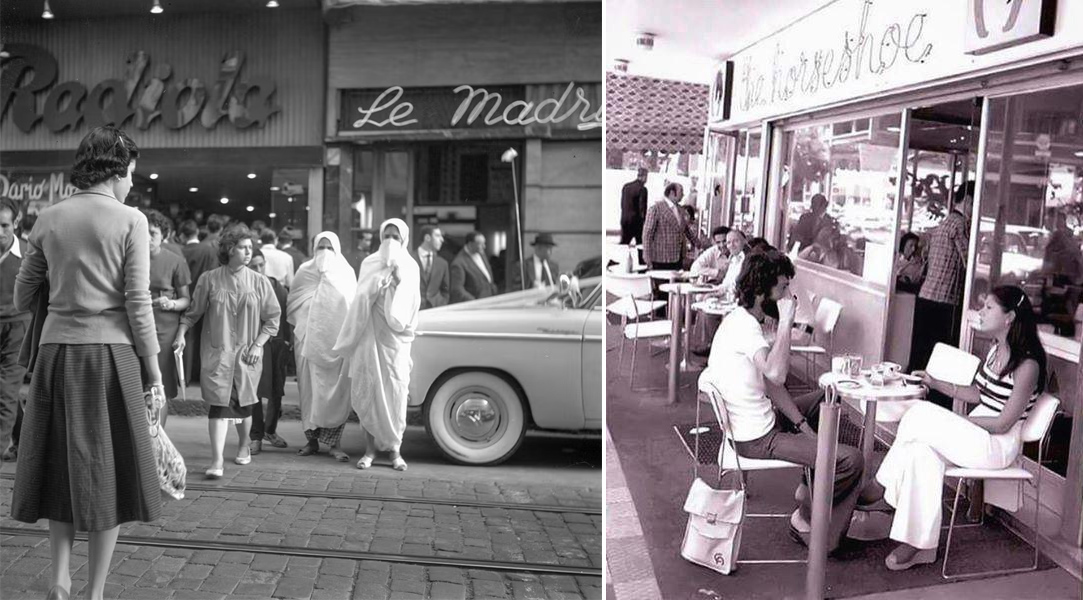
On the left, Bab-El-Oued, Algeria, April 1959, photographed by Pierre Bourdieu, from Fondation Pierre Bourdieu/Camera Austria, Graz. On the right, photograph of The Horseshoe Cafe on Hamra Street, Beirut, circa 1974.
Trauma reshapes historical memory. People do not necessarily long for the past because it was ideal, but because the present became unbearable. Writers associated with Romanticism often imagined the past as spiritually richer or more authentic than industrial modernity. Postcolonial criticism often interrogates nostalgia, whether for empire, lost cosmopolitanism, or precolonial identities. Such topics are especially relevant to Algeria, Lebanon, Egypt, and Syria. In the Arab context in particular, the idea of the “good old days” often becomes a way of negotiating rupture — colonialism, failed national projects, civil war, exile, authoritarianism, or rapid modernization. Two notable forms of nostalgia emerge: “restorative nostalgia,” which attempts to reconstruct an idealized national past while suppressing historical contradictions, and “reflective nostalgia,” a critical examination of why societies long for the past and what that longing conceals.
The term “nostalgia” was used in the 1688 dissertation of Swiss medical student Johannes Hofer to describe the phenomenon of Swiss soldiers abroad experiencing psychological turmoil that ultimately brought them to their deaths. Even further back, its roots lie in the Greek “nostos” (homecoming) and “algos” (pain or grief), a painful yearning for home. For centuries, the term has been used to refer to a debilitating condition, yet that perception has shifted dramatically in the modern era, to the point that nostalgia is often associated with favorable emotions.
In his article “Justifying Failure Through a Return to the ‘Beautiful Past’ in Algeria,” Said Khatibi calls for an interrogation of nostalgia and warns against surrendering to it, especially in Algeria.* Khatibi criticizes the phenomenon of nostalgia becoming an “overwhelming social behavior” in Algeria, to the extent that the past is treated like a failsafe to which people constantly retreat, perpetuating romanticized notions of a vanished, more glorious past. This attitude normalizes a state of complacency that not only justifies failure but lures the unsuspecting audience into idealizing a history advertised through falsehoods. As a result, one becomes preoccupied with the idea that the past will always be better than the present, trapped in what Khatibi describes as “a time overtaken by events.” Nostalgia immunizes the past to criticism and questioning. Those who remain fixated on the “good old days” fail to focus on the present reality or on preparations for the future, instead fixating on a stagnant nostalgia for bygone times.
Algeria possesses one of the strongest anti-colonial national narratives in the Arab world. Simultaneously, however, social media contributes to the vast romanticization of colonial architecture, French-era urbanism, cafés, boulevards, transportation systems, and images of orderly cities. This creates a profound contradiction: a society built on anti-colonial legitimacy yet emotionally drawn to colonial aesthetics. Because Algeria officially defines itself through anti-colonial struggle, nostalgia for colonial-era spaces becomes politically and psychologically charged.
Social media functions as a ‘nostalgia machine.’ Algerian nostalgia today is heavily mediated by digital platforms, with pages dedicated to the “Algeria of the beautiful era,” old television, vintage consumer products, football, colonial cities, and post-independence industries; these communities aestheticize history and transform memory into emotional consumption, overlooking or failing to acknowledge contradictions to the images they present. As Khatibi observes, these communities capture their audience through objects and items found in everyday life, harmless on the surface yet deceptively charged with symbolism. Photographs, games, tools, clothing, people, and lifestyles from a previous era, all presented through an aesthetic lens — viewers are urged to believe that these past iterations are far superior to the present. Upon a closer reading, however, Khatibi notes that the glorification of the past is an unknowing celebration of colonialism. The much-praised objects, streets, and architecture featured in posts belong to a period when administration was under colonial rule. And those praising them — inadvertent audiences nostalgic for colonialism.
Such communities appeal to nostalgia to present Algeria in a state of reconciliation and openness, overlooking the Eurocentric and colonial contexts at play. In the words of Khatibi, “It is as though the administrators of these pages secretly yearn for the return of French soldiers to the country. Although these pages sing of patriotism and love of [the homeland], they stir feelings of enthusiasm among their followers in ways that reconcile them with an era defined by occupation, without any sense of embarrassment.” He explains, “The question that immediately comes to mind is: why did those scenes disappear after independence? These pages encourage people to compare the past with the present, and this seems to be their underlying aim. Yet it is a blind comparison, because they speak of a time that was not truly ours, but one lived under colonial domination.”
These social media pages frame the 70s and 80s as a “beautiful era,” taking photographs of objects, tools, architecture, local businesses, and daily life while removing them from their contexts — those of violence, censorship, and authoritarian rule. The pages glorify the period while failing to acknowledge the many shortcomings and the unspoken other side to the photos. Khatibi writes, “These social media pages seek to convince people that Algeria was once a country that manufactured shoes, clothes, and all kinds of goods. Yet they conceal the fact that it was also importing wheat, food, medicine, and other basic necessities…hiding the reality that these national companies collapsed at the first test of competition with imported products.” He reveals the unfiltered truths behind several aspects of Algeria’s past that have been praised without critique within these communities: the local dinar, though indeed a strong currency, was highly susceptible to fluctuations due to Algeria’s volatile, rentier economy; the local companies and businesses celebrated in these online posts were in reality unable to keep the currency afloat, since they were incapable to exporting and competing with imports.
In Algeria, nostalgia often revolves around colonial urbanism and post-independence nationalism — a misplaced nostalgia for order and stability, economic dignity, and centralized authority. As Khatibi aptly puts it, these communities “exploit the condition of citizens living in the present — those who retreat into the past to escape the shocks of today.”
Mohamed Ftelina observes nostalgia in Algeria through a different lens in his essay, “Why Does Algeria’s Past Seem More Beautiful Than Its Present?”, published in Al-Quds Al-Arabi.** Like Khatibi, Ftelina points out the nostalgia evoked by old photographs from the ‘good old days’ — like black-and-white photographs from school albums of schoolchildren posed in front of their classrooms or school courtyards, bringing back memories of entire chapters of lives. He explains, “For them, the image serves as a window offering a wondrous glimpse into a world that, in retrospect, seems far more stable and orderly than the present day.” Yet Ftelina hesitates to accept the notion of a glorious, superior past at face value. He asks, "Was that past truly more beautiful?" Or does time, by its very nature, cast a beautiful glow over memories, making them appear more radiant than reality ever was?
According to Ftelina, the root of this nostalgia — what Algerians of that generation yearn for — is the discipline that characterized daily life. The issue is less concerned about politics, colonialism, or the economy, but more about a “value system that was more deeply embedded in society…when they compare the past with the present, they are not comparing two states or political systems, but rather contrasting behaviors, social relationships, and lifestyles,” he writes. He broaches the reservations some have about linking this nostalgia to the colonial era; in their view, “the issue concerns neither France nor the French school system, but rather…a state in which many feel that substance has given way to spectacle, personal connections outweigh competence, and the culture of sustained effort has lost ground to a mindset of quick profit and social opportunism,” writes Ftelina.
Algerians have harbored many frustrations with the way the state has been managed over the past few decades, from volatile policies and the dominance of centralism to weak local initiatives, the gap between official rhetoric and society’s actual needs, and the narrow circles of decision-making. Comparing the past to the present becomes almost a crutch for the discontent.
Following this perspective, nostalgics do not necessarily yearn for the colonial era itself, but rather for their own youth and for a “clearer-cut and more stable” society. Ftelina states, “The past, for all its hardships, always appears simpler than the present; its events have unfolded and concluded, whereas the present remains fraught with anxiety, uncertainty, and unanswered questions.” However, he emphasizes, “The past was not a perfect paradise, just as the present is not an unmitigated disaster. The past held its share of hardships, inequalities, and constraints, while the present offers achievements and opportunities that were unavailable to previous generations…The future is not forged by nostalgia; it is shaped by knowledge, action, and the imagination to envision what has not yet appeared in any album.”
In some ways, Ftelina’s approach shares a common thread with the article “Is Nostalgia a Past or Future-Oriented Experience? Affective, Behavioral, Social Cognitive, and Neuroscientific Evidence” by Taylor A. FioRito and Clay Routledge, published in “Frontiers of Psychology,” Vol. 11, 2020, which proposes that nostalgia is a future-oriented emotional experience that “involves reflecting on past experiences but it motivates affective states, behaviors, and goals that improve people’s future lives.”*** As others see it, however, the experience of nostalgia in the Middle East can be said to reveal the opposite. Though similar to the Algerian case, Lebanese interaction with nostalgia is a byproduct of vastly different experiences.
I spent my formative years in Beirut, leaving it toward the end of the good old days. I was fortunate to experience the "good old days" of Beirut before my departure from the city. This preceded the onset of a hellish period, the bloody civil war (1975-1990). My mental anguish about the Lebanese civil war, academically and intellectually, during my diaspora period lasted for a long time.
Having said this, I would like to add that many Lebanese align with most scholars' views on why they keep talking about the ‘good old days.’ It is not miraculous; they long for the time of "no war," wishing to forget ongoing wars and even the thought of them, which they are currently experiencing, though not among themselves but on the territories of their homeland.
The Lebanese yearn for cosmopolitanism and for times when they were more unified than in the current era, particularly during the civil war. They long for peace and harmony, though their nostalgia is tinged with painful, bittersweet memories. Having lived for more than half a century in the diaspora, I rarely encounter fellow Lebanese without hearing their reminiscences about the civil war and the loss of lives and property. Without the civil war, they would have many fond memories to look back on, even during the reconstruction period under Prime Minister Rafik Hariri.
Reminiscing about the ‘good old days’ is a widely invoked theme in Lebanon and its diaspora. Nostalgia is not simply homesickness or a sentimental memory, but a modern condition linked to exile, displacement, nationalism, modernity, and historical rupture. In Lebanon, this manifests as a nostalgia for coexistence, pluralism, urban sophistication, and lost social intimacy. Fiction and memoir employ nostalgia as a coping mechanism for change, loss, and identity crises. Lebanese nostalgia often centers on urban culture, liberal openness, artistic life, and myths of coexistence, perpetuated through images, songs, and memories of an aestheticized past.
There is a substantial and growing body of scholarship on nostalgia for prewar Beirut, especially around themes of cosmopolitanism, memory, urban loss, postwar reconstruction, civil war trauma, and the mythologized “old Beirut,” a memory of a ‘golden age’ untouched by civil war. Much of this literature intersects with memory studies, postcolonial studies, urban studies, and Lebanese cultural criticism. Nostalgia especially goes hand in hand with exile writing, which deals with the longing for lost homelands, as in the works of Mahmoud Darwish.
Many yearn for the return of Beirut’s image as the “Paris of the Middle East,” as a cosmopolitan Mediterranean city, multicultural crossroads, and site of openness and liberalism. The study “Oral Histories of Ras Beirut: Nostalgia, Memory, and the Construction of History” by Susanne Abou Ghaida and Alia al-Zougbi investigates Ras Beirut as a symbol of the lost cosmopolitan Beirut.**** The article explores how nostalgia varies across class, memory, and personal history, challenging the idea that nostalgia is uniform.
Nostalgia for the past is also carried through song. The works of Lebanese singer Fairuz, who often sang about the village, mountains, Beirut, childhood, and prewar coexistence, created a romanticized fondness for the past. She, for many, is the voice behind a collective longing. Zeina Tarraf, author of the essay “(Re)negotiating Belonging: Nostalgia and Popular Culture in Postwar Lebanon,” examines how Lebanese popular culture — especially works associated with Fairuz and the film “West Beirut” — constructs emotional attachment to a lost Lebanon.***** The article argues that nostalgia in Lebanon is not simply escapist, but a way of negotiating collective loss and fractured national identity.
Meanwhile, Fairuz’s late son, Lebanese composer and playwright Ziad Rahbani, represents a more ironic and politically critical engagement with Lebanese memory. Unlike idealized nostalgia, Rahbani’s work often exposes sectarian hypocrisy, bourgeois nostalgia, and the contradictions of prewar Lebanon. His music dismantles nostalgic myths through irony, satire, and political critique.
Nostalgia in Lebanon goes beyond a mere yearning for the past — it is a byproduct of ruin, survival, class, sectarian fragmentation, exile, and the impossibility of recovering a coherent national narrative. Beirut, perhaps more than any Arab city, has become a symbolic landscape of memory itself.
Both Algeria's and Lebanon’s cases of nostalgia involve the idealization of lost historical moments. In Algeria, nostalgia frequently centers on the state, modernization, colonial urbanism, and the mythology of national strength. In Lebanon, nostalgia is often urban, cultural, sonic, and emotional — tied to cafes, cinemas, Fairuz, Hamra Street, Ras Beirut, prewar nightlife, Mediterranean cosmopolitanism, and vanished social worlds. Yet both forms of nostalgia emerge from disappointment with the present, fractured historical memory, and uncertainty about the future.
*Said Khatibi’s essay, “Justifying Failure Through a Return to the ‘Beautiful Past’ in Algeria,” was published in Arabic in Al-Quds Al-Arabi.
**Mohamed Ftelina’s essay, “Why Does Algeria’s Past Seem More Beautiful Than Its Present?”, was published in Arabic in Al-Quds Al-Arabi.
***Taylor A. FioRito and Clay Routledge’s essay, “Is Nostalgia a Past or Future-Oriented Experience? Affective, Behavioral, Social Cognitive, and Neuroscientific Evidence,” was published in “Frontiers of Psychology,” Vol. 11, 2020.
****Susanne Abou Ghaida and Alia al-Zougbi’s essay, “Oral Histories of Ras Beirut: Nostalgia, Memory, and the Construction of History,” was published in the Journal of Mediterranean Studies, Vol. 15, No. 2, 2005.
*****Zeina Tarraf’s essay, “(Re)negotiating Belonging: Nostalgia and Popular Culture in Postwar Lebanon,” was published in the Journal of Intercultural Studies, Vol. 41, No. 3, 2020.
This article appeared in Inside Al Jadid Reports, No. 172, 2026.
Copyright © 2026 AL JADID MAGAZINE