
Leila Slimani on Living Between Languages as a Francophone Writer
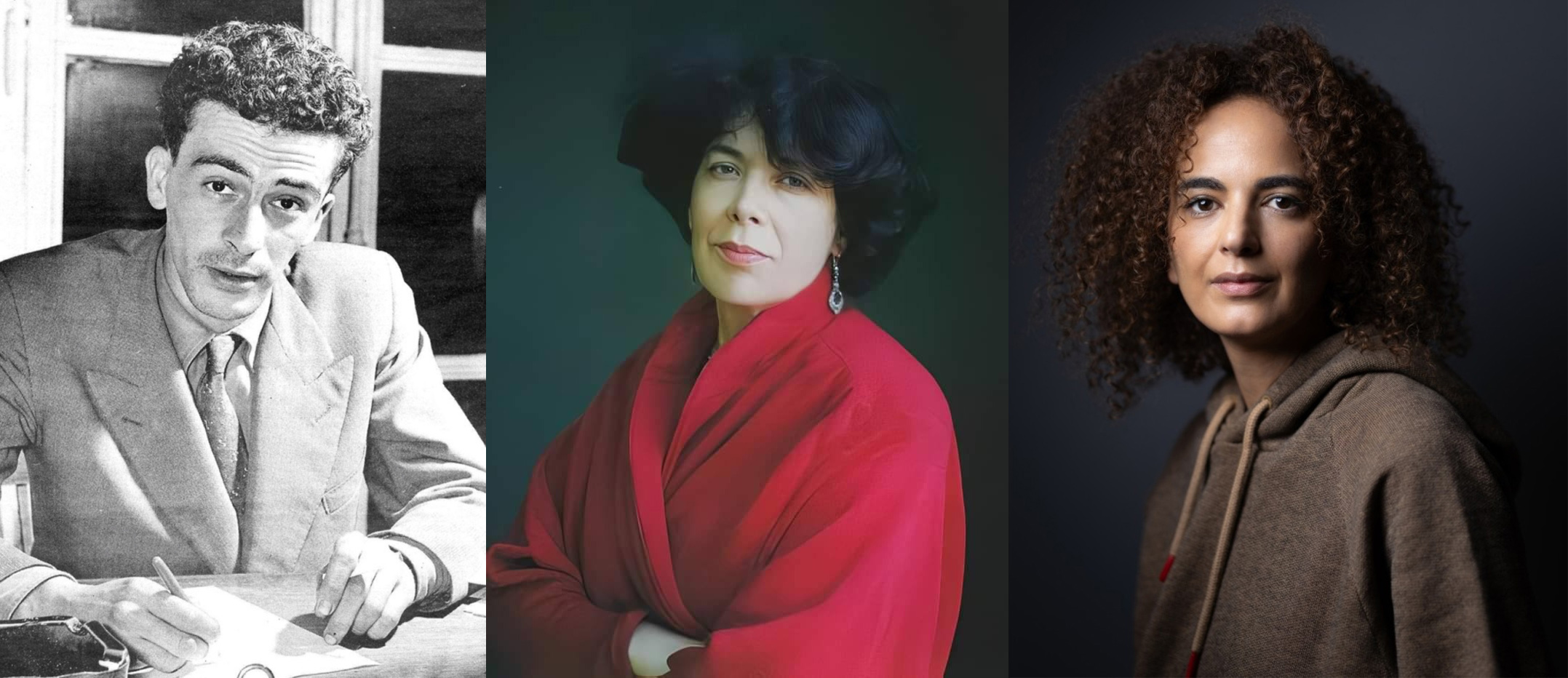
From left to right: Francophone writers Kateb Yacine, Assia Djebar, and Leila Slimani.
Two languages, two sets of expectations — a twofold rejection on both sides, and at the heart of it, a complex relationship with identity. The Francophone writer perpetually exists between two worlds, regardless of efforts to bridge the distance between them. French-Moroccan writer Leila Slimani’s recent book, “Assault on the Border” (Assaut contre la frontière, Gallimard, 2026) explores the predicament of Maghrebi identity fragmented by two languages — more specifically, the writer’s relationship to her language, Arabic, bound by a “yearning that can never be sated, for its object was not suddenly lost, but rather never fully formed in the first place,” writes Anisa Makhalda in Asharq al-Awsat.* “Assault on the Border” provides an intimate look into the writer’s personal life and reservations, especially surrounding Slimani’s “profound loss of Arabic” as a Francophone writer who has lost touch with what she considers her “paternal language.”
In the words of Makhalda, “Thus, within the pages of this book, mourning a person and mourning a language intertwine to form a rare confessional tapestry — one that endows the text with a personal depth extending far beyond mere cultural reflection.” The breaching of borders referenced in the title indicates “an assault on mental boundaries before it is an assault on geographical ones,” states Antoine Jockey in Al Majalla, who adds that the work, which blends personal experience with philosophical reflection, weaves “the intimate with the political, and the quotidian with the universal — thereby endowing her text with a literary dimension that transcends the confines of traditional intellectual inquiry.”**
Leila Slimani was born in Rabat into a French-speaking Moroccan family. Though surrounded by the linguistic diversity of Morocco while growing up and frequently hearing Moroccan Darija, Spanish, German, and the Amazigh dialect, she explains in her book that Classical Arabic never took root as a means of expression for her as a child. In adulthood, its absence left a gaping hole, one filled with shame.
Morocco’s primary spoken languages are Darija (Moroccan Arabic) and Amazigh, with Modern Standard Arabic and French used in government, business, and educational settings. As Makhalda explains, French is not “merely an incidental colonial legacy,” but functioned for many years as the language of social mobility and the urban elite. Arabic, she writes, “was confined to the realms of sentiment, religion, and symbolic identity.”
According to Jockey, Slimani’s experience living “in-between” languages and identities as a Francophone writer is a “daily existential experience in which a sense of proximity intertwines with a feeling of exile. She lives within two languages, two memories, and two histories, without allowing any one of them to swallow the other.”
Slimani describes her fragmented relationship with Arabic as “akin to living with a phantom limb — an amputated member whose presence is felt despite its absence.” These struggles are frequently touched upon in works by Francophone writers. The late Lebanese poet and painter Etel Adnan once remarked that “having found herself standing at the threshold of that language, she transformed it into a myth and a lost paradise,” as cited by Makhalda.
The book draws from intimate personal experiences and fears. Slimani expresses shame in her grasp of the Arabic language, speaking in a manner resembling a child speaking before adults, "embarrassed by their own inadequacy and fearful of ridicule,” explains Makhalda, who notes that this shame habituates the works of numerous Maghrebi writers who found literary renown in the French language “while Arabic remained waiting on the threshold,” a shame that is deeply ingrained within these writers like a “secret inheritance.” Makhalda lists examples such as Kateb Yacine, who viewed French as "spoils of war" reclaimed from the colonizer; Assia Djebar, who “spent her life navigating the fractured space between writing in French, thinking in Arabic, and dreaming in Amazigh”; and Albert Memmi, whose work “The Colonizer and the Colonized” analyzed how “the colonizer’s language becomes a vehicle for the social ascent of the colonized elite, ultimately leading to what he termed "self-contempt."’
Makhalda praises the way Slimani engages with the topic in a class consciousness “far more explicit than that displayed by her predecessors.” In her words, “The distinction between Slimani and the writers of the first generation lies in the fact that the pioneers wrote in French as if it were an act of resistance — or an inescapable historical imperative — whereas she [Slimani] writes about it, and about its limitations.”
Slimani does not hesitate to describe herself as a “cliché of the Francophone bourgeoisie that does not speak its own language." As Makhalda explains, within this statement lies “an indictment of a social class that profited from linguistic division and inherited its privileges from it; and an indictment of an educational system that, over generations, has produced Moroccan elites who speak the language of the 'Other' fluently, yet stumble over their own mother tongue.”
Slimani rejects discourses surrounding both Arabic and French — the conservative Moroccan discourse that “views the monolingualism of Arabic as a shield against cultural imperialism” and the French discourse that upholds the French language as a “pure” and incapable of transformation, states Makhalda. The writer fiercely defends linguistic multiplicity, aligning herself with thinkers who similarly endorse linguistic pluralism as a source of enrichment rather than a threat. As cited by Jockey, Slimani champions the concept of a ‘“Happy Babel’...wherein linguistic multiplicity is not a curse, but rather a prerequisite for dialogue and freedom. In a broader sense, she views translation as an “act of crossing between worlds, serving as an organic extension of the act of writing itself.”
In Makhalda’s words, for Slimani, language is “not merely a matter of cultural representation”; it is not an arena for testing one’s loyalty, but a space for the formation of the self. “Slimani rejects simplistic notions of linguistic identity, deconstructing the idea that language definitively determines belonging, and demonstrates how one can exist amidst multiple languages without belonging wholly to any single one,” explains Jockey. “Assault on the Border” contends with the question: Can a writer remain true to themselves while writing within a language they do not inhabit in its entirety? The text does not present any clear-cut yes or no, but implies that the answer lies in the “continuous act of writing, perpetually in search of a form of truthfulness that transcends such binary constraints,” writes Makhalda. Slimani describes one of her recurring nightmare scenarios, a situation in which, invalidated by using French, she is unable to defend herself in Arabic. As Makhalda analyzes, “This nightmare describes not merely a linguistic incapacity, but rather diagnoses an entire identity crisis: an innocence that can be proven only through a language that has been lost. Perhaps it is this other statement by the author — in which she asserts: “Writing, perhaps, means coming to terms with this defeat — or, at the very least, searching for my own language: a language that submits to no classification.”
Slimani discusses her persistent sense that she is required to justify her relationship with the French language and expresses the fear felt by some of speaking Arabic in public spaces in France since the 2015 attacks, a time when the use of Arabic became a sign of suspicion. Language and identity have been reshaped into instruments of categorization and exclusion. Her book demonstrates that language, especially under politically tense conditions, can become an object of suspicion and acquire violent connotations that transcend its literal meanings. Jockey writes, “Arabic, for instance, is no longer perceived within the Western imagination merely as a language of poetry and everyday life; rather, in the collective consciousness, it has become inextricably linked with violence and terrorism.”
Similarly, identity has been molded into a means of categorization that Slimani considers a “form of subtle cultural racism,” as Jockey notes. She criticizes the insistence of Western cultural and media institutions on categorizing writers based on their origins, begrudging the fact that a writer cannot exist simply as a “writer” but must also carry other labels — “Maghrebi,” “Arab,” or “African,” expected to write exclusively about their identity, homeland, and their colonial trauma, according to Jockey. Recognition is conditional upon the writer’s origins, a “kind of symbolic confinement that reduces the literary experience to a mere ethnic background.”
Slimani aligns herself with the broad literary tradition that champions the writer’s right to exist as an individual rather than as a spokesperson for a collective. She believes true literature is “not crafted within the confines of pre-packaged identity molds, but rather emerges from a realm of greater freedom and complexity — a space where the human being takes precedence over any affiliation,” Jockey states.
Jockey praises “Assault on the Border” as a “humanistic plea against the boundaries that divide people — whether geographical, cultural, linguistic, or pertaining to identity.” Slimani’s text is a powerfully personal discussion of writing at the borders of language and identity, the effects of categorization, and expectations as a writer.
*Anisa Makhalda’s essay, “Leila Slimani and a Question That Always Haunts Her: Why Don't I Speak Arabic? The Goncourt Prize-Winning Novelist Reveals a Personal Shame That Condemns an Entire Social Structure,” was published in Arabic in Asharq al-Awsat.
**Antoine Jockey’s essay, “Leila Slimani Shakes the Walls of Identity with the Freedom of Literature,” was published in Arabic in Al Majalla.
This article appeared in Inside Al Jadid Reports, No. 171, 2026.
Copyright © 2026 AL JADID MAGAZINE