
How Digital Images Sustain Hope Among Lebanon’s Displaced
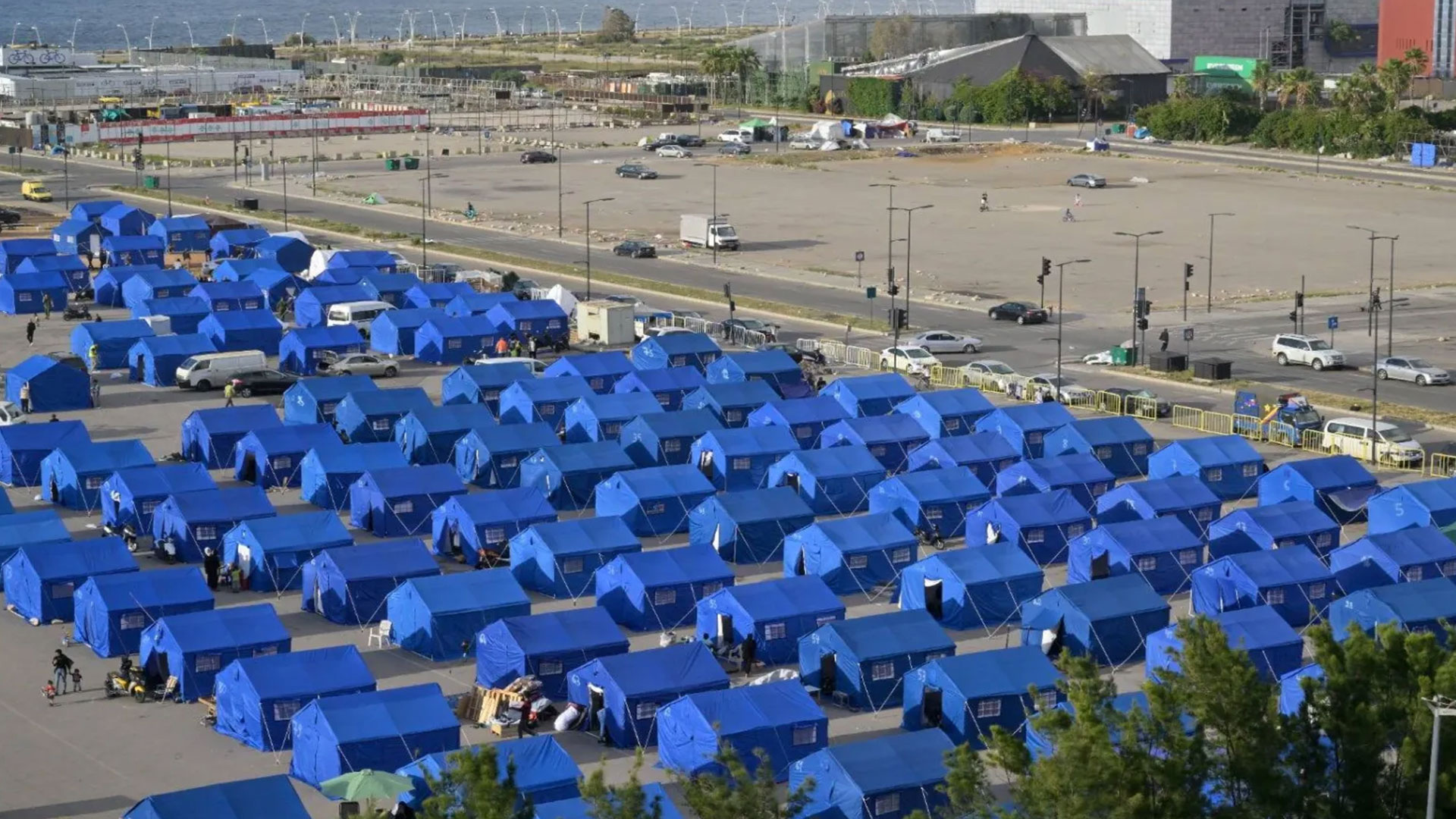
A camp housing displaced people from southern Lebanon and Beirut’s southern suburbs on the Lebanese capital’s waterfront. Photograph credit Asharq Al-Awsat.
Social media has become an invaluable resource to many facing displacement throughout Lebanon’s ongoing conflict. A senior UN official reported to Reuters that approximately 100,000 people are registered in shelters, but the number of displaced residents is expected to be higher, as many families are staying with relatives, in public areas, or on the streets. The estimated number of people displaced from Southern Lebanon, according to statistics reported by the United Nations High Commissioner for Refugees (UNHCR) on March 31, 2026, is over 1 million, with a large percentage unable to access food, shelter, or basic necessities. For many, this is not the first time they have had to flee, but their second or even third.
The importance of social media for those facing vulnerability, uncertainty, and unabated anxiety cannot be understated. Advanced technology, widespread use, and the ability to connect with others instantaneously have elevated platforms like Facebook, Instagram, and TikTok — used for entertainment under normal circumstances — into vital networks for news and information. Recent reports have shown that social media is used as a resource by the displaced, for example, to search for shelter. But as many are aware, reliance on social media for information can be a gamble between hope and despair.
Lebanese journalist Nagham Rabih’s essay, “Searching for Our Homes in Photographers’ Videos,” encapsulates the hope and desperation of those who fled Southern Lebanon and the Suburbs as they use whatever resources they have to learn the fate of their homes.* “Residents live in a state of daily suspense, suspended between two possibilities: the survival of their home or its destruction,” she writes.
A simple photo, or perhaps a short video clip — in evacuated areas or those affected by the conflict between Israel and Hezbollah, this uploaded data does more than capture abandoned neighborhoods, but is the key to the hopes of thousands anxiously awaiting news about their homes. Photographs and videos captured by photojournalists or those passing through the empty streets have become a “daily lifeline” for the thousands who were forced to leave. In the words of Rabih, “Social media platforms have gradually transformed into living maps of people’s homes. Social media is no longer merely a platform for following the news; it has become a space where people remotely survey their streets, scouting posted clips for a familiar angle — a shop they used to pass by, a balcony resembling their own, or a building entrance that encapsulates a single, pressing question: “Is everything still in its place?”’
Images and footage posted on social media allow people a chance to see, with their own eyes (albeit through a screen), the state of their homes during a precarious time when it is far too dangerous to return in person due to the threats targeting civilian and residential zones. This is not the first time social media has been used in this way; in 2024, when many were forced to flee the Israeli air strikes targeting the Beirut suburb of Dahieh, a BBC report featured two TikTokers, Ali Baydoun and Adam Kassak, who used their platforms to document the damage for those who left.**
Those relying on these clips understand there are no guarantees whether their home has been spared or destroyed. At the same time, they cannot help but continue searching, grasping at any chance to find answers and ease their anxieties, which renew with each passing day. Many Lebanese have taken to social media daily, a habit of scouring through videos which Rabih describes as an “integral part of the experience of displacement itself.” What appears on the surface as simple photographs or videos of an empty neighborhood or its ruins carries enormous significance for those who have no other way to find news about their homes. The virtual search for any trace of a familiar street, wall, or building becomes a source of equal parts anxiety and reassurance.
Fascinatingly, videos and photographs on social media have become like information networks that help the displaced, thanks to widespread community efforts by neighbors and friends who try to keep each other updated. In these uncertain times of anxiously waiting, hope lies at one’s fingertips, on the other side of a glass screen, at the simple press of “Play” on a video clip.
*Nagham Rabih’s essay, “Searching for Our Homes in Photographers’ Videos,” was published in Arabic in Al Modon.
**”Beirut: Meet the TikTokers Filming Destroyed Homes” was published by the BBC.
This article appeared in Inside Al Jadid Reports, No. 169, 2026.
Copyright © 2026 AL JADID MAGAZINE