
Karantina and the Cycles of Exile in Beirut
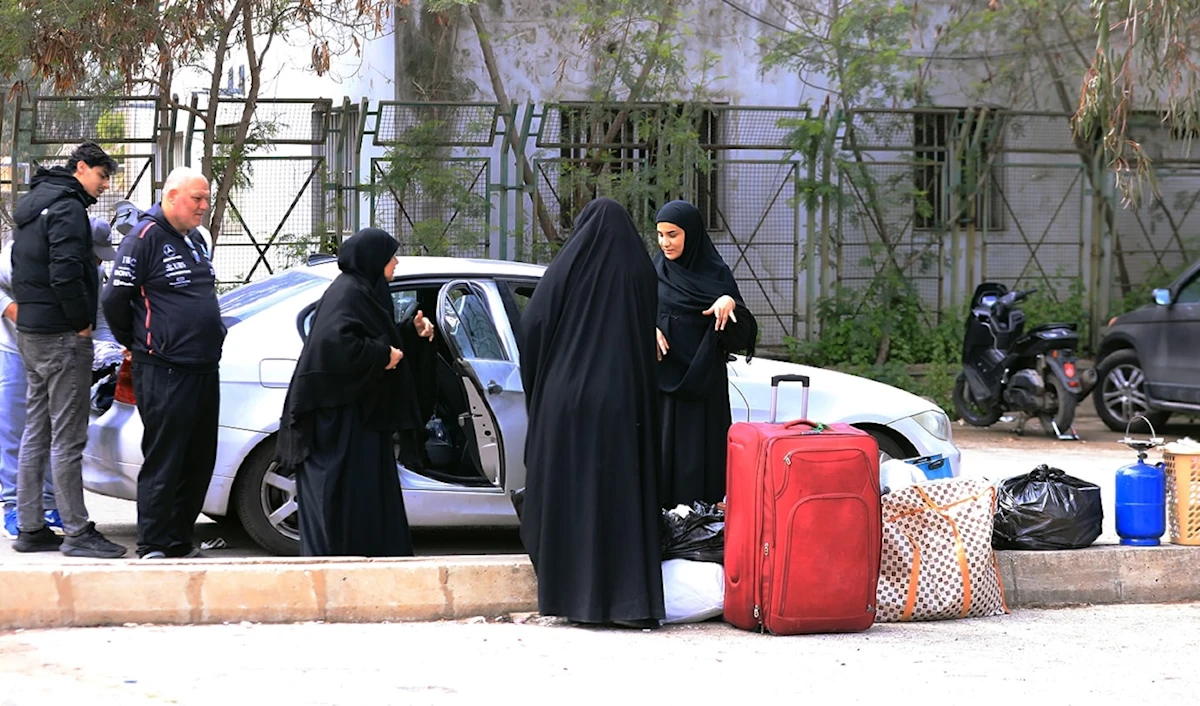
Lebanese displaced by the ongoing conflict, photographed by Haitham al-Mousawi.
The current debate in Lebanon — following successive rounds of war between Hezbollah and Israel — centers on one of its most profound human costs: mass displacement. More than one million Lebanese have been internally displaced in a country already hosting approximately 1.5 million Syrians displaced by the protracted Syrian civil war. Even as Lebanon briefly exhaled after the collapse of the Assad regime on December 8, 2024, renewed war further intensified demographic pressures, particularly with the displacement of populations from the south of the country and other areas targeted by Israeli attacks.
This acute housing crisis has generated economic, social, and sectarian tensions, raising concerns about the fragility of communal coexistence. These tensions became especially visible in debates over sheltering predominantly Shiite displaced communities in largely Christian neighborhoods of East Beirut. The emotional impact of these reactions recalls the atmosphere of the 1970s civil war — an irony made sharper by the reemergence of the district of Karantina as a focal point of contention, a neighborhood historically marked by one of the most notorious massacres of that war in 1976.
Karantina, an industrial district in northeastern Beirut, has long occupied a marginal position within the city’s spatial and social order. The name "Karantina" derives from the district’s historical origins: it was the site of a quarantine station built in the early 19th century, designed to prevent the spread of epidemics and diseases within the city. Historically populated by impoverished and displaced communities, it has often been framed as both an economic burden and a moral or spatial contaminant. Such representations — articulated through a language of “filth,” “wretchedness,” and “illegality” — were not merely descriptive but constitutive, helping to produce the conditions under which its residents could later be targeted.
Lebanon’s contemporary challenges in sheltering the displaced cannot be understood apart from these deeper historical dynamics. Sectarian interests, rooted in long-standing political and social divisions, continue to shape responses to displacement. These divisions extend beyond binary Christian-Muslim tensions to include a broader spectrum of ethnic and cultural variations, encompassing Armenians, Kurds, and various Arab communities. What emerges is not simply a reluctance to coexist, but a persistent inability to imagine shared urban belonging.
At the heart of this crisis lies a paradox: Lebanon’s urban identity is itself the product of successive waves of displacement. Beirut, in particular, has been shaped by the arrival of refugees and migrants from the end of World War I, including Armenians, Kurds, and Palestinians after 1948, to rural Lebanese populations seeking economic survival. Karantina, also known as the Slaughterhouse District. Its population, often labeled as “outsiders,” reveals the fundamentally constructed nature of such designations. In reality, the category of the “native” urban inhabitant is continually undermined by the very processes that sustain the city. By the 1960s, Karantina had evolved into a working-class neighborhood with an active labor force that supplied inexpensive labor to local factories and businesses.
Karantina underwent major changes, including the 1976 Karantina massacre. The Karantina district witnessed the first massacre in the history of the Lebanese Civil War, where hundreds of residents were killed, and the vast majority of the population was displaced. Subsequently, the area became a major stronghold for Christian political parties, which repurposed the district to serve their military objectives. This period saw a systematic demolition of numerous residential buildings, which were subsequently replaced by military barracks and training bases.
With the end of the Civil War and the return of residents to the neighborhood, policies of marginalization persisted, and Lebanese military forces continued to occupy the headquarters originally established by wartime militias. Thirty years later, numerous plots of land owned by local residents or the Municipality of Beirut continue to be used as military barracks — a situation that effectively deprives the people of Karantina of both their homes and their livelihoods.
The Karantina neighborhood still bears the traces of a violent civil war past — bullet-scarred walls, vacant lots, and fragmented urban forms — while the absence of its original residents remains strikingly absent. Memory persists not as a coherent narrative but as a set of disjointed signs. Even attempts at memorialization, such as the much-discussed “coffin-shaped” nightclub, point to a troubling commodification of violence, transforming history into an aesthetic gesture. Karantina thus exists as a residual space of memory: neither fully integrated into the city nor entirely erased.
The 1976 Karantina massacre remains a pivotal moment in this history. It marked a decisive stage in the production of sectarian geography in Lebanon, where violence was used to redraw spatial and demographic boundaries. The neighborhood’s population — largely composed of refugees and economically marginalized groups — had long been stigmatized in political and social discourse. This prior discursive violence rendered them vulnerable to physical elimination. The massacre, therefore, must be understood not as an isolated incident but as the culmination of intersecting forces: rapid urbanization, forced migration, class inequality, and sectarian mobilization.
Displacement, in this context, is not an exception but a foundational condition of Lebanese history. Lebanon is not merely shaped by displacement; it actively produces it while selectively narrating its causes and consequences. Karantina illustrates this process with particular clarity. Over time, the neighborhood has moved through successive stages: from quarantine zone to industrial periphery, from refugee settlement to impoverished enclave, from site of massacre to marginalized urban residue. Each stage does not rupture the previous one but transforms and rearticulates it.
Central to this transformation is the role of narrative. The stigmatization of Karantina’s inhabitants — through terms such as “illegal housing,” “urban blight,” “enemy enclave,” and “foreign presence” — constitutes a form of symbolic violence that precedes and legitimizes material violence. These labels are not neutral descriptors; they are political means that shape perceptions of belonging and exclusion. In this sense, the narration of displacement is itself a political act, one that determines who is entitled to remain and who can be removed.
This dynamic can also be understood through a shift from biopolitics to necropolitics. Karantina’s origins as a quarantine site reflect an early form of managing life — controlling disease and regulating entry. By 1976, this logic had evolved into a logic of managing death, in which entire populations could be deemed expendable. The “infected body” of the past becomes, in this transformation, the “sectarian other” of the civil war.
The history of Karantina also reveals a recursive pattern of displacement. Each wave lays the groundwork for the next: Armenian refugees in the early twentieth century; Palestinian displacement after 1948; internal Lebanese displacement during the civil war; and, more recently, forms of secondary displacement driven by postwar urban development. These processes are not discrete but interconnected, forming a continuous chain in which displacement reproduces itself.
Before the civil war, residents of Karantina were already subjected to forms of discursive exclusion, portrayed as sources of disorder and pollution. Parliamentary debates and public discourse in the 1960s framed the urban poor and displaced as burdens on the state, legitimizing calls for property reclamation and urban planning measures that often masked exclusionary aims. When violence erupted in 1976, it followed a well-established narrative trajectory.
The attack on Karantina resulted in widespread killing and forced displacement. Civilians who survived were expelled to peripheral areas such as Jnah and Ouzai — spaces that themselves embodied the contradictions of displacement, as former leisure zones were transformed into sites of refuge. Here, too, the spatial inversion reflects the broader violence of forced movement.
An equal calamity to the 1976 massacre in Karantina was the Beirut explosion in August 2020. Experts claim that the explosion is the largest non-nuclear incident since Hiroshima. In the critical hours after the explosion, no ambulance or rescue team was dispatched to Karantina. This forced residents to tend to victims themselves, transporting the injured in their cars or on foot. Just as they had previously been left to endure their misfortunes in isolation, they now faced the most devastating catastrophe in their history entirely alone. Unlike their neighbors in the well-to-do Mar Mikhael and Gemmayzeh — predominantly middle- and upper-class areas where residents could evacuate to summer homes in the mountains or stay with relatives — the low-income population of Karantina had nowhere to turn. Many spent the first night after the explosion amid shattered glass in homes without doors or windows, and some remain on the streets to this day.
Today, Karantina remains marked by this history. Its landscape — defined by ruins, absences, and partial redevelopment — testifies to the enduring effect of violence. State interventions have often overwritten rather than addressed these histories, leaving memory dislocated and fragmented.
In conclusion, Karantina reveals that displacement in Lebanon is not a singular event but an ongoing process shaped by discourse, policy, and force. It is a mechanism through which space is reordered, populations are managed, and belonging is contested. What Karantina ultimately exposes is not only the persistence of violence, but the continuity of a system that produces displacement while rendering its victims marginal, invisible, or expendable.
This article appeared in Inside Al Jadid Reports, No. 168, 2026.
Copyright © 2026 AL JADID MAGAZINE