
Living Across Two Geographies of Fear and Freedom
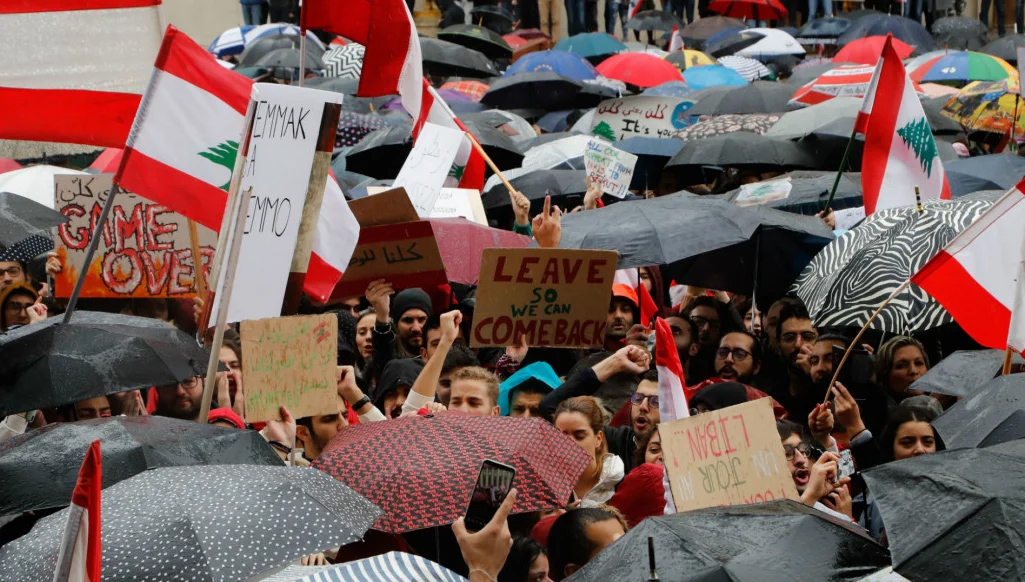
Demonstrations in Paris, France in 2019, paralleling the popular uprising in Lebanon, October 2019. Photograph credit AFP.
“I offer these lines to the world on behalf of all those who have left a homeland tossed about by crises and conflicts,” writes Samah Halawani in the opening lines of her essay, “I Walk ‘Here,’ Wrapped in a Screen That Relays the Events of ‘There,’” published in Al Modon.* Halawani’s words speak to the complex experiences of those in exile, divided between their homeland and their new dwellings — an existential struggle between attachment and detachment. This dual existence, she states, is a difficulty that anyone who has left their homelands behind may also experience, whether they arrived in their new countries by choice or by force.
Leaving one’s homeland is a decision that continues to follow you, even when that decision was made out of survival. As in Halawani’s experience, many remain attached to their homelands because they are the places where they grew up, came of age, and dreamed. Yet this same love for the homeland becomes a double-edged sword during times of crisis and conflict. For those long accustomed to suffering, the constant struggle to simply survive weighs down the soul. Halawani describes her native Lebanon as “a homeland where a daily groan rises, gnawing at the bones, making me chase the smallest movements and sounds around me in a state of defensive alertness, bracing for any violation, quarrel, or explosion that might erupt at any moment. A homeland where exhaustion keeps mounting.”
In leaving her homeland in pursuit of a safer, more peaceful life, Halawani also leaves behind those who choose to remain. In the safety of “here” — the country in which she now resides — she bears an exhaustion stemming from her yearning for the homeland (“there”) and the connections with her fellow Lebanese, forged out of their shared endurance of pain. “This exhaustion was born when I saw everyone clinging to a fragment of the dignity of survival,” she writes. “It intensifies when I cannot join them — cannot fuse with them in embraces of connection and evening gatherings.” This deep attachment to her homeland and people is tied to a sense of guilt over her inability to comfort those still at home or to physically connect with them. At the same time, she understands the reason many, like her, left the country: “We did not realize then that we had placed all our confusions and individual dreams into the arena of struggle — that single remaining space for connection — and so we scattered.”
After enduring pain and suffering countless times, many are left with limited options — becoming fatigued, some stop trying. Others continue to persist, remaining in their country to confront the same challenges as ever. Or, like Halawani, they leave.
In her new residence, Halawani struggles between phases of inspiration and stagnancy, a state of inertia that forces her to retreat into silence and isolation, as if arrested in time. She describes, “Here, I find peace of mind. I am no longer compelled to remain on constant alert to protect my survival. I can present myself with pride, carrying the experiences I lived through ‘there.’ I enjoy spaces of expression and connection — but I remain tied to the remaining space, ‘there.”’ She states, “I am confronted with stillness.” This ‘stillness’ may initially come across as a quiet relief, a sign of her escape from the volatility, fear, and dangers that constantly threatened her in the homeland. However, rather than suggesting peacefulness, the stillness that follows Halawani is more akin to a gaping hole in her life; a void. Readers feel profoundly that this “stillness” that incapacitates her, preventing her from fully healing and moving forward with her life, is the feeling of absence — a sense of longing and guilt for the life and people she left behind. Halawani suggests, ironically, that while she had left her home to reclaim her vitality that was slowly being suffocated, she lost a part of herself in exile. She lives her days in an existential crisis that has driven her into a corner of solitude and silence. Conscious of this, she grasps for a fragment of the willpower that had persuaded her to leave her country behind in the first place.
“And I found, in the stillness that pursues me, a refuge for healing, though I do not know whether it is false or real,” she writes. Yet she is unable to seize this ‘stillness’ as a chance to heal, immobilized by her attachment to the homeland. She freezes and withdraws “not for any clear reason, but out of fear of an approaching cry, of a longing for an embrace, for a stolen laugh; fear of a loss shadowed by death, a loss I am not prepared for...So I grow ever more still. I have refused that pain and that fear many times before. I have not yet healed from the separation from those who departed. I have not wept them, nor reconciled myself to their absence.”
In Halawani’s words, "Here, I feel my body free, unbound; my mind unrestrained by fear, the two moving in harmony. But my breath — my inner being — remains suspended there.” Her continued references to “here” and “there,” avoiding the names of any single country, convey the detachment she experiences regarding her homeland. While its non-specificity makes her experience feel universal, it equally expresses the loneliness and confusion of life in exile — a fluctuating, undefined state of existence between ‘here’ and ‘there.’ She confirms, “Yes, there is fatigue and pain even here: for I live in two worlds, and I cannot fully inhabit either of them.” Though she explains that she is no stranger to leaving and returning to the homeland, she expresses, “No one told me that repeating it would mean confronting two worlds: a condition of splitting, of shedding, of a suffocating attachment of feeling.”
Halawani continues to search for that lost spark of vitality within herself, but trapped within the dilemma of detachment and attachment to the homeland, she remains constantly occupied by fear for those who remain — a fear that immobilizes her from being able to heal and move forward.
*Samah Halawani’s essay, “I Walk ‘Here,’ Wrapped in a Screen That Relays the Events of ‘There,’” was published in Arabic in Al Modon.
This article appeared in Inside Al Jadid Reports, No. 163, 2026.
Copyright © 2026 AL JADID MAGAZINE