
The Persistence of a Human Moment
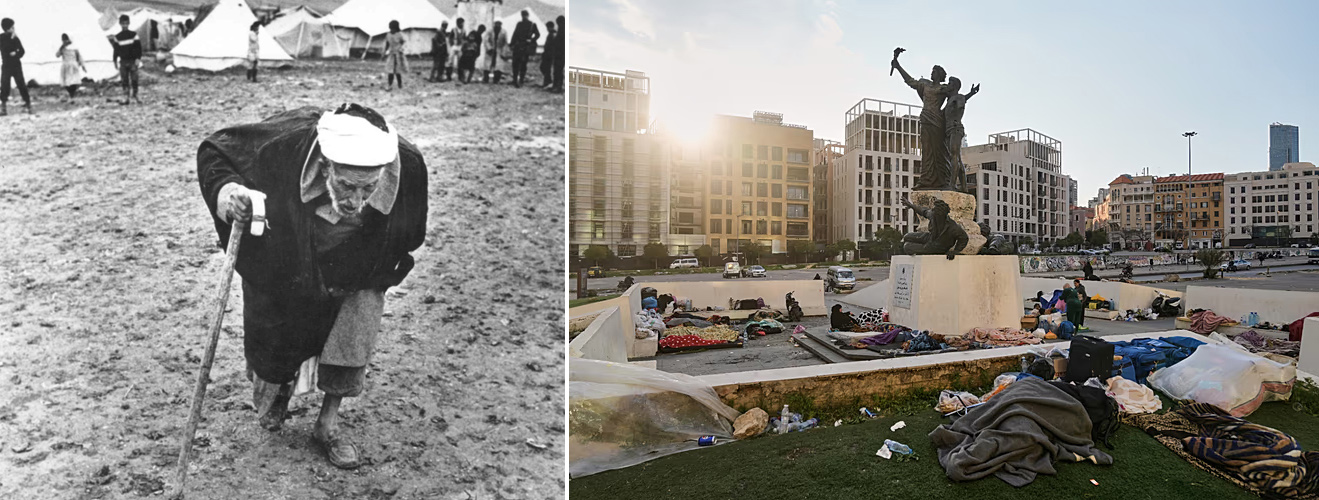
On the left, a photograph of a Palestinian refugee, 1948. Photograph credit UNRWA. On the right, displaced Lebanese sleeping in Martyr’s Square on 7 March 2026, photographed by Bilal Hussein/AP.
For generations, in Lebanon and across the Arab world — and even in the diaspora — the term Nakba has carried a weight that exceeds its literal meaning of “catastrophe.” It is not merely a historical reference but a formative concept, one through which collective memory, political consciousness, and emotional identification have been shaped. I first encountered the term in Lebanon during my formative years, and later engaged with it more critically in the United States during my undergraduate and graduate studies in Middle Eastern politics.
The word itself emerged in 1948, in the aftermath of Israel’s establishment and the mass displacement of Palestinians into neighboring Arab states — Lebanon, Syria, and Jordan among them. Lebanon alone came to host multiple refugee camps, embedding the Palestinian experience into its own social and political landscape. Over time, the Nakba became not only a Palestinian tragedy, but also a shared point of reference across the Arab world.
But what, if anything, connects that historical moment to the present? What do Palestinians in 1948 and Lebanese civilians today truly share?
The Palestinian who left his village in 1948 and the Lebanese who leaves his home today do not share the same politics, nor do they belong to the same historical moment. Yet they meet — quietly, almost imperceptibly — in a single human instant: the moment of standing at the threshold of the house.
This image has endured. When the 50th anniversary of the Palestinian displacement was commemorated in 1998, I reflected on it in an op-ed titled “A Generation of Catastrophe: The Palestinian Problem in Half a Century,” published in The Philadelphia Inquirer and other publications. The Nakba was not simply a historical episode; it had already become a lasting condition — one that shaped identity, memory, and political imagination.
In the decades since, the term has been invoked repeatedly in Arab political discourse, often as an analogy or shorthand for catastrophe. In Lebanon, as elsewhere, reference to Palestine carries both emotional and ideological resonance. Support for the Palestinian cause has, in many ways, become part of a broader political culture — sometimes deeply felt, sometimes publicly performed, even by those whose private views may diverge. The language of the Nakba persists not only because of history, but because it continues to offer a vocabulary for loss.
It is in this context that Marwan Harb’s recent essay in Al Modon, “Our New Nakba… At the Threshold,” is particularly striking.* Harb does not collapse the Lebanese experience into that of the Palestinians, nor does he ignore their differences. Instead, he identifies a shared human moment: the instant of departure, when one stands at the threshold of home, suspended between what is being left behind and what remains unknown.
This moment, as Harb suggests, transcends historical specificity. Across time and place, scenes of displacement recur with unsettling familiarity: villages emptied, families departing under the assumption that their absence will be temporary, houses left behind as if waiting for their return. In 1948, Palestinians carried keys with them — not merely as objects, but as symbols of an anticipated return. Yet time, in this region, has rarely honored such promises.
Today, similar scenes unfold in Lebanon. Displacement — both internal and external — has once again become part of lived reality. And yet, many Lebanese cling to the belief that their departure is temporary, shaped in part by the country’s history of repeated upheavals from the 1970s through 2006. That expectation, however, rests on fragile ground.
Cultural production — books, films, archival images — has long documented the emotional texture of displacement, particularly in the Palestinian case. These works reveal not only the scale of loss but its intimacy: the attachment to home, the memory of daily life, the haunting possibility of never returning. The threshold, in these representations, becomes a recurring motif — a point at which the ordinary transforms into the irrevocable.
It is precisely in such moments of personal rupture that ideology recedes. Grand narratives lose their force. As Harb observes, history is not only made in battles or inscribed in political declarations; it is also forged in silence — in the act of leaving, in the uncertainty of the road ahead. What remains is not rhetoric but the dense, often inarticulate weight of loss.
This insight is central to understanding the enduring significance of the Nakba. For Palestinians, it has come to signify more than displacement; it has become constitutive of identity itself. One is defined not only by what one is, but by what one has lost. In Lebanon, it may be too early to fully grasp the long-term implications of current displacements. The historical trajectories differ, and the comparison must be handled cautiously. Yet the experiential parallel — the sense of uprooting, of becoming estranged from a place that once felt inseparable from one’s life — is unmistakable.
To leave one’s home is to lose more than shelter. It is to lose a form of continuity — the quiet assumption that tomorrow will resemble yesterday. In its place emerges uncertainty, and with it, the unsettling awareness that return is never guaranteed.
Displacement, in this sense, cannot be understood solely as a consequence of war. It is also shaped by political choices and sustained by the discourses that justify them. Wars are not only fought on battlefields; they are also narrated to gain legitimacy. These narratives often privilege abstractions — territory, victory, dignity — over the lived realities of those who bear their costs. Land becomes a site of conflict before it is recognized as a home.
Herein lies a profound and troubling paradox: societies may become victims of the very narratives that claim to defend them. The language of resistance and honor can coexist with, and even obscure, the reality of empty homes and displaced lives.
In Lebanon today, this paradox is starkly visible. Grand narratives of struggle continue to circulate, even as displacement reshapes the social landscape. The distance between discourse and lived experience widens, measured in the silence of abandoned houses and the uncertainty of those who have left them behind.
The persistence of this moment, from Palestine in 1948 to Lebanon today, does not lie in identical histories, but in a shared human condition. It is the condition of standing at the edge of one’s life as it was known, confronted with the possibility that return may remain forever out of reach.
And so, the threshold endures — not only as a physical space, but as a symbol of rupture, memory, and uncertain futures. It reminds us that history is not only written in its grand events, but lived in its quietest moments.
There, at the threshold, the meaning of loss becomes clear. And it is there, too, that the future — however fragile — begins.
*Marwan Harb’s essay, “Our New Nakba… At the Threshold,” was published in Arabic in Al Modon.
This article appeared in Inside Al Jadid Reports, No. 162, 2026.
Copyright © 2026 AL JADID MAGAZINE