
How 'Niyū Yūrk' Archives the Story of Middle Eastern New York
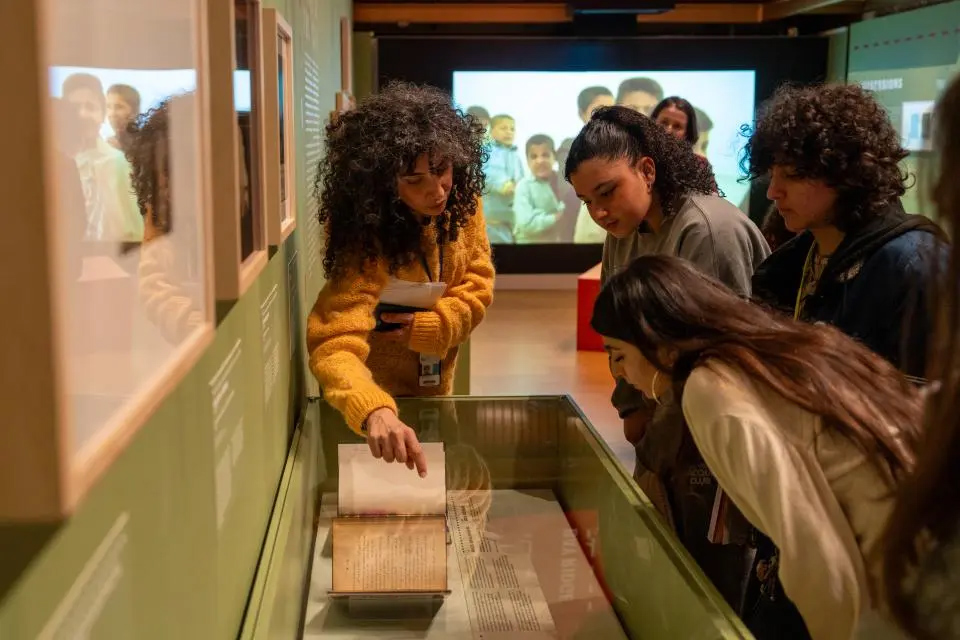
Curator Hiba Abid working alongside 11th and 12th grade students in the Niyu Yurk exhibition. Photograph credit New York Public Library (NYPL).
A rich resource capturing the vast cultural history of New York’s MENA community over centuries, the exhibition "Niyū Yūrk: Middle Eastern and North African Lives in the City" ran from October 4, 2025, to March 8, 2026. Curated by Hiba Abid, the Curator for Middle Eastern and Islamic Studies, and organized by the New York Public Library, the exhibition explores the history of Middle Eastern and North African (MENA) immigration to New York City from the late 19th century to the present, tracing through art, music, literature, and the slew of accomplishments made by the community the ways these emigrants planted their roots in their new home.
Hosted at the New York Public Library’s Stephen A. Schwarzman Building at the Celeste Gottesman Bartos and Mahnaz Ispahani Bartos Exhibitions Gallery, the exhibition shows these stories of immigration and community through a selection of 60 works from the library’s collections, dating back over a century. With references to immigrants who hoped to bridge the cultures of their homelands to their diasporic communities, including but not limited to Kahlil Gibran, Ameen Rihani, the Pen League, as well as a plethora of materials across time and genre, many works feature a multicultural exchange between homeland and adopted country as these communities established themselves in the face of prevailing stereotypes and citizenship struggles.
The exhibition features the works and contributions of members of the MENA community, including photographs, documents, archives, books, music, and even dance, many of whom have helped introduce Americans to Middle Eastern culture through their art. As curator Hiba Abid explains, quoted in “Arab Migrations to New York: Books, Photographs, and Musical Recordings” by Ibtisam Azem in The New Arab, “The concept for this exhibition emerged from a project I oversaw, centered on highlighting — and delving deeper into — the Arabic and Middle Eastern collections amassed by the New York Public Library over the course of more than a century: specifically, since the late 19th century, and in some cases, even earlier."*
Among the topics discussed are questions regarding assimilation, the preservation of ancestral identity and language, naturalization, and gender roles. Abid states in “Hiba Abid: Arab Intellectuals in America Since the 19th Century,” published by Ibtisam Azem in The New Arab, that the exhibition materials were carefully gathered and selected from various departments and research centers, including the Library for the Performing Arts and the journalism division, “to be presented to the public for the first time in a single exhibition.”** Some exhibits include a video interview with the Palestinian American academic Edward Said, a photograph series focusing on Yemeni bodega owners, and writings by members of the Pen League, an Arab literary society formed in the early 1900s.
The materials sourced do not focus solely on famous figures like Gibran or the Pen League members, but also include different voices — valuable resources like newspapers offer a glimpse into the lives of ordinary people. In the words of Abid, “Newspapers, in general, serve as an incredibly rich source of information — one upon which entire books could be written.” These documents provide important details and insights into the concerns of the times, including issues regarding naturalization, citizenship, and gender rights. Abid acknowledges in an interview with Rosie (Toumanian) Nisanyan in The Armenian Weekly that Arabic materials are more represented in the exhibition, “mostly because Arab communities were among the earliest and largest demographic groups from the region to settle in New York.”***
The “Niyū Yūrk” exhibition includes four sections: Roads to New York, A Life in the City, Impressions, and In Our Own Skin. Roads to New York provides a historical look into the waves of migration that brought over 100,000 emigrants from Greater Syria (present-day Lebanon, Syria, Jordan, and Palestine) into the U.S. between 1880 and 1940. These immigrants, among them Christian Syrians, Muslims, Druze, and Jews, fled from their home countries due to economic and political reasons. Through materials sourced from the New York Public Library, the exhibition delves into the lives and challenges of these immigrants, who contended with social prejudice and Orientalist stereotypes.
The oldest book in the library’s collection is Istanbul-born Armenian Christopher Oscanyan’s book “The Sultan and His People” (1857). Oscanyan challenged the stereotypes about Middle Eastern culture through lectures and writing, publishing plays, essays, and books. “The Sultan and His People” explains the history, politics, religions, and customs of the Ottoman Empire.
The second section, “A Life in the City,” touches on the cultural scene and how MENA immigrants shaped the city's cultural fabric. Bringing in the historic presence of peddlers and businesses, as well as works by Arab poets, writers, musicians, dancers, and journalists, this section focuses on the community’s social, political, and cultural growth. One key development includes initiatives in establishing newspapers in Arabic, Armenian, and other languages. Lebanese brothers Salloum Mokarzel and Naoum Mokarzel (founder of the newspaper Al-Hoda) successfully adapted the Linotype machine for Arabic script, revolutionizing Arabic-language publications both within and outside the United States.
The exhibition also features musical pieces by immigrant musicians dating back to the early 20th century, such as the musical score for “America, Ya Hilwa” (America, Oh Beautiful), composed by Iskandar (Alexander) Maloof, as well as a copy of Ameen Rihani’s “The Book of Khalid,” the first Arab-American novel published, and exhibits on the dance traditions of the Middle East.
The section “Impressions” features materials discussing the hopes and dreams of MENA immigrants upon arriving in America, as well as works that capture the difficulties of adapting to their new lives. The exhibit explores themes on both ends of the spectrum — from struggles with disillusionment, as shown in works by the Pen League members, covering migration, exile, and lost identity, to themes of reclamation and celebration of identity. Alexander Maloof is cited as a musician whose work engaged Arab American audiences and is known for composing “Orientalist” music tailored to local tastes.
The final section, “In Our Own Skin,” focuses on the struggle to reclaim narratives and subvert Orientalist exoticism and tropes of violence and extremism that were on the rise after the Arab-Israeli war of 1967 and the events of 9/11. As the exhibition states in its catalogue, “This section celebrates those who have reclaimed their narratives and amplified MENA voices in the face of scrutiny, affirming the power of art, scholarship, and activism to shape new possibilities of self-representation.”
The New York Public Library’s “Niyū Yūrk” exhibition offers a richly curated selection of works and documents touching on the legacy, history, and present-day lives of MENA diasporas in New York. When asked about the motivation behind the exhibition in her interview with The Armenian Weekly, Hiba Abid answers, “...it’s not only a topic that I believe all New Yorkers should learn about and engage with, it’s also one that the communities themselves have expressed a real need for — a need to see themselves reflected in major cultural institutions, especially a public one that is accessible to everyone.”
*Ibtisam Azem’s essay, “Arab Migrations to New York: Books, Photographs, and Musical Recordings,” was published in Arabic in The New Arab.
**Ibtisam Azem’s essay, “Hiba Abid: Arab Intellectuals in America Since the 19th Century,” was published in Arabic in The New Arab.
***Rosie (Toumanian) Nisanyan’s essay, “In 'Niyū Yūrk,” NYPL Shares a Glimpse of the City’s MENA Communities,” was published in The Armenian Weekly.
This article appeared in Inside Al Jadid Reports, No. 161, 2026.
Copyright © 2026 AL JADID MAGAZINE