
The Drone Above Us, the Debate Among Us
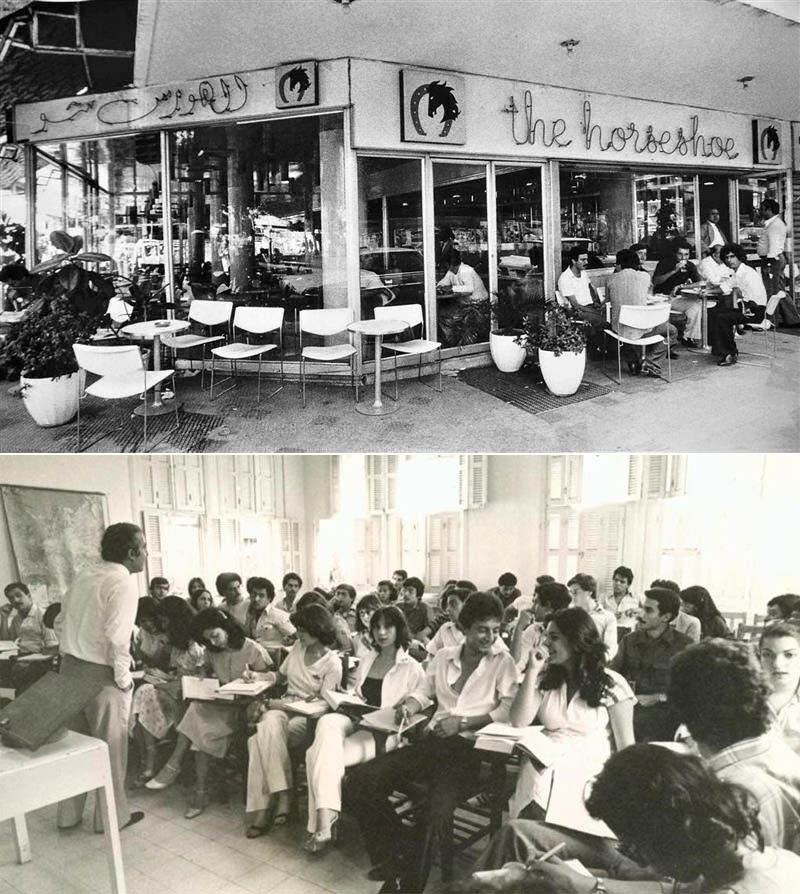
Top to bottom: A web-based photograph of The Horseshoe Cafe in Hamra Street in the beginning of the 1970s; Lebanese American University students gathered in a classroom, photograph credit by Lebanese American University (LAU).
What caught my attention amid the ongoing war involving Israel, the United States, Iran, and Hezbollah are scenes strikingly similar to those I have personally witnessed — albeit remotely — in my native Lebanon, and now, in different ways, within the diaspora. Many of the reactions expressed by the Lebanese, as captured in Nisrine Nakousi’s column in Al Modon, “Every Lebanese Is an Analyst… Every Lebanese Is Afraid,” feel deeply familiar.* They reveal not only a political culture but also a shared emotional condition shaped by uncertainty, fear, and the search for meaning in times of crisis.
In Lebanon, social gatherings — whether at home or outdoors, during holidays or ordinary evenings — often begin with casual commentary on political developments. These conversations quickly evolve into animated and sometimes chaotic debates. Voices rise, arguments overlap, and the intensity of discussion can, at times, drown out even the distant hum of drones overhead. To cite Nakousi, “When a part of what they had said came to pass, a glint resembling a small victory would sparkle in their eyes.”
While every Lebanese seems to assume the role of a strategic analyst, Nakousi clarifies that the label is not ironic and is far from satirical. It reflects a necessity born of lived experience. In a region where conflicts frequently spill across borders and disrupt daily life, uncertainty becomes a constant companion. In response, the act of analyzing events — of predicting outcomes and interpreting motives — emerges as a way to cope with anxiety and to reclaim a sense of agency.
Within this context, opinions and interpretations function as survival mechanisms. When individuals lack meaningful control over their present or future, analysis offers an alternative form of engagement. It allows people to feel involved, even influential, in shaping events that remain fundamentally beyond their reach. In societies where frustration cannot always be channeled through effective democratic institutions, public discourse often becomes emotionally charged, reflecting both political disillusionment and psychological strain.
This analytical culture manifests itself in both public and private spaces. Even during periods of relative calm, memories of past conflicts and anticipation of future ones linger just beneath the surface of everyday life. This underlying tension is evident in the high-pitched discussions heard in Beirut cafés and among Lebanese communities abroad, where participants attempt to identify the decisive factors that might determine the course of the war.
Equally significant is the identity of those engaged in these debates. They are not necessarily experts or policymakers, but ordinary citizens — taxi drivers, shopkeepers, students, and professionals. Their participation underscores the extent to which geopolitical awareness has become embedded in daily life. Yet beneath these discussions lies a deeper, shared purpose: the attempt to tame fear.
As Nakousi’s article suggests, these reactions stem less from the prospect of violence itself than from the anxiety generated by the unknown. The anticipation of war produces a heightened emotional state in which speculation becomes a form of psychological preparation. However, the experience of war differs profoundly from its discussion. When conflict becomes immediate — marked by explosions, displacement, and visible destruction — the abstract frameworks of analysis collapse under the weight of reality.
In such moments, fear shifts from an intellectual concept to a lived experience. The limitations of analytical thinking become evident as individuals confront the emotional and physical impact of danger. The distinction between knowledge and experience is stark: what can be theorized from a distance becomes overwhelming when encountered directly. Yet, once the initial shock subsides, interpretation gradually resumes, now reshaped by lived experience and a more subdued awareness of reality.
Anxiety, in this context, manifests in a range of emotional responses. Some react with anger, others withdraw into silence; some resort to nervous laughter, while others find a grim sense of validation when their predictions prove accurate. These varied reactions are not signs of indifference but expressions of human vulnerability. They reflect the search for meaning in moments of uncertainty, shaped by personal histories, individual temperaments, and broader social conditions.
At its core, this phenomenon highlights several interrelated themes: the fragility of human beings in the face of overwhelming forces, the collapse of analytical certainty during moments of immediate danger, and the enduring importance of social bonds in navigating crises. Indeed, one of the most striking aspects of these experiences is the way in which people turn to one another for reassurance. Even heated debates, paradoxically, contribute to a network of emotional support, as individuals share their fears, interpretations, and hopes.
Despite the apparent disorder of the world we inhabit, people persist in their efforts to interpret events and impose meaning on chaos. This impulse reflects not only a refusal to succumb to uncertainty but also a fundamental human desire for connection and understanding. Political analysis, in this sense, becomes more than a cognitive exercise; it is a psychological and social practice through which individuals seek stability.
Lebanon’s position — at times on the margins of direct conflict — further intensifies this analytical tendency. Observing regional developments from a relative distance encourages speculation, fueling dynamic and often emotionally charged debates about possible scenarios. Yet this distance is always precarious, as the boundary between observer and participant can dissolve at any moment.
Ultimately, political debate in Lebanon and within its diaspora should be understood less as a display of expertise than as a collective response to vulnerability. Analysis does not eliminate fear, but it provides a language through which fear can be expressed, shared, and momentarily contained. In this way, the act of interpretation becomes an essential coping mechanism, allowing individuals to navigate uncertainty while maintaining a sense of connection to one another.
Nothing captures the state of mind of those under the bombing better than the author's statement: "Perhaps this is why every Lebanese person, at some point, transforms into an analyst. It is not because they possess the answers, but because they refuse to remain without an explanation; otherwise, they would suffocate beneath the weight of absurdity and futility. Between the drones hovering overhead and the discussions rising above them, lies a space of fear — a void we attempt to fill with words. Yet, when the strike finally lands, the roles are reversed: the loud voices fall silent, and the ordinary, frightened human being emerges — the one who simply needs someone to take them by the hand."
*Nisrine Nakousi’s essay, “Every Lebanese Is an Analyst… Every Lebanese Is Afraid,” was published in Arabic in Al Modon.
This article appeared in Inside Al Jadid Reports, No. 160, 2026.
Copyright © 2026 AL JADID MAGAZINE