
Psychiatry, the State, and the Collapse of Care in Lebanon
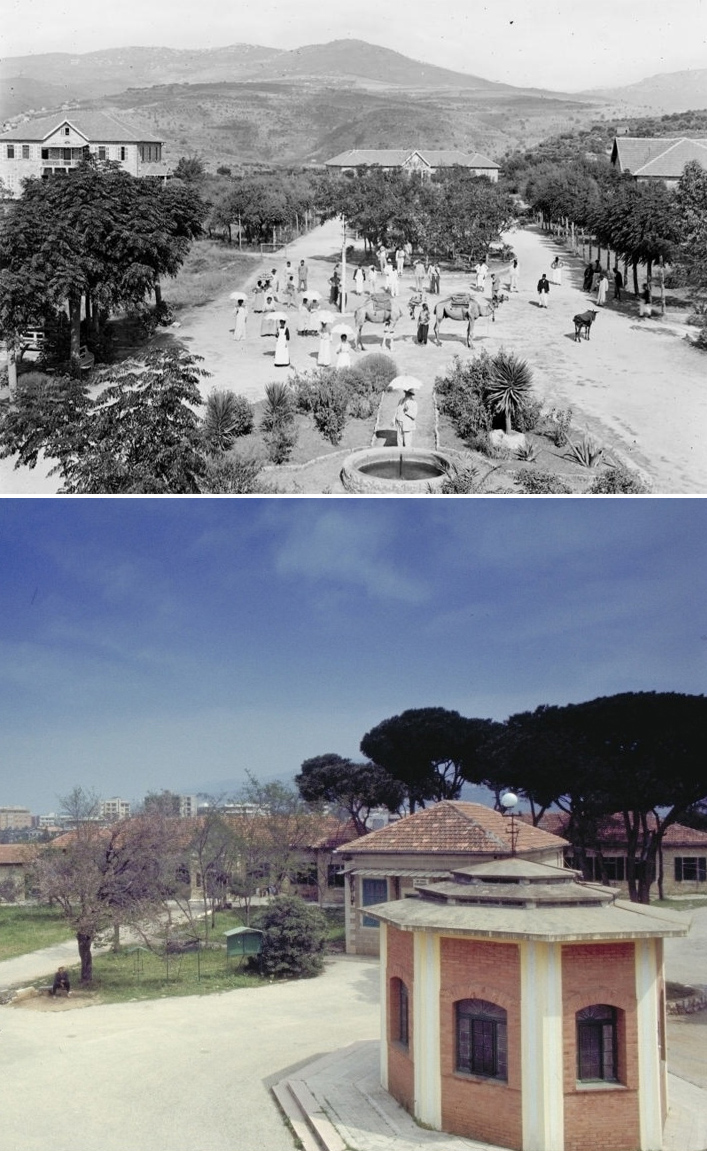
Top to bottom: View of the hospital grounds from Dr. Theophilus Waldmeier’s house in 1907, photograph credit Lebanese Philatelic Association (LAP); a web-based photograph of the Asfourieh Hospital’s buildings.
The stigmatization of mental illness remains prevalent in the Arab world, especially surrounding psychiatric institutions like the Asfourieh Hospital, formally known as the Lebanon Hospital for the Insane, which closed its doors in 1982. While part of Asfourieh’s reputation stems from its direct associations with infamous cases like that of May Ziadeh, much of the hospital’s history has been overlooked, from its ties to the development of treatment for the mentally ill, its contributions in furthering psychiatric studies, and its role as one of the leaders in modernizing medicine in the Arab world at the time.
Asfourieh Hospital is predominantly associated with “madness,” operating as an asylum and depicted in popular culture as a metaphor for mental illness, abnormal behavior, and deviance, often bearing derogatory connotations. Countering reductive misrepresentations of the hospital, author Joelle M. Abi-Rached probes Asfourieh’s longstanding ties to the history of psychiatry and mental illness in Lebanon and the Middle East, primarily through her book “ʿAṣfūriyyeh: A History of Madness, Modernity, and War in the Middle East” (MIT Press, 2020), published in English. An Associate Professor of Medicine at the American University of Beirut and lecturer on the history of science at Harvard University, Abi-Rached discusses her book in an article published in Bidayat Magazine, “The History of Asfouriyeh Hospital and the Development of Global Psychiatry.”*
Institutions dedicated to treating mental illnesses have existed long before the establishment of Asfourieh and its contemporaries. Specifically, the bimaristan — a Persian word meaning ‘house of the sick’ — laid the groundwork for psychiatric care facilities. Bimaristans were charitable hospitals for the care of the sick and poor in what is now southwestern Iran and Turkey, as well as in Baghdad, Damascus, and Cairo. Mentally ill patients received various treatments according to medical knowledge of the time, ranging from confinement, restraint with chains, and music therapy to Galenic treatments such as rest, diet, baths, bloodletting, purgatives, and other pharmacological treatments. However, these institutions declined with the decline of the Ottoman Empire by the end of the 19th century, as Abi-Rached explains in her book.
Prior to Asfourieh’s founding, two other hospitals were known for treating mental illness: Süleymaniye Hospital in Constantinople, founded by Sultan Suleiman the Magnificent in 1560, and the Abbasiya Hospital in Cairo, established under the rule of Muhammad Ali Pasha in 1880. Together with Asfourieh, these three hospitals were distinguished by their liberal and modernizing approaches, according to Abi-Rached in Bidayat Magazine. These three hospitals were also distinct from one another in how they were funded and which patients they typically treated. Süleymaniye Hospital was a charitable institution sustained by the patronage of wealthy rulers, while also an effort of the Ottoman state to ensure public order through controlling the destitute and “undesirable,” writes Abi-Rached. Similarly, Abbasiya Hospital was the British colonial apparatus’s effort in Egypt to contain and control the population.
Abi-Rached describes Asfourieh Hospital as part of the revivalist and millenarian movements of the late 19th century, which were simultaneously “civilizing, missionary, and humanitarian.” She adds that the hospital was also distinguished by the enthusiastic support it received from the local intellectual elite and prominent citizens. Unlike the state-run institutions Süleymaniye and Abbasiya, Asfourieh Hospital was a private hospital dependent on donations. Abi-Rached acknowledges the claims by some that Ottoman authorities used Asfourieh Hospital to remove ‘undesirable’ individuals from the streets of Beirut, but also points out the lack of historical evidence supporting such claims. In her words, “The majority of admissions were 'ordinary,' consisting mostly of private patients and some indigent patients sponsored by the hospital or charitable organizations. Furthermore, the number of private patients generally exceeded that of government-sponsored patients (those covered by social welfare policies, municipalities, the army, or the Ministry of Justice).”
During its years of operation, Asfourieh Hospital was known for its cosmopolitan character, attracting patients from across the Middle East, including Latakia, Mosul, Alexandria, Haifa, Jerusalem, Tehran, Mount Lebanon, and Beirut. Patients were mostly from the working and middle classes, brought in by their families rather than by local authorities. The hospital remains infamously known for its involvement in the forced hospitalization for “epidemic melancholia” of May Ziadeh during the 1930s by relatives seeking to control her estate. Her hospitalization sparked widespread protests against involuntary confinement.
Founded in 1896 by the Swiss Quaker missionary Theophilus Waldmeier, Asfourieh Hospital was specifically constructed in Hazmieh, Mount Lebanon, with the geopolitics of the surrounding area in mind. Waldmeier was conscious of the sectarian unrest in the region — sectarian clashes in 1840-1841 left Mount Lebanon divided between Maronite and Druze rule. International agreements between the European powers and the Ottoman Empire, following massacres in 1860-1861, led to the unification of the districts into the Mutasarrifate of Mount Lebanon. According to Abi-Rached, the location became ideal for missionary work due to the region’s newfound semi-autonomous rule. She explains, “It was precisely for this reason that Waldmeier chose Asfourieh, not only for the therapeutic potential of the area but also to secure the hospital’s political survival in a threatening and hostile environment.” The hospital opened its doors with a vow to “serve the poorest of the poor,” becoming a refuge for the poor and marginalized and eventually evolving into a modern hospital.
Muhammad Turki al-Rabi’u writes in his essay, “Al-Asfourieh: Madness, Modernity, and War in the Middle East,” published in Al Quds Al Arabi, “The history of psychiatry cannot be separated from the history of the state, war, sectarianism, and the political economy of care...Asfourieh thus becomes a historical laboratory for understanding how concepts of madness were produced, how therapeutic practices evolved, and how the figure of the “mentally ill patient” was redefined across different periods.”** He reviews Abi-Rached’s book in his essay, which praises the book for bypassing “reductive narratives that depict Asfourieh either as a colonial missionary tool or as a progressive Western import.”
Historically, madness has been used as an indicator of inherent and moral deficiency. According to Rabi’u, European travelers and physicians have depicted scenes in their writings of the insane being chained in monasteries or abandoned in the streets in order to reinforce the idea that the East “lacked the humanistic and institutional sensibilities necessary to deal with mental illness.” European physicians, he writes, assumed madness was less prevalent in the East due to “primitiveness” and “their supposed inability to attain the psychological complexity produced by civilization.” These representations, however, overlook the extensive history of Islamic and Arab medicine. Arab intellectuals challenged these notions and argued that Arab cities are not less afflicted by madness, but “less capable of registering and documenting it” due to the absence of statistics, weakness of care institutions, and the common practice of concealing patients within homes and monasteries, states Rabi’u.
He cites Abi-Rached, who furthers that the intellectual and medical elites active in the Arab Renaissance movement contributed to a more complex local discourse on madness. In Rabi’u’s words, “Although popular beliefs in demonic possession and jinn remained widespread, and practices such as chaining, beating, starvation, and cauterization were commonly used to treat the insane, Nahda thinkers explicitly rejected these explanations. In medical articles and public lectures, they emphasized that madness was a psychological and organic illness, not a religious or moral failing, and that attributing it to jinn or Satan was a form of ignorance that needed to be overcome.” Abi-Rached credits scientific and medical journals active during the Nahda (such as Al-Muqtataf and Al-Tabib) for their treatment of madness as a bodily disease like any other, critically engaging and challenging theories rather than blindly imitating the West.
This discourse defined madness in naturalistic terms, as a disease affecting the brain and nervous system. Superstition and ignorance were instead regarded as symptoms of deeper social, political, and moral decay, states Rabi’u, who adds, “In their [Nahda thinkers] view, it was not the ‘Eastern mind’ that was pathological, but rather modes of governance, social organization, and the collapse of public values. Madness thus ceased to be merely an individual condition and became an indicator of collective dysfunction — in education, justice, wealth distribution, and the relationship between the state and its citizens.” In Nahda discourse, madness became a topic of social critique, used to diagnose the nation's maladies rather than to condemn its nature.
One of the leading medical journals, the British Medical Journal, considered Asfourieh “the only institution of its kind in the Ottoman Empire between Cairo and Constantinople, disseminating the beneficial effects of modern medical science and humanitarian zeal, not only among those living in its vicinity but also among travelers coming from distant lands,” writes Abi-Rached in Bidayat Magazine. Discoveries in the West were quickly adopted at Asfourieh, with occupational therapy, insulin coma therapy, electroshock therapy, lobotomy, and psychotropic medications as some examples.
Lebanese psychiatrists have supervised the education and training of Arab physicians who came from Palestine, Egypt, Jordan, and Syria, according to Professor Sami Richa.*** Richa, a specialist in psychiatry and mental healthcare in Lebanon and author of “A History of Psychiatry in Lebanon — From Asfourieh to the Present Day: A century of Psychiatry in Lebanon” (Une histoire de la Psychiatrie au Liban — De Asfourieh á nos jours: un siécle de psychiatrie au Liban, Complicites, 2025), was interviewed by Zahra Marai in Al Quds Al Arabi. He explains that psychiatry was taught at Asfourieh as early as 1900.
Asfourieh Hospital was also a major player in the decriminalization of drug use and the medicalization of criminal insanity. As Abi-Rached writes in an article for the MIT Press Reader, Asfourieh was among the first institutions in the Middle East to medicalize criminal insanity and substance-use related disorders, during a time when it was common to imprison and abandon those who were accused of consuming and selling “toxic” substances.**** The criminalization of drug use for heroin, cocaine, and hashish during the 1960s had resulted in increased numbers of inmates at Asfourieh, leading to the establishment of a forensic unit in the hospital to house and treat them, states Abi-Rached. The hospital played a role in prison reform — Asfourieh was involved in legal reforms, in addition to consultations and psychiatric treatments the hospital provided to different state prisons free of charge, as well as the medical care provided in its own facilities. Abi-Rached adds that some commentators have recently begun to denounce the lack of psychiatric facilities in Lebanese prisons.
Asfourieh’s contributions distinguished it from other psychiatric hospitals; during its years of operation, the hospital contributed to the psychiatric discourse, opening discussions about how poverty, religious fanaticism, and migration were considered primary causes of madness in the early 20th century. Swiss physician Otto Wolff listed the variety of reasons for admission to Asfourieh as depression, misery, poverty, untreated malaria, lethargy, marriage, and emigration to the Americas. He also diagnosed madness caused by migration and the failure of the American Dream, cites Abi-Rached. In many cases, those who returned from life abroad came back mentally ill and bankrupt. This was a result of the alienation and pressures they experienced in their adopted country. During the 1950s and 60s, a period in Lebanon characterized by economic growth and prosperity, mental illness causes were replaced by others, such as war trauma and drug use.
As Abi-Rached states in Bidayat Magazine, Asfourieh Hospital’s story is unique in that it shows the influence of politics and sectarian culture on the ethics of care and the healthcare infrastructure. The hospital opened its doors to all religions and sects. She credits Asfourieh as one of the few institutions where people of different sects could work together during the height of the civil war in the 1970s, maintaining its non-sectarian principles up to its official closure in 1982, despite the pressures that challenged these principles. In her words, “It is no exaggeration to say that the hospital’s pluralistic character is what made it a target of violence during the civil war.”
Muhammad Turki al-Rabi’u explains that during the civil war period, hospitals “turned into spheres of influence, and sectarian identity became a prerequisite for protection and funding.” Asfourieh may have upheld a non-sectarian stance, but this did not exempt it from the sectarian strife surrounding it; rather, the hospital was caught in numerous conflicts. On November 5, 1975, armed men breached the hospital’s barriers and kidnapped several Muslim students. Throughout the following year, the hospital was frequently bombed. Abi-Rached states in the MIT Press Reader, “The continuous shelling caused heavy damage to the hospital, and the physical violence against the patients continued unabated, with more patients being killed, injured, or kidnapped. The militiamen had also started to assault female patients. By March 29, 1976, every one of the hospital’s buildings had been hit at least once.”
A ceasefire in April 1976 allowed the discharge of the hospital’s remaining patients. Abi-Rached describes the details of their transport as a “delicate affair”: Muslim patients were transferred to Muslim-controlled areas, Christians to Christian-controlled areas, and all others — including Druze, Jewish, Buddhist, and atheist — were also transferred due to the dangers of remaining on the hospital premises. In the words of Abi-Rached, “This moment marked the beginning of the disintegration of harmony and peace in which ‘diverse races, creeds, temperaments and social conditions’ had coexisted for decades.” Rabi’u notes that, unlike in the West, where hospitals closed due to deinstitutionalization and anti-asylum movements, Asfourieh’s closure was tied to political transformation in the region, in which “the notion of public health gave way to sectarian and charitable networks of care.”
Indeed, Asfourieh Hospital’s closure in 1982 marked what Abi-Rached calls “the birth of the ‘sectarianization of healthcare,' particularly mental healthcare. In Asfourieh’s absence, institutions serving the needs of two specific communities rose — Deir al-Salid for Christians and Dar al-Ajaza al-Islamiyya for Muslims. Asfourieh’s closure was a major loss on all fronts. In his interview with Al Quds Al Arabi, Dr. Sami Richa recalls his conversation with Dr. Antoine Chakhchoura, a former employee at Asfourieh, who told him that after the hospital closed in Hazmieh and preparations began for a new facility in Aramoun, “the equipment — among the most advanced, including specialized psychiatric beds — was stolen from the port when the civil war broke out.”
Mental illness resulting from the war emerged in its aftermath. Abi-Rached describes in the MIT Press Reader that many suffered from traumas of the war, with some succumbing to their fears and anxieties and others dying by suicide. She paints vivid, if not devastating, images: “Tragic stories abound; of a relative who “lost his mind” after witnessing some horrific act of violence, of the unbearable grief of losing a child killed by shrapnel, a car bomb or a mine, of a relative who disappeared after returning from work and was never accounted for, of a career aborted because of the war, and so on and so forth. As one journalist put it, “the voice of the missing still resonates in Lebanon decades on.” Schizophrenia, paranoia, anxiety, depression, and other emotional distress caused by the civil war have overwhelmed families, shattered individuals, and continue to linger on decades later.”
Dr. Richa touches on the present-day concerns regarding the state of psychiatry and psychiatric care in Lebanon, which culminate in an overwhelming and urgent need for dedicated psychiatric infrastructure, such as psychiatric beds in hospitals. The country continues to experience a severe lack of psychiatric specialists since many left the country during the 2019 financial collapse and economic meltdown. According to Richa, only 50 psychiatric specialists remain as of November 2025. Meanwhile, treatment remains out of reach for many, as insurance companies do not cover psychiatric treatment. Richa suggests that, in the current state of the country and its healthcare systems, psychiatric treatments are exclusively for the wealthy — a point he finds unacceptable. In his words, “All psychiatric patients have the right to treatment at the state’s expense, and it is the state’s duty to cover costs in private hospitals. Ironically, those holding insurance policies issued outside Lebanon receive psychiatric care without obstacles.”
*Joelle M. Abi-Rached’s essay, “The History of Asfouriyeh Hospital and the Development of Global Psychiatry,” was published in Arabic in Bidayat Magazine.
**Muhammad Turki al-Rabi‘us essay, “Al-Asfouriya: Madness, Modernity, and War in the Middle East,” was published in Arabic in Al Quds Al Arabi.
***Zahra Marai’s essay, “Dr. Sami Richa: The People of Our Region Suffer from Depression and Anxiety Due to the Absence of Security… It Is the State’s Duty to Treat All Mental Health Patients,” was published in Arabic in Al Quds Al Arabi.
****Joelle M. Abi-Rached’s essay, “The Tragic Downfall of ʿAṣfūriyyeh (The Lebanon Hospital for the Insane),” was published in the MIT Press Reader.
This article appeared in Inside Al Jadid Reports, No. 159, 2026.
Copyright © 2026 AL JADID MAGAZINE