Why Syrian Literature Struggles to Cross Borders
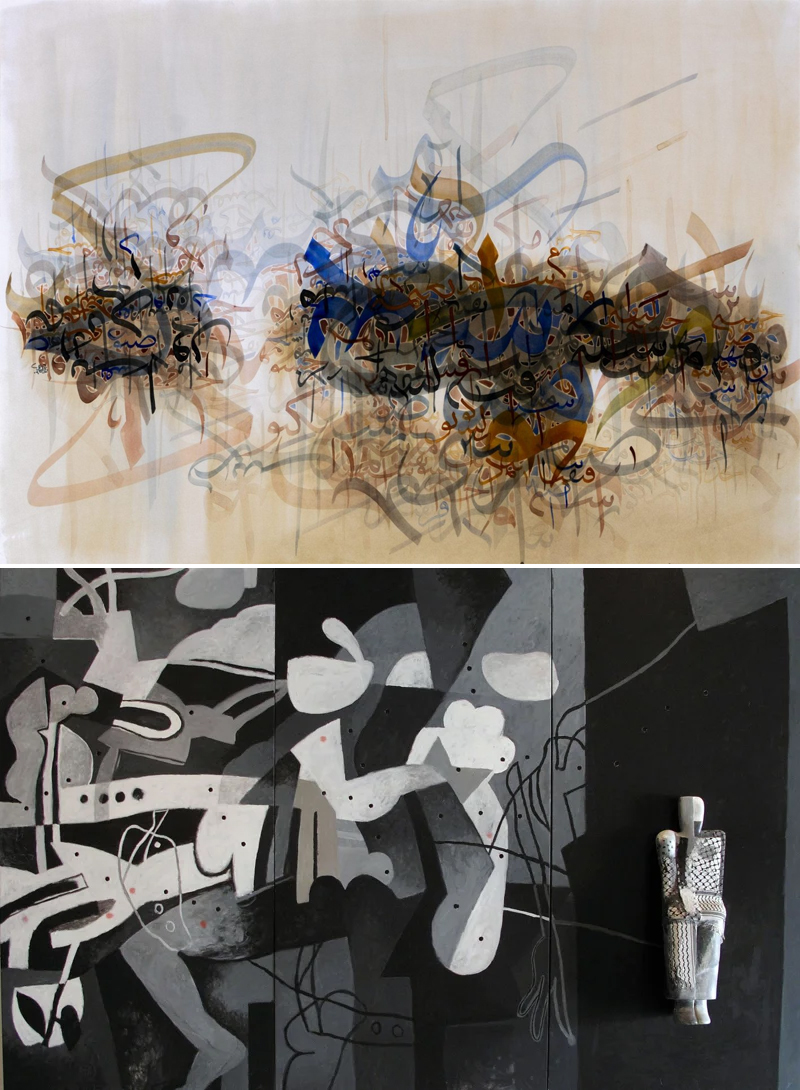
From top to bottom: “Untitled” (2009) by Khaled Saa’i and “Wounded Soul, Silent Witness” (2011) by Dia al-Azzawi.
Ali Safar, a Syrian writer and critic based in Paris, raises thought-provoking questions in his essay “Why Don’t Syrian Writers Reach Global Recognition?” — questions that prompted my selection of this issue.* Published in The New Arab, Safar’s piece explores the global marginalization of Syrian literature. While his focus is squarely on Syria, my familiarity with the region leads me to note that the problem extends beyond its borders, encompassing neighboring Arab countries such as Lebanon, Jordan, and Iraq.
Safar’s emphasis on "marginalization" is particularly insightful. He highlights a complex web of political, cultural, institutional, and literary forces — both historical and contemporary — that shape the international reception of Syrian literature. Yet it would be an oversimplification to attribute this marginalization solely to authoritarianism. Such a reductionist view can obscure the role of other factors, including a weak cultural infrastructure, the diversion of resources into censorship, and mechanisms of control inherited from both current and former regimes. In such contexts, the absence of robust critical traditions is evident, particularly in the lack of a free, professional press that might otherwise help identify and elevate emerging literary voices. Without critics or journals that sort, elevate, or debate works, it becomes hard for “the best” Syrian literature to appear as visible or exemplary.
This entanglement is mirrored in the cultural landscape itself. The challenges facing Syria’s literary infrastructure also help explain the marginalization of translation efforts. Currently, many translations are initiated by individuals or non-professional organizations, often without a coherent strategy. What’s needed instead is an institutional framework: a panel that can evaluate which works merit translation, and that operates in coordination with a national cultural strategy aimed at enhancing Syria’s literary visibility abroad.
Safar argues that the politicization of translation plays a central role in marginalizing Syrian literature. When political concerns dominate, broader human and artistic themes are sidelined, thereby reducing global interest. Sporadic, uncoordinated translation efforts further erode institutional support. What’s needed is a clear and comprehensive strategy — one that builds institutional capacity, focuses on significant authors and works, and engages major publishers. Only then can Syrian literature gain the visibility and influence it deserves on the global stage.
As the editor of Al Jadid, I have also thought of Safar’s questions. For many years, I was the recipient of extensive lists of translated works in publishers' yearly and bi-yearly catalogues. Equally notable is the broad coverage these publications receive in daily and weekly cultural pages. Furthermore, the significance they hold for their Arab authors, who often claim that their works are now accessible to European and Western audiences, cannot be overlooked.
Safar draws a clear distinction between individual efforts and systemic support for translations. Systemic support requires institutions and long-term investment. In Syria, even well-intentioned initiatives within the Ministry of Culture have proven short-lived, mainly due to the fragile cultural infrastructure. Under Ba’athist rule, culture was instrumentalized for propaganda, rather than nurtured as a domain of independent artistic expression.
Ideally, Syrian and Arab writers seek global recognition through merit-based evaluation by respected academic institutions, international organizations, or peer reviewers. However, they are keenly aware that political narratives often eclipse the intrinsic artistic value of their work. Over time, many have come to understand that the absence of a strong cultural foundation — especially one that includes critical traditions and platforms for international engagement — hampers the emergence of authentic literary voices. Without systems in place to assess, discuss, and promote cultural production, intellectual and artistic development stagnates, making it more difficult for writers to gain recognition for their craft.
Censorship operates at multiple levels, both overt and covert, complicating the creative environment. While government repression is a clear form of control, internal self-censorship is subtle but can be even more dangerous. Writers often silence themselves out of fear of surveillance or punishment, making self-censorship a valuable tool for authoritarian governments. It allows them to suppress dissent without the political costs of imprisoning or exiling writers. The link between self-censorship and creativity is essential. Writers, predicting what the censor will allow, shape their work not based on artistic or intellectual reasons but due to external pressures. This damages authenticity, resulting in unoriginal and shallow works. When these works are read abroad, they often lack the depth and urgency needed to connect with international audiences.
Another challenge lies in the lack of trusted mechanisms for identifying significant literary works. This creates a vacuum in which foreign publishers and translators must rely on limited or politicized sources of information. Without credible gatekeepers, Syrian literature struggles to gain international traction or serious critical attention. Since access to a global readership depends on translation, many creative voices remain untranslated or overshadowed by refugee or war narratives, which fatigues global audiences and negatively affects the reception of even serious literary works, according to Safar.
Nepotism and corruption are deeply ingrained in education systems, both in authoritarian regimes like Syria and pseudo-democratic ones like Lebanon. These practices weaken the integrity and effectiveness of educational and cultural institutions, undermining their ability to promote merit-based advancement and equal opportunities. University admissions are often rigged, and poorly trained faculty are hired, leading to cultural and academic decline. These practices have a ripple effect: opportunities are reserved for those with connections, mediocrity becomes commonplace, and talented individuals leave their homelands in search of more equitable systems. Corruption diverts vital resources from infrastructure, libraries, research, and teacher training. Writers, artists, and academics often align with power networks to survive, which can prevent them from producing bold, original work. Ultimately, nepotism and corruption degrade education as a path for mobility and creativity, fostering a culture of dependency, conformity, and mediocrity.
Moreover, an overemphasis on the novel as the dominant genre in translation sidelines poetry, short stories, and theater, which are equally vital to Syria’s literary tradition. The result is a constriction of narrative possibilities. Audiences, both local and international, have also grown weary of recurring themes — war, displacement, exile — that, while important, often overshadow the artistic and human dimensions of Syrian storytelling. Marketing strategies that favor traditional, realist narratives over experimental or stylistically bold works have only deepened this fatigue.
Ultimately, sectarian and ideological divisions continue to limit exploration of identity, memory, and belonging in Syrian exile literature. These internal divisions not only weaken the cultural identity of Syrian literature but also echo similar challenges in neighboring Lebanon, where no unified narrative of the civil wars has emerged. Ignoring indigenous traditions — such as Damascene storytelling or Sufi poetic heritage in Syria — further dilutes the cultural specificity that might otherwise captivate international readers.
*Ali Safar’s essay, “Why Don’t Syrian Writers Reach Global Recognition?”, was published in Arabic in The New Arab.
This article appeared in Inside Al Jadid Reports, No. 158, 2026.
Copyright © 2026 AL JADID MAGAZINE