
Issam Mahfouz’s Theatre, Criticism, and the Struggle for Meaning
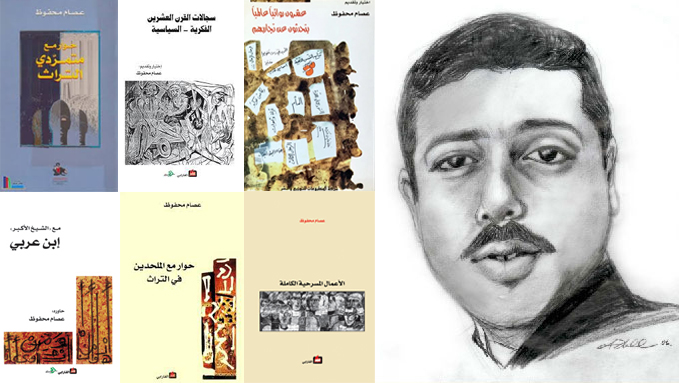
A collage of works by Issam Mahfouz and artwork of Issam Mahfouz by Alicia Hall for Al Jadid.
The late Lebanese playwright, poet, and critic Issam Mahfouz was known for his contributions in numerous fields, including modern poetry, journalism, and, perhaps most famously, as one of the pioneering figures of the Lebanese modern theater movement that lasted from the late 1950s up to the outbreak of the Lebanese civil war in 1975. Following his death in 2006, Al Jadid published a feature article by the late Mohammad Dakroub highlighting Mahfouz’s contributions to Arab criticism.* Now, 21 years after his death, many continue to recall his legacy. Alhussam Muhy al-Din’s article, “Twenty Years After the Passing of Issam Mahfouz: A Legacy That Extends Beyond the Theater,” published in Al Quds Al Arabi, rekindles appreciation for the works of this celebrated writer.**
Issam Mahfouz was born on September 12, 1939, in the southern Lebanese town of Jdeideh, Marjeyoun, where he spent most of his childhood before moving to Beirut in 1957 to continue his education. He held firm beliefs about writing and applied them to his work. According to Muhy al-Din, Mahfouz believed writing was only worthwhile “if it embraced all genres of thought, literature, and art, through in-depth study and experience, not merely superficial acquaintance.” He continues, “He avoided personal opinions or ideological ideas mixed with politics and self-interest, believing that a national understanding of society was sufficient to establish a culture of rapprochement and dialogue that would transcend the challenges of sectarianism and politics among the components of the small nation.”
Mahfouz’s early contributions included journalistic work and poetry. He was well known as the literary editor of the Beirut-based An Nahar, which was noted for the cultural knowledge it published and disseminated, and he wrote for its cultural section from 1966 to 1996. In 1958, the writer met the poet Shawki Abu Shaqra, who introduced him to Yussuf al-Khal, founder of Shi’ir Magazine (Poetry Magazine), a Lebanese literary magazine that revolutionized modern Arab poetry. Mahfouz was a member of its editorial board from 1958 until 1964. During this period, he wrote free-verse poetry and published two collections: “Dead Things” (Ashya’a Mayta, 1959) and “Summer Weeds” (Ashab al-Ṣayf, 1961). In the words of Muhy al-Din, Mahfouz’s poetry was characterized by “melancholy, existential anxiety, and pessimism.”
The outcome of the 1967 Arab-Israeli war marked a major turning point in Mahfouz’s creative career, as he retreated from poetry in favor of theater. As Muhy al-Din writes, “After poetry, theater ceased to be a spontaneous pursuit or an easy option for writers, but rather a battle, an effort, and a creative struggle that elevates the text from adaptation and preparation through translation to original authorship — an affirmation of the competence of the Arab mind in establishing a pure tradition of playwriting that draws inspiration from reality and guides it along the path of Lebanese theatrical tradition to the stage.”
Though he did not begin his career in theater, Mahfouz’s connection to theater began at a young age. He produced plays in his childhood, inviting friends and family to play supporting roles while he performed as the main character, as he recalls in his book, “A Playwright and the Theater” (Masraḥi Wa-al-Masraḥ, 1995). His work in Arab theater as an adult would bring about revolutionary change to the Arab stage. During the late 1960s and early 1970s, within Lebanon's modern theater movement, Mahfouz spearheaded the development of theatrical language and advocated for the reform of Arab theater. He published “The First Theater Manifesto” in 1968, in which he proposed replacing the language of theater from classical to a local dialect that would be more accessible to the general public. As Mohammad Dakroub writes in “The Attractive Modernist: The Poet, Playwright, and Critic Issam Mahfouz (1939-2006),” published in Al Jadid, Vol. 11, No. 52, Summer 2005, the change in language “helped shift the theatrical movement from behind the walls of tradition and expose it to the light of modernism in art and social and political visions.”
Some of Mahfouz’s noteworthy plays include “The Chinaberry” (Al-Zanzalakht, 1964), which was “considered a pioneering work among locally produced plays and an original text in the history of contemporary Lebanese theater,” employing a political form and including revolutionary content, according to Muhy al-Din. He also wrote “The Killing” (Al-Qatl, 1968), “The Dictator” (Al Diktator, 1969), “Why?” (Limaza, 1971), and “11 Cases Against Freedom” (11 Kadiyya Dod al-Huriyya, 1975), among others. He directed only once, for his play “Why?” (1971).
According to Muhy al-Din, Mahfouz believed Arab theater prior to WWI was essentially Lebanese theater, from the pioneering work of Maroun Naqqash in 1847 to the migration of his contemporaries from the Levant to Khedival Egypt, where they led theatrical activity in the second half of the 19th century. He viewed theater as a “continuous process of experimentation, blending ideas with the urgent need for change.” In his works, Mahfouz “demonstrated his interpretations of the Lebanese experience through a cultural lens that both observed and implemented, considering it an active part of a human community, regardless of ethnic, racial, or religious affiliations."
As for the role of actors and directors in theater, Mahfouz believed the actor was “one of the two wings of theatrical work, along with the audience, and that the theatrical act is completed by the actor and the audience, perhaps even without words, plot, or acts, but by achieving a moment of connection,” states Muhy al-Din. Meanwhile, the director’s involvement in the work is a “dynamic process that connects the text to the community without altering it…he [the director] attempts to break the illusion and eliminate the imaginary fourth wall between the stage and the audience, emphasizing theatricality from the perspective of making the audience witnesses to themselves, confronting their own tragedies.”
Alongside his theatrical work, Mahfouz produced critical works across various genres, from theater critique to research on Arab culture and the Arab novel. His works include “The Notebook of Arab Culture” (1970), “The Avant-Garde Arab Novel” (1972), “The Scenario of Arab Theatre” (1981, reprinted 2018), “Georges Schehadé: Angel of Poetry and Theatre" (1989), and two volumes of “Theatre of the Twentieth Century” — spanning over 40 publications across diverse subjects throughout his life.
Mahfouz’s theoretical foundations were based on experience rather than any specific critical schools of thought. According to Muhy al-Din, he “never deliberately mentioned or alluded to being influenced by a particular methodological approach. Instead, he presented objectivity as the fundamental scientific basis for any text he wrote.” He adds that Mahfouz considered academic studies that adopt critical methodologies to be “comprehensive but constrained by specific criteria that the critic might misapply or be unaware of, diagnosing the relationship between criticism and creativity from a forward-looking perspective that has gained acceptance and continues to do so. If creativity precedes criticism, then the latter must keep pace with the former through study, interpretation, and judgment before its impact reaches the audience. Otherwise, it falls short of keeping pace and achieving results, which necessitates intellectual collaboration with the author's vision before the audience, in addition to being a clear attempt to create a parallel critical platform that keeps pace with the theatrical text."
Mahfouz’s “dialogue” series was among his most distinctive critical works. Published in book form and read similarly to plays, these texts were imagined dialogues in which he engaged with intellectual figures. They served as research projects examining different aspects of cultural and intellectual history through imaginary conversations he had with intellectuals and philosophers, “mainly those of the rational and progressive schools who believe in change and who are committed to resisting oppression, repression, and pseudo-oppressors,” in the words of Mohammad Dakroub in “The Attractive Modernist: The Poet, Playwright, and Critic Issam Mahfouz (1939-2006).” Dakroub adds that, through these works, Mahfouz taught cultural journalism a poignant lesson and provided an educational incentive, asking: how is dialogue conducted with, or serving as part of, the cultural and creative community? Some of these dialogues include “A Dialogue with the Pioneers of Arab Renaissance in the 19th Century,” “Dialogue with Nonconformists in Our Heritage,” “Dialogue with the Atheists of Our Heritage,” and “With The Great Sheikh Ibn Arabi,” among other works.
The dialogues aimed to “cultivate new perspectives on their [the intellectuals’] ideas from his [Mahfouz’s] own time and place,” writes Muhy al-Din. As with his plays, Mahfouz’s dialogues shared a rebelliousness against Arab defeatism. Muhy al-Din states that the writer was “tireless in presenting the creative idea that highlighted the national sentiment, which was a necessity after that setback, and his feelings and concerns were aligned with the affairs of his society and its crucial issues.”
According to Dakroub, Mahfouz’s primary concern in these writings was to “be progressive, entertaining, and non-complex, all characteristics that perfectly describe his presentation of and his position toward these distinguished figures. Despite the entertaining format, this critical project presents to the reader cultural and factual materials that the author diligently researched, compiled, and produced while critically examining them through contemporary lenses.” Dakroub notes that Mahfouz approached these figures with appreciation, recognizing them as pioneers in their respective fields. He is praised for treating both the subject and readers with respect, familiarizing himself with the author’s works while adequately informing the reader about the essential intellectual aspects of the author as well. Dakroub states, “Even more critically, he respected himself when he dialogued with the author, not only out of his knowledge of the author’s works but also from basing his dialogue on his intellectual and critical position, so that the dialogue became an actual debate rather than mere questions and answers.”
Issam Mahfouz was admitted to the hospital after a cerebral stroke in 2005 that left him partially paralyzed. Still, he remained committed to his work, using his left hand to complete four books: “A Cultural Voyage in Nineteen-Seventies: East and West” (Riḥla Thaqafīyah fī Sab’īnat al-Qarn al-‘ishrīn Bayn al-Sharq wa-al-Maghrib), “Poetic Works” (al-A’mal al-Shi’rīyah), “The Dramatic Works with Additions and Revisions” (al-A’māl al-Masraḥīyah, Tab’a Munaqah wa Mazid), and “Our Teachers in the 20th Century” (Asātithātuna Fī al-Qarn al-‘Ishrīn). Mahfouz died on February 3, 2006, leaving a rich literary legacy. The rebellious nature of Mahfouz’s writing makes his works enduring and iconic, both for challenging the language used in theater and for resisting Arab defeatism during a pivotal period of history — a characteristic that keeps his legacy alive even 21 years after his death.
*Mohammad Dakroub’s essay, “The Attractive Modernist: The Poet, Playwright, and Critic Issam Mahfouz (1939-2006),” was published in Al Jadid Magazine, Vol. 11, No. 52, Summer 2005. To read the full article, click on the link below:
**Alhussam Muhy al-Din’s essay, “Twenty Years After the Passing of Issam Mahfouz: A Legacy That Extends Beyond the Theater,” was published in Arabic in Al-Quds Al-Arabi.
This article appeared in Inside Al Jadid Reports, No. 157, 2026.
Copyright © 2026 AL JADID MAGAZINE