
Minority Politics Without Authoritarianism
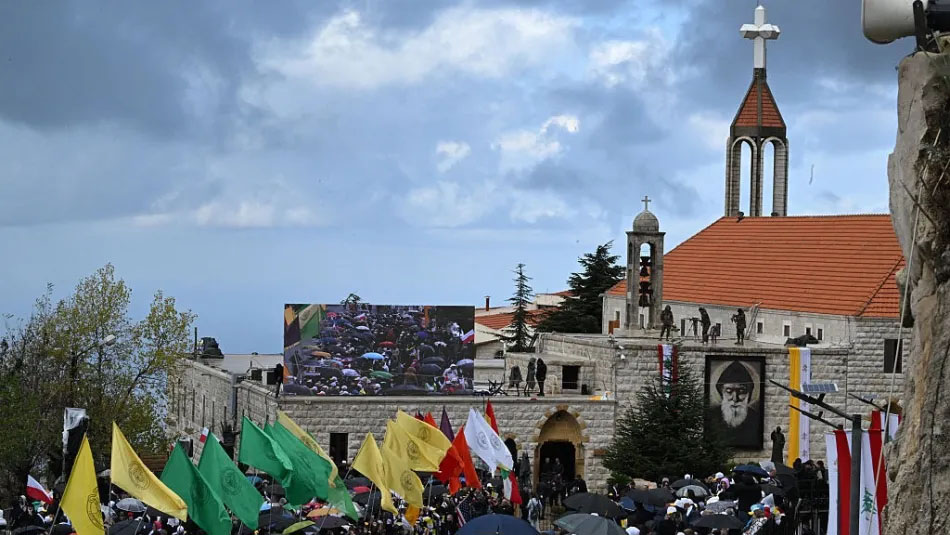
Crowds gather for the arrival of Pope Leo XIV to the tomb of Mar Charbel, a Lebanese Maronite monk and priest, at the Saint Maron monastery in Annaya, north of the capital Beirut on December 1, 2025. Photograph credit Joseph Eid/AFP via Getty Images.
Lebanon's politics have occupied a large part of my life. Reflecting on my past and drawing on refreshed memories of early Lebanese days and the diaspora, I can clearly see that my perspective on Lebanese politics has shifted between idealistic and realistic outlooks. Marwan Harb’s discussion of Lebanon as a political exception among other countries in the region in his article “The Maronite Exception in Lebanon: A Minority Unseduced by Authoritarianism,” published in Al Modon, particularly piqued my interest.*
In his research, Paris-based Lebanese scholar Marwan Harb highlights an anomaly in the politics of Middle Eastern countries, specifically in Lebanon, Syria, and Iraq: Why has authoritarianism taken hold in these countries but not in Lebanon? The comparative approach lends greater authenticity to his probe, which focuses on the "minoritarian" dimension. In his Al Modon article, Harb describes the Maronite minority’s experience in Lebanon as an exception, particularly when compared with the regional minority policies of Syria and Iraq, where Syria and Iraq, despite their respective Sunni and Shiite majority populations, were ruled by the Alawite (in Syria) and Sunni (in Iraq) minorities. His text treats authoritarianism among Middle Eastern minorities not as an ethical deviation but as a predictable political response to insecurity. In this climate, Lebanon diverges from the experiences of its neighbors in two respects: its prevailing attitude of restraint and the military's defined role vis-à-vis the state.
According to Harb, Maronites demonstrated wisdom in their refusal to translate demographic anxiety into authoritarian rule, as occurred in Syria under the Assads. To be precise, he explains that the Lebanese uphold pluralism. This stance draws from Lebanese theorist Michel Chiha’s deliberate-restraint approach and refusal to turn the army into an instrument of repression. Chiha did not theorize the rule of one sect over another, but advocated for a logic of balance and mutual recognition, writes Harb. His ideas, which are described in his book “Lebanon in Its Character and Presence” (Dar al-Nahar, 1998), argue that Lebanon “could not be built on numerical majoritarianism or sectarian solidarity, but on partnership.”
Two major political traditions have shaped Lebanese and Syrian approaches to minorities. Lebanon, representing one tradition, has embraced a pluralistic culture influenced by the aforementioned Lebanese liberal thinker and banker Michel Chica. The second tradition, prevalent in Syria, championed nationalistic ideals advocated by figures such as Michel Aflaq, Sati al-Husari, and Antoun Saadeh, the heads of numerous pan-Arabist and pan-Syrian political parties. These figures opposed Chiha's pluralist perspective. A close look at the political culture of the 1940s and 1950s places these two groups on rivaling sides, with Aflaq, al-Husari, and Saadeh on one hand, and Chiha on the other. The former laid the groundwork for nationalism and authoritarianism, while Chiha laid the groundwork for pluralism and coexistence.
Harb describes the Maronite experience as one of ‘restraint’: refraining from turning minority fear into a state ideology, refraining from transforming the army into an instrument of repression, and refraining from embracing authoritarianism. However, he contends that this attitude of restraint bears both positive and negative repercussions. On the downside, he notes that the Maronites have repeatedly failed to fortify the state and its institutions, committing errors in budget management and in protecting the idea of an inclusive state. However, exercising restraint has also prevented them from what he describes as the “easiest and most destructive option” — dictatorship. In using restraint as an active political stance, Lebanon refuses to militarize fear or ideologize security. Constrained by costs and vulnerability, showing restraint emphasizes the trade-offs between coercive power dominance and fragile pluralism. Despite Harb's emphasis on "restraint," though, some critics argue that the 1975-1990 civil war could have been avoided if the Lebanese army had been more active. Unlike most armies in the Arab world, Lebanon's army serves the state's legitimacy and governance rather than enforcing power.
Though short-lived, the mandate system introduced free elections and multi-party systems to Syria, Iraq, and Lebanon. This promising era ended in the mid-1950s, leading to military coups and authoritarianism. Lebanon avoided military coups, apart from a failed bloodless coup in 1961. Is there a relationship between civil wars and authoritarianism? There is no easy answer to this question. Syria endured more than half a century of dictatorial rule, yet its civil war began in 2011. Lebanon endured 15 years of civil war, yet did not have an authoritarian regime. Despite violence and internal divisions within its army, Lebanon resisted the temptation to stage a successful coup d'état and establish an authoritarian regime. But to answer this question fully, we need to examine the country's political, sectarian, and intellectual history, which we do not have space to explore here.
According to Harb, a key difference in a country’s path towards authoritarianism depends on the military’s position. He explains that in most countries of the region, armies were built upon a clear internal doctrine. Armies in these countries were established under the banner of “protecting the regime from society,” while also serving as the state's authority. The army “surveils the interior, disciplines politics, and manufactures legitimacy through force,” he states. Harb challenges the effectiveness of force and violence, drawing on Lebanon’s experience. The Lebanese army, despite divisions and civil wars, has “historically and symbolically remained closer to an institution tasked with protecting the entity and preventing its local collapse, rather than a systematic instrument of subjugation,” according to Harb. In Lebanon, the army prioritizes its unity and neutrality. Because of this, the army is considered, by some, including Harb, the last embodiment of an ‘inclusive state’ amid the country’s financial and institutional collapse. According to him, Lebanon’s exception to the authoritarian pipeline is evidence “that politics can be practiced without turning into a barracks, that minorities can seek security without manufacturing a dictator, and that the army can remain the pillar of the state without becoming the ceiling that suffocates society.”
Harb notes that Lebanon’s army cannot be supported through local resources alone, given the country’s financial state. Given the army’s necessity in maintaining the country’s stability and preventing the disintegration of the state, he emphasizes the importance of international responsibility — “not as charity, nor as a gateway to tutelage, but as a direct investment in stability.” He writes, “Such support does not contradict sovereignty; it constitutes one of its conditions.” Harb’s assumption is valid: international support can enhance sovereignty, though not in every situation or at all times. This aligns with the notion that international support may both strengthen and undermine sovereignty, depending on the context. A brief look at Lebanon before 2024 and after the Syrian regime's collapse suggests that foreign intervention could bolster sovereignty, whether through military assistance or efforts to deter Syrian intervention, though historical evidence is mixed. Observers cannot dispute that the Lebanese case is an exception, unfinished and still precarious. Lebanon's exception is not as a model but a fragile experiment that could still fail.
*Marwan Harb’s essay, “The Maronite Exception in Lebanon: A Minority Unseduced by Authoritarianism,” was published in Arabic in Al Modon.
This article appeared in Inside Al Jadid Reports, No. 156, 2026.
Copyright © 2026 AL JADID MAGAZINE