
Papal Visit Garners a Carefully Choreographed Welcome From Lebanon, a Pause in the Skies From Israel
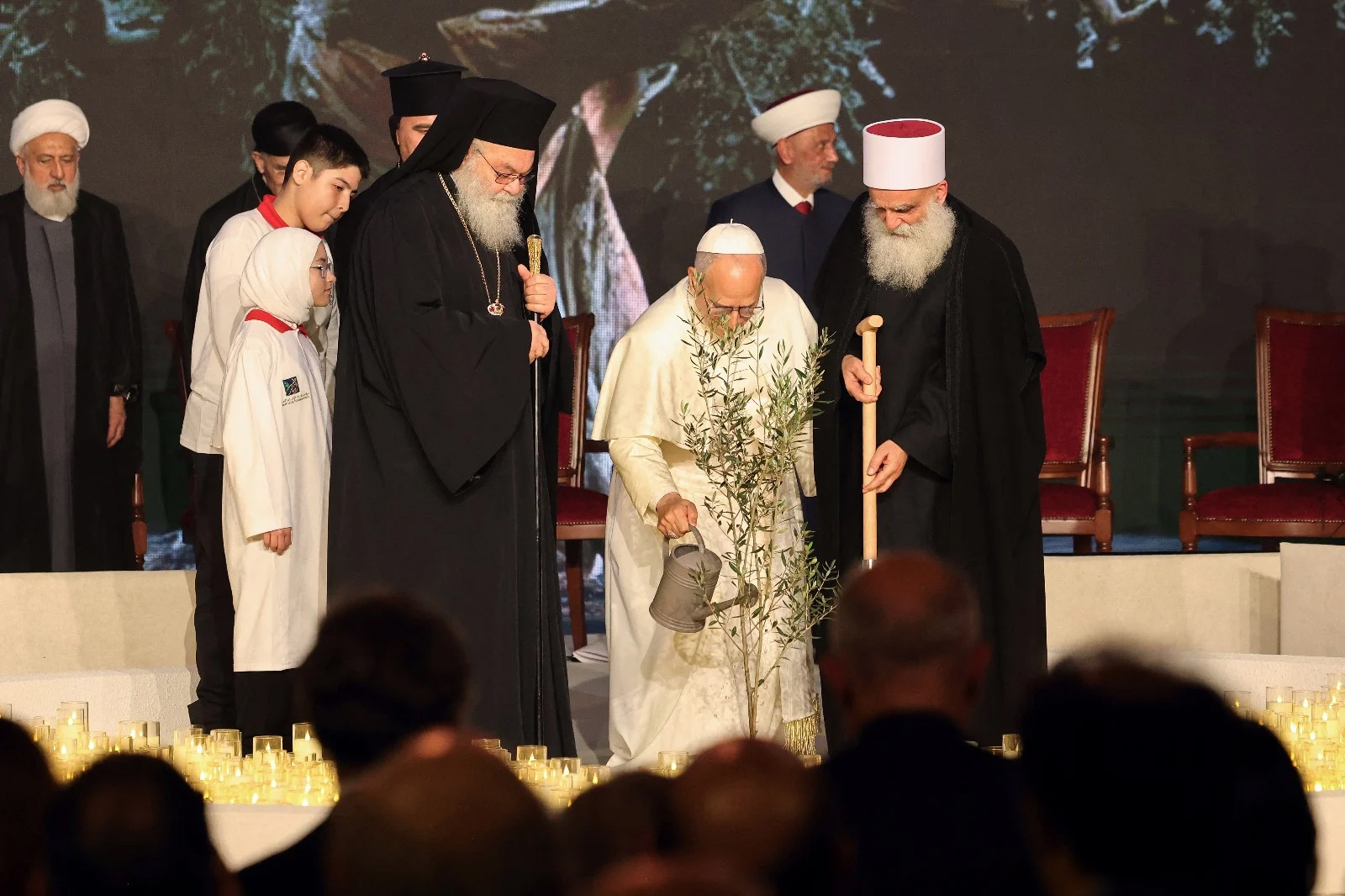
Pope Leo XIV meeting with representatives of Christian churches in the region as well as leaders from Lebanon’s various Muslim communities, held at Martyrs’ Square in Downtown Beirut. Photograph credit Anwar Amro/AFP.
Pope Leo XIV visited Turkey from November 27 to 30 and Lebanon from November 30 to December 2, 2025, completing his first foreign trip since assuming leadership of the Catholic Church. Lebanon welcomed the Pope with open arms as he arrived at Rafik Hariri International Airport in Beirut, greeted by Lebanese President Joseph Aoun and First Lady Naamat Aoun.
Pope Leo XIV was elected in May 2025, succeeding Pope Francis. He was born Robert Francis Prevost in 1955 in Chicago. He was the Prior General of the Order of Saint Augustine from 2001 to 2013. He previously served as Prefect of the Dicastery for Bishops, President of the Pontifical Commission for Latin America, Cardinal Deacon of Santa Monica, and Cardinal Bishop of Albano. Known for his pro-peace stance, he has expressed particular interest in Middle Eastern affairs. He calls for the protection of religious pluralism and peaceful coexistence.
Pope Leo XIV’s itinerary included meetings with President Joseph Aoun at Baabda Palace, Prime Minister Nawaf Salam, and, afterward, with Speaker of Parliament Nabih Berri in Ain al-Tineh. Before returning to Rome, the Pope gave a silent vigil at the Beirut Port to pray for the victims of the August 4, 2020, explosion and presided over a Mass at the waterfront.
With his visit to Lebanon, Pope Leo XIV continues to advocate for dialogue and unity amidst rising tensions in the region, arriving only days after an Israeli airstrike on southern Beirut. His visit constitutes the fourth papal visit to Lebanon, following those of Pope Paul VI in 1964, Pope John Paul II in 1997, and Pope Benedict XVI in 2012. Though Pope Francis had spoken of visiting Lebanon, he was unable to do so before his death last year due to the country’s crises and his declining health. In the words of Independent Arabia, “These visits centered on upholding hope and resilience, supporting coexistence, and reinforcing Lebanon’s ‘mission’ in the region, emphasizing that Lebanon will remain a land of encounter and dialogue, a message of peace to both the East and the West.”
As Hassan Ayoub explains in his essay, “The Pope’s Visit to Lebanon: Between the Spiritual Message and National and Economic Implications,” published in An Nahar, previous papal visits to Lebanon demonstrate how the objectives and impact of each visit have varied depending on the Pope's personality and the circumstances surrounding the visit.* Pope John Paul II’s visit, for example, focused on establishing Lebanon as a model of coexistence and promoted national reconciliation, as it occurred during a volatile period after years of division. Pope Benedict XVI’s visit took place amid regional turmoil and a fragile internal balance, with a focus on supporting the Christian presence, preserving religious identity, and fostering coexistence, writes Ayoub.
Compared to previous papal visits, Pope Leo XIV’s visit reveals the depth of Lebanon’s crises. According to Elie Kussayfi in Al Majalla, Lebanon has been mired in a bloody political crisis following the assassination of Prime Minister Rafik Hariri in 2005 and the withdrawal of Syrian forces from Lebanon, and to this day has yet to emerge from it.** The pope’s visit comes at a time of national crisis with economic, social, political, and security dimensions — particularly surrounding fears of a new war being launched by Israel in the near future — reflecting his concern for social justice and advocacy for the poor and marginalized. Ayoub suggests that the visit represents a "multifaceted opportunity for Lebanon: economically, to boost consumption and growth; politically, to send positive signals of stability and encourage investment; and nationally, to strengthen unity and a shared identity.” The event also reaffirms the Vatican’s view of Lebanon as a model of interfaith and intercultural existence as well as a cornerstone of the Middle East, states Independent Arabia, which adds: “The Pope carries a message of reassurance to Christians in Lebanon and the region, amidst widespread emigration and demographic decline. The visit also places the country back on the international map and provides an opportunity to open the door to humanitarian and diplomatic aid and initiatives.”
Writer and journalist Antoine Saad explains to Najia Dahsha in Al Jazeera that failing states, or those whose future is uncertain, are typically avoided by prominent figures, especially the Pope of the Catholic Church, citing Lebanon’s turbulent political history and the noticeable decline in visits by international leaders and figures.*** By visiting Lebanon after its recent election of a new president and formation of a new cabinet, Pope Leo XIV sends a signal to the Vatican that Lebanon, “despite its crises, is not a failed state as some claim, but rather a country still capable of facing the formidable challenges confronting it,” states Dahsha. The visit also carries a pointed message that Lebanon should not be turned into an arena for attacks or regional and international conflicts, urging all parties to “cease attempts at pressure and control and to stop pushing the country towards paths it cannot handle.”
Many challenges stand in the way of these goals, the most glaring of which remains pressure from Israel. Kussayfi notes that while Israeli planes ‘respected’ the Pope’s visit, “they are undoubtedly planning new rounds of attacks, perhaps even more violent ones.” He continues to question: “how can ‘violence and divisions in the Middle East be ‘overcome’ (quoting the Pope’s words) at a time when Israel is undergoing radical transformations that are taking it to the far right of the nationalist and religious spectrum, where the logic prevails that ‘what cannot be achieved by force can be achieved with more force’? This is a fundamental question that cannot be ignored when truly searching for new approaches to the conflict, approaches that cannot begin without a new understanding of Israel's mindset after October 7th.”
According to political analyst Sarkis Naoum, who spoke with Dahsha in Al Jazeera, Lebanese people of all sects welcomed the Pope’s visit and the Vatican’s role in establishing and restoring peace. He believes that the visit may be more exploratory than practical, as "the Vatican at this moment does not seem capable of taking direct steps towards Lebanon." However, he believes that the Pope will listen to the various Lebanese components, learn about the country's reality and the extent of popular interaction with him, and be briefed on the issues related to the different religious communities and political forces, writes Dahsha.
Lebanon has 18 officially recognized religious and sectarian communities — including 12 Christian denominations — with Shia and Sunni Muslims currently considered the largest religious groups in the country. Maronite Catholics are the largest Christian group, followed by Greek Orthodox. The Christians residing in Lebanon today have weathered wars and genocide over the past two millennia, with monastic communities dwelling in caves in the mountains to safeguard their faith and avoid persecution in the past. As Bassem Mroue writes in “Pope Leo XIV’s Visit Highlights Christian Resilience in Lebanon Despite Regional Turmoil,” published in the National Catholic Reporter, “Since the establishment of the State of Greater Lebanon in 1920 following World War I, Christians have played an instrumental role in shaping the country’s politics and economy.”**** Lebanon is home to the largest percentage of Christians in the Middle East, with Christians comprising approximately one-third of Lebanon’s five million population, giving the country its reputation as the “Christian heartland,”’ in Mroue's words.
Lebanon is also the only Arab country with a Christian head of state. Since its independence from France in 1943, a power-sharing agreement has designated the presidential seat for a Maronite, the Speaker of Parliament for a Shiite Muslim, and the prime minister for a Sunni Muslim. Additionally, after the end of the civil war in 1990 that left a rift between Christians and Muslims, seats in Parliament and the Cabinet have been equally divided between Christians and Muslims. Command of two of the country’s four security agencies is also entrusted to Christians: a Maronite general heads the Army, and a Greek Orthodox general heads the State Security.
Despite the historic presence of Christians in Lebanon, however, their future in the country — and arguably in the Middle East as a whole — has come under threat. Elie Kussayfi raises his concerns over Lebanese Christians’ commitment to neutrality and how this stance affects their plight. He asks: “Can the crisis of the Christians be examined in isolation from the crisis of Lebanon as a whole, and from the crisis of the region as a whole? In fact, there is a historical tendency among Lebanese Christians to isolate themselves from regional developments, even though they have failed to address them effectively, as in the 1975 war, which clearly demonstrated the extent of the interconnectedness between the Lebanese and regional spheres. This reality remains true today, albeit with different forces, personalities, and policies. Currently, the prevailing term is ‘neutrality,’ which practically repeats the same historical logical and political fallacy of Lebanese Christians in believing that they can politically isolate themselves within Lebanon, separate from the rest of the Lebanese population.” The attitude he refers to carries on today; many Christians in the country, including the head of the Maronite Church, Cardinal Bechara Rai, maintain that Lebanon should be “a neutral state (non-aligned with East or West) rather than an arena where regional and world powers settle their accounts,” as quoted by Mroue.
Another glaring problem, emigration from the region, not exclusive to Lebanon, has led to a decline in Arab Christian communities. In the past few decades, hundreds of thousands of Christians have permanently left their native lands due to wars and the rise of Muslim extremists. Mroue points out the situation in Iraq and Syria: in Iraq, large numbers of Christians fled after the U.S.-led invasion in 2003 and the rise of the Islamic State group. In 2014, ISIS declared a caliphate in large parts of Iraq and Syria, leading to an exodus of Christians and followers of other religions. ISIS has blown up churches in Syria and Iraq and confiscated many Christians’ property. Mroue furthers that a recent church bombing in Damascus in 2025 has made the remaining Christians in Syria consider leaving, explaining that “many Christians in Syria have been concerned about the direction of the country’s new government under interim President Ahmad al-Sharaa, former leader of the Islamist insurgent group Hayat Tahrir al-Sham.”
Against this background, Pope Leo XIV’s visit to Lebanon is “a recognition of the importance of Lebanon’s religious pluralism and a message to Christians not to abandon the region,” writes Mroue.
Lebanese Christians are among the groups most vulnerable to exclusion from power, political and security repression, and marginalization, states Kussayfi. Under the relentless pressures of the country’s economic crisis and the challenges of recovery following the Beirut port explosion, emigration was one of the few feasible options for this group. Yet many Christians refuse to leave, holding on to their ancestral homeland. “Perhaps this shift for Lebanese Christians, from ‘marginalization’ to ‘emigration,’ is what makes the Vatican so interested in Lebanon as the last major stronghold of Christians in the region,” says Kussayfi.
In the words of political analyst Youssef Diab, cited in Al Jazeera, Pope Leo XIV’s visit “serves to affirm this unique diversity and reinforce the idea that Lebanon is a gateway for the region to the world, and a platform for divine messages, culture, and coexistence, especially between Muslims and Christians, within a national unity that should be built on developing communities, not pushing them into internal conflicts that drain their resources.” Diab notes that the visit represented a “rare point of convergence among Lebanese of all sects and political parties, as they united in organizing a reception befitting the Pope, amidst a noticeable improvement in Muslim-Christian relations” — an unprecedented convergence of interests in building a “nation of message and coexistence, and a state that protects all its citizens equally in rights and duties.”
This mission of building a bridge between Muslims and Christians appears to be one of the Pope’s many goals, extending beyond Lebanon. In fact, Pope Leo XIV announced on the day of his departure from Lebanon his intention to visit Algeria as well, sparking widespread anticipation, with many hopes that the future visit would provide an opportunity for Algeria to reaffirm its openness to a Christian perspective.
Correction: A previous version of this article erroneously stated Pope Leo XIV is of Bolivian-American descent, which has been corrected.
*Hassan Ayoub’s essay, “The Pope’s Visit to Lebanon: Between the Spiritual Message and National and Economic Implications,” was published in Arabic in An Nahar.
*Hassan Ayoub’s essay, “The Pope’s Visit to Lebanon: Between the Spiritual Message and National and Economic Implications,” was published in Arabic in An Nahar.
**Elie Kussayfi’s essay, “The Pope’s Visit to Lebanon… Are ‘New Approaches’ Truly Possible?” was published in Arabic in Al Majalla.
***Najia Dahsha’s essay, “The Pope’s Visit to Lebanon: A Spiritual Event that Opens the Door to Political Questions,” was published in Arabic in Al Jazeera.
****Bassem Mroue’s essay, “Pope Leo XIV’s Visit Highlights Christian Resilience in Lebanon Despite Regional Turmoil,” was published in the online National Catholic Reporter.
This article appeared in Inside Al Jadid Reports, No. 151, 2026.
Copyright © 2026 AL JADID MAGAZINE