
Migration, Collective Memory, and National Trauma in the ‘Shadows of the Titanic’
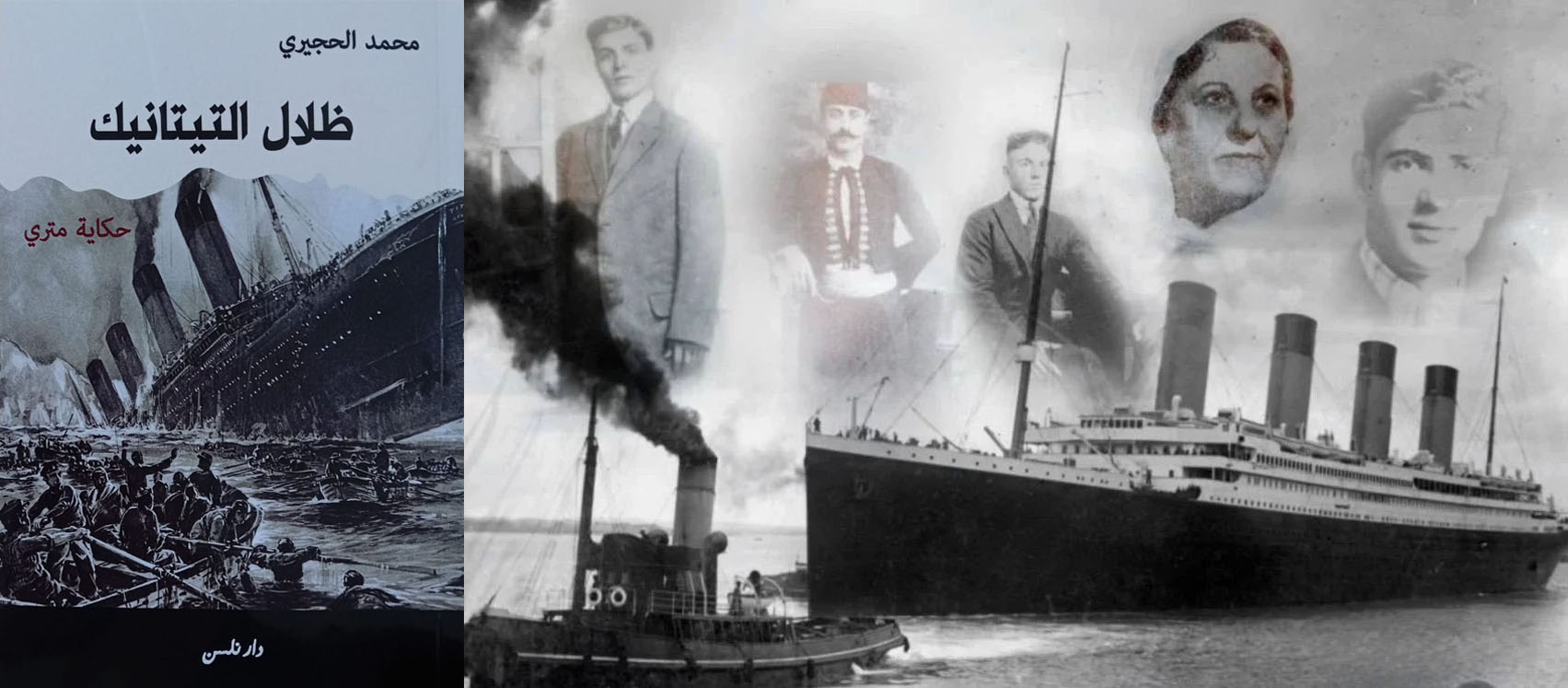
On the left, cover of “Shadows of the Titanic” (Dar Nelson, 2025) by Muhammad al-Hujairi. On the right, a photomontage of the Lebanese passengers aboard the RMS Titanic, courtesy of L’Orient-Le Jour.
Fascination with the Titanic has grasped the public for well over a century. Its name easily brings to mind several artistic and literary works — the 1997 film by James Cameron, the 1995 nonfiction book by American historian Walter Lord, “A Night to Remember,” and numerous sources like Encyclopedia Titanica dedicated to recording as many details as possible about the ship and its downfall. Syrian-American writer Leila Salloum Elias’ 2010 book “The Dream and then the Nightmare: Syrians Who Boarded the Titanic” broached the often overlooked Syrian and Lebanese victims of the sinking. The losses of the maritime tragedy — arguably among the most famous and deadly in history — were felt and mourned across the ocean, in Lebanese villages, where names of loved ones were lost, mis-reported, or remain unknown.
A new book published in 2025 touches on the Titanic and its connection to Lebanese immigrants. Muhammad al-Hujairi’s “Shadows of the Titanic,” published by Dar Nelson in November, draws from the intrigue surrounding the sinking Titanic and the loss of countless immigrant lives. The novel traces the life of 80-year-old Mitri Nasrallah, an emigrant living in Ottawa, Canada, who was born in the small Lebanese village of Kfar Mishki in 1942 — 30 years after the Titanic claimed over 1,500 lives after striking an iceberg on the night of April 14, 1912 and sinking to the depths of the Atlantic.
According to Encyclopedia Titanica, a comprehensive database comprised of research by historians, biographies, and articles relating to the RMS Titanic and its passengers, around 165 Lebanese and Syrian passengers were aboard the Titanic when it made its final journey, many of whom came from Mount Lebanon and some localities in the South.* Statistics indicate these passengers as Syrian due to the historic reality of the time (being that the region was then known as Greater Syria under Ottoman rule), but these numbers refer to both Lebanese and Syrians.
Lebanese made up one of the larger communities on the Titanic, ranking 5th after the British (327 passengers), Americans (306), Irish (120), and Swedish (113), with the youngest Arab passengers ranging from 3 months to 16 years old and the oldest being 45, cites Kamal Kobeissi in “Part II: The Story of the Forgotten Arab Victims of the Titanic, Told 100 Years Later,” published in Al Arabiya London.** Of the estimated 165 Lebanese passengers, only 30 survived; among them, only 4 men. Leila Salloum Elias’ research published in her essay “The Syrian Passengers on the Titanic — Almost Lost in History” in the online website Arab America found evidence of five Palestinian men who boarded the ship, whose presence are only confirmed by “one bell of five originally made that is on display in the Tulkaram Museum of Palestinian History. The five original bells were made and sent to various Palestinian schools to be rung commemorating the loss of the five Palestinian passengers.”***
The majority of the Titanic’s Lebanese passengers were in steerage, or Third Class, and were mostly laborers or farmers, as indicated by the travel contracts they signed with the company that owned the ship, writes Kobeissi. He adds, “The only proof that those passengers were Lebanese is not their travel document since they carried Ottoman identification that referred to them as residents of Greater Syria, which includes present-day Syria, Lebanon, Palestine, and Jordan. It was rather the fact that they came from villages that still have the same names in Lebanon.”
In search of better futures, these migrants left their native lands to escape poverty and mandatory conscription under Ottoman rule. Suzanne Baaklini in L’Orient-Le Jour notes that mothers encouraged their sons to emigrate for better job opportunities; Lebanese artisans were losing their jobs due to new technologies introduced by Europe, while main industries like silk production were in crisis.**** At the same time, many were journeying to meet their relatives abroad who had made the trips before them. Baaklini describes one of the many routes that these travelers took: “To arrive at Cherbourg port, many traveled a long and expensive journey. First, one needed to reach Beirut by donkey or horseback, where they would then embark for Marseille. From Marseille a train would be taken to Paris, and finally, another one to the Norman Port.”
In total, 13 or 14 inhabitants of the Lebanese village Kfar Mishki attempted the crossing, the reported number depending on varying sources. Of this number, only one — Mariana Assaf Khalil (alternatively spelled Mariyam Assaf Khalil) — survived. This was the largest number of Titanic fatalities for any one Lebanese village. According to Salloum Elias, members from the village who had left and established a community in Ottawa, Canada had difficulty recognizing Khalil, until the confusion was cleared by New York-based Arabic language newspaper Mir’at al-Gharb on May 10, 1912, which revealed her identity as Zad Nasrallah from Kfar Mishki. As the sole survivor from her village, Nasrallah had been the one who confirmed the loss of her fellow villagers in the sinking, states Salloum Elias.
The aftermath of the Titanic’s sinking left the Arab community in disarray and simultaneously showed the lengths the community could go to support each other. While survivors received between 150-200 USD in charitable funds from organizations and the owners of the Titanic, White Star Line, the issue of identifying the victims remained. Newspapers published the names of passengers from First and Second Class initially, then Third Class a few days later, cites Salloum Elias. Due to language barriers, the spellings of Lebanese passengers’ names were often distorted by the European crew. Amid the rush for answers, the Arabic-language newspapers in New York played vital roles in keeping their communities informed. As Salloum Elias writes, “The Syrian community in the U.S. depended on the Arabic-language newspapers of New York as their news outlet. Queries were published in these papers from those seeking clarification as to the passengers and their hometowns. Letters from the American and Canadian Syrian communities were published in the various Arabic newspapers asking if any of the survivors had information on those who had boarded from their hometowns.”
Though a work of fiction, Muhammad al-Hujairi’s novel “Shadows of the Titanic” closely resembles real places, times, people, and events. In the words of Salman Zain al-Din, who reviews the book in Independent Arabia, “Hujairi’s engagement with the tragedy [the sinking of the Titanic] is merely a pretext for discussing migration, rather than the central axis of the novel.”*****
The story follows 80-year-old Mitri Nasrallah, an emigrant who was born in Kfar Mishki in 1942, as he retraces his memories “in the hope of freeing himself from the burdens of its painful episodes,” observes Zain al-Din. A man whose life has been riddled with misfortune, Mitri recalls the different stages of his life — from his childhood in the village, his adolescence and youth in Beirut, to his adulthood and old age, encompassing the trials he encountered in education, work, marriage, migration, and divorce. Mitri was raised by a miserly father and mentally unstable mother who beat him. He ended up marrying a woman who cheats on him with her cousin. After being kidnapped in the Barbir area of Beirut in May 1976, he and his family decided to migrate to Canada. His wife’s infidelity becomes a regret that haunts him his entire life, as he can neither live with her nor divorce her, the ecclesiastical church ruling in her favor when he finally tries to file for divorce.
Mitri perpetually lives at a crossroads between past and present, Lebanon and Canada, exile and yearning, marriage and love pitted against divorce and betrayal. As Zain al-Din writes, “Such tensions are common among migrants — especially in the early months of migration — but when they persist throughout life, as in Mitri’s case, they indicate deeper psychological wounds. This is why, even at the age of 80, he follows every piece of news about his hometown, Kfar Mishki, and remains preoccupied with the Titanic disaster that occurred 30 years before he was born — because 12 of its victims came from his village.”
“Shadows of the Titanic,” though not a work directly dealing with the tragedy of the Titanic, offers a unique look into the perils and setbacks Lebanese migrants have faced in their exile, whether in the early 20th century, in the 1970s, or the present. In the words of Zain al-Din, “Hujairi raises the question of 20th century migration to the American West — driven by poverty, hunger, misery, and war, and motivated by the search for a dignified life in the New World.” He continues, “Some succeeded; others returned with nothing to show for their efforts; still others found their paths cut off entirely. The novel traces what migrants endure: anxiety, uprooting, alienation, loneliness, poverty, longing, and the dangers that may prevent them from reaching their destination — including the threat of drowning, as in the case of the Titanic’s emigrants.”
*Leila Salloum Elias’ essay, “Alien Passengers: Syrians Aboard the Titanic,” was published in Encyclopedia Titanica.
**Kamal Kobeissi’s essay, “Part II: The story of the Forgotten Arab Victims of the Titanic, Told 100 Years Later,” was published in Arabic in Al Arabiya.
***Leila Salloum Elias’ essay, “The Syrian Passengers on the Titanic — Almost Lost in History,” was published in Arab America.
****Suzanne Baaklini’s essay, “Lebanese Passengers Aboard the Titanic: In Pursuit of the American Dream,” was published in L’Orient-Le Jour.
*****Salman Zain al-Din’s essay, ‘“Shadows of the Titanic’ Raises the Question of Lebanese Migration to America,” was published in Arabic in Independent Arabia.
This article appeared in Inside Al Jadid Reports, No. 149, 2025.
Copyright © 2025 AL JADID MAGAZINE