
Seven Years After Her Passing, Emily Nasrallah’s Words Still Carry the Homeland
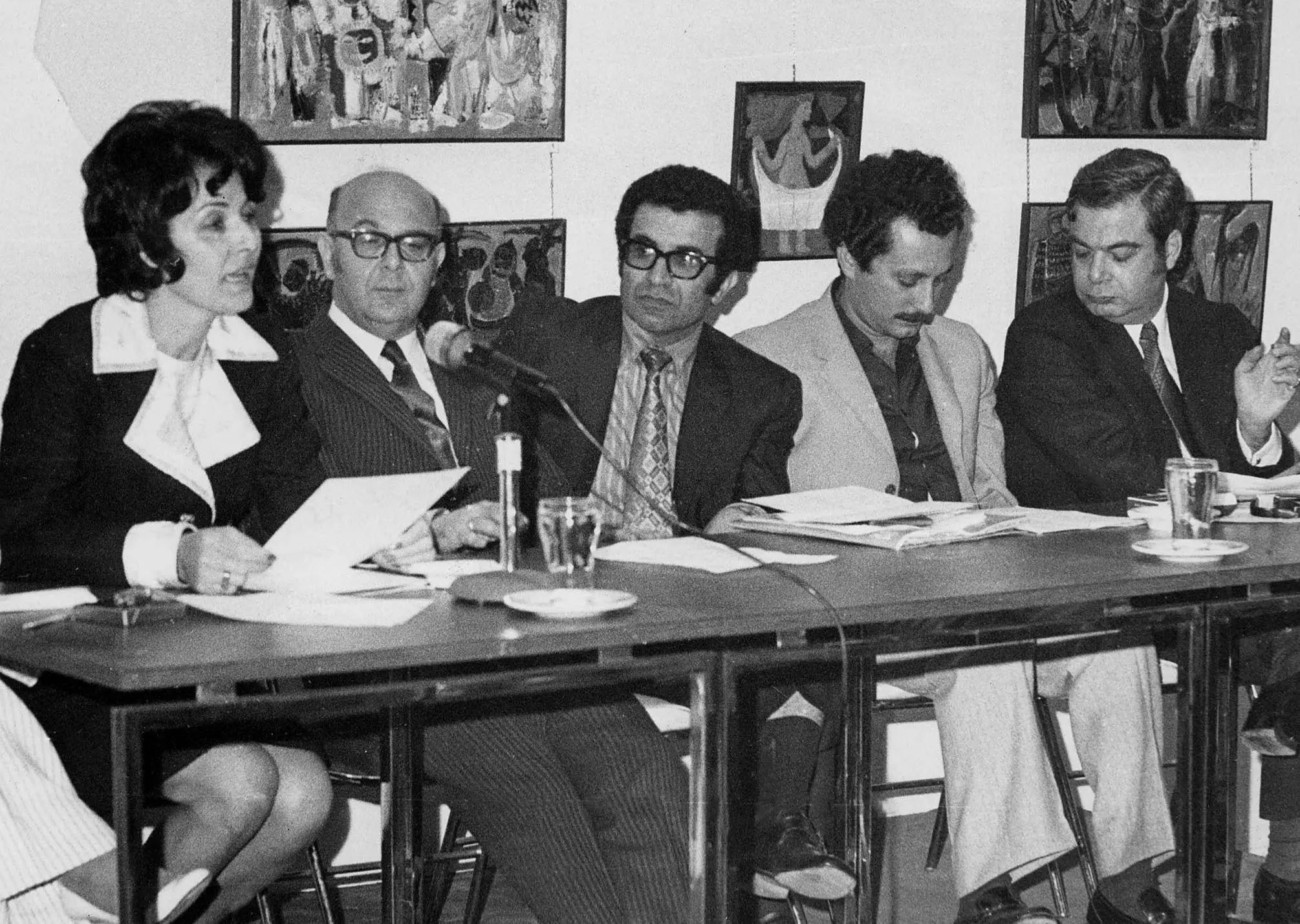
Left to right: Lebanese novelist Emily Nasrallah, Beirut’s Pen Club president, Lebanese writer Jamil Jabre, Syrian novelist Halim Barakat, Palestinian author Ghassan Kanafani, and Lebanese novelist Yussef Habshi al-Ashqar, Dar al-Fan Gallery, 1971. (AFP)
Renowned Lebanese writer Emily Nasrallah’s legacy continues to broaden the understanding of emigration and exile, celebrated seven years after her death and living on through a foundation established in her honor, the Beit Touyour Ayloul Foundation, named after her first novel, “Birds of September.” On July 7, 2025, the Oriental Library of the Saint Joseph University of Beirut became the new home to a part of Nasrallah’s archive. A decade ago, Nasrallah had also donated 17 documents of her literary works to the same library.
Born on July 6, 1931, in Kfeir, South Lebanon, the late Emily Nasrallah (née Abi Rached) remains one of the most influential Lebanese women writers. A novelist, journalist, and activist, her writing frequently addressed women’s issues, the Lebanese Civil War, and the void left by migration. She is perhaps most famously known for her works centered on Lebanese rural life, exploring the complexity of family roots, tradition, migration from the village, and their contrast with urban life.
Nasrallah received her formal education in the elementary public school of Kfeir, and went on to complete her secondary education in Shoueifat National College with the support of her uncle. She studied at the Beirut University College (Lebanese American University) and graduated with a B.A. Degree in Education from the American University of Beirut in 1958. Though she began working in journalism as a college student, it wasn’t until the early 1960s that Nasrallah started to foray into novelistic writing. According to Salman Zain al-Din in his essay, “Emily Nasrallah Revived Village Literature and Launched ‘Birds of September,”’ published in Independent Arabia, she was attending a reception at the Indian Embassy when her friend Ruba Jensen asked her when she would write her first novel.* In 1962, Nasrallah published her first novel, “Birds of September,” fully launching her writing career. The novel won a slew of awards — the Friends of the Book Prize and Said Akl Prize — and has been reprinted in 16 editions in multiple languages, including a Braille edition in 2015.
“Birds of September” (Touyour Ayloul) is a portrait of life in the Lebanese countryside, its limited opportunities, and the “forces that drive its young men and women to migrate to the city abroad, where they experience their first estrangement,” writes Zain al-Din. “When some return, they live their second estrangement, realizing that neither home nor self is as before. She traces human relationships bound by tradition and social norms, love stories stifled by custom, and the submission of women to patriarchal rural mentality — all while not overlooking the village’s positive dimensions. The novel thus offers a multi-layered perspective — simultaneously critical and affectionate — on the village, the city, and the diaspora.”
Nasrallah wrote about war, exile, immigration, poverty, and the plight of women in both the countryside and urban settings. The village was central to her writing — “it is ‘land’ and ‘nature’ and the ‘roots’ which could not be extracted since they are ‘rooted in the self.’ As if she wants to distance herself from naive romanticization of village life, she highlights how the ‘traditions of the village’ tend to humiliate woman, negate her will, emotion, mind and ambition and then her existence,” as the late Professor Mitri Salim Boulous writes in An Nahar’s Supplement, quoted in “Women’s Concerns Occupy the Consciousness of Lebanese Novelist, Emily Nasrallah,” published in Al Jadid, Vol. 2, No. 9, July 1996.**
In contrast to the village, city life equally plays a significant role in her stories. In her novel “The Bondaged” (Al Rahina, 1974), the heroine Rania, a rural girl, leaves her village for the city in pursuit of education, yet “lives the traditions of the village in her heart,” ultimately returning to her village, “where her roots are,” states Boulous. “Those Memories” (Tilka az Zikrayat, 1980) centers on the city and the onset of the Lebanese Civil War. In the words of Boulous, the novel articulates a “rejection of the logic of war regardless of its type,” urging intellectuals, both men and women, to continue in their pursuit of literary creativity in spite of the dangerous realities with which they face. Nasrallah’s contributions in writing on war earned her a reputation as one of the Beirut Decentrists, a term used by academic Miriam Cooke in her book “Women Write War: The Centering of the Beirut Decentrists” (1987) in reference to a group of women writers based in Beirut who were active during the civil war years.
Nasrallah’s last novel, “What Happened in Tamaya Islands” (Ma Hadatha Fi Jozor Tamaya, 2006) tells the story of the “Lebanese dream — from its perilous beginnings and love of adventure to the pursuit of a better life, the daily struggle, and the quest for wealth through both legitimate and illegitimate means — culminating in tragic ends,” states Zain al-Din. The subject of migration takes center stage, depicting an emigrant’s attempts to flee poverty and oppression only to find alienation, suffering, and deceit. He adds: “The novel thus adopts a pessimistic view of exile, portraying migration as a grinder that crushes both the virtuous and the corrupt alike…The language is direct and unadorned, naming things plainly, integrating colloquial expressions, proverbs, and popular idioms — a mirror of the reality it depicts.”
Nasrallah’s daughter Maha told The National, “The fact that people were born to emigrate made her mother sad,” as quoted by Olivia Snaije in her article, “A Wish Fulfilled: Inside the Cultural Foundation Set Up for Emily Nasrallah.”*** In her novel “Flight Against Time” (Al Iklaa Aks Az Zaman, 1981), translated into English by Issa Boullata, Nasrallah wrote: “The village changed into a nursery that embraced the seedlings for a while, and when the trunk grew, and the roots became stronger, the seedling would seek to be transplanted to a larger land.”
Emily Nasrallah died on March 13, 2018, after battling stage-3 breast cancer. The author produced 64 works total, 45 of which were published. These included 9 novels, 10 short story collections, 7 young adult novels, 5 children’s books, six volumes of her Nisaa' Ra'idat series (Pioneering Women from the East and West), five volumes of “From the Harvest of Days,” one poetry collection, a book of interviews, and an autobiography, “The Place” (Al-Makan, 2018), published posthumously. The autobiography, spanning the 19th to the mid-20th century, followed the migration stories of Nasrallah’s close and extended family and recounted Lebanese village life as she remembered it. Nasrallah was posthumously awarded an Honorable Mention for her book in the 2018 Khayrallah Prize competition, receiving $1,000 for her foundation.
Carrying on the author’s legacy, the Beit Touyour Ayloul Foundation was founded by her daughter, Maha, in her honor, realizing a longtime dream that began in 2011 when Nasrallah and her siblings reunited in her hometown of Kfeir and began discussing transforming their family home into a library and cultural center specializing in migration literature. The family home was fully renovated in 2015 by Maha, an artist, architect, and the executor of her mother’s estate. Beit Touyour Ayloul Foundation opened its doors shortly after Nasrallah’s death, welcoming the public to peruse its two libraries, one including Nasrallah’s personal library and her published books, and a second library focusing entirely on emigration from the region.
With the recent donation of her works to Saint Joseph University in Beirut, Nasrallah’s writing will continue to touch the lives of others and offer immensely valuable insight into Lebanese migration, women’s issues, and war. As she once wrote in the preface to a collection of short stories, quoted in The National: “The word has become a refuge and a lifeboat — the poem or story, a substitute nation.”
*Salman Zain al-Din’s essay, “Emily Nasrallah Revived Village Literature and Launched ‘Birds of September,”’ was published in Arabic in Independent Arabia.
**“Women’s Concerns Occupy the Consciousness of Lebanese Novelist, Emily Nasrallah” appeared in Al Jadid Magazine, Vol. 2, No. 9, July 1996.
***Olivia Snaije’s essay, “A Wish Fulfilled: Inside the Cultural Foundation Set Up for Emily Nasrallah,” was published in The National.
Further Reading
Al Jadid previously published articles by or about Emily Nasrallah and her works, which can be found below:
“Women’s Concerns Occupy the Consciousness of Lebanese Novelist, Emily Nasrallah” appeared in Al Jadid Magazine, Vol. 2, No. 9, July 1996.
“Tradition’s Victims: Love and Marriage in Emily Nasrallah’s ‘Dormant Embers”’ by John Naoum Tannous appeared in Al Jadid Magazine, Vol. 8, No. 40, Summer 2002. To read the article, click on the link below:
“The Lebanese Abroad” by Emily Nasrallah appeared in Al Jadid Magazine, Vol. 8, No. 41, Fall 2002. To read the article, click on the link below:
This article appeared in Inside Al Jadid Reports, No. 147, 2025.
Copyright © 2025 AL JADID MAGAZINE