
Algeria and the Courage to Look
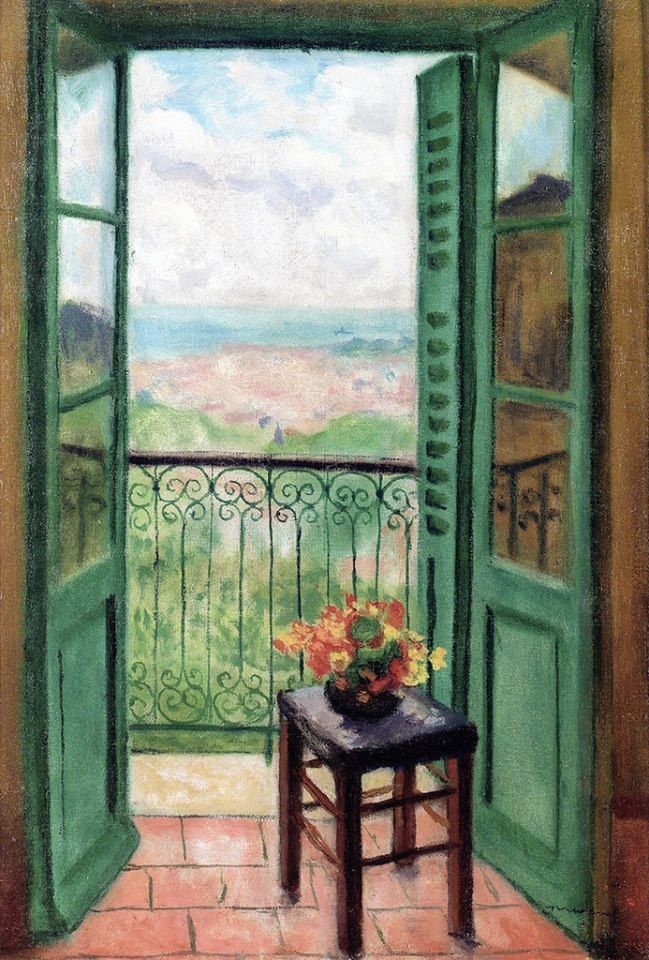
“Fenêtre ouverte sur la baie d’Alger” (Window Overlooking the Bay of Algiers, 1913) by Albert Marquet.
A healthy literature cannot be entirely free of crime fiction, or, more broadly, of literature that confronts crime, violence, and human conflict. No society is free of conflicts, whether visible or hidden. A brief look at Algeria’s history before and after independence reveals a long record of political upheaval, repression, and violence. The question, then, is not whether such realities exist, but whether literature is willing to confront them.
Award-winning Algerian novelist Said Khatibi raises precisely this question in his Al-Quds al-Arabi column.* While his observations concern Algerian literature, they also resonate beyond Algeria, across other Arab and North African societies. Khatibi criticizes what he describes as “soft,” “blind,” and “accommodating” literature, or writing that avoids difficult questions, seeks the safety of prevailing narratives, and prefers to reassure readers rather than disturb them. Against this tendency, he calls for a literature capable of looking directly at its society and questioning the forces that have shaped it.
For Khatibi, Algeria’s turbulent history cannot be separated from its literary imagination. The country’s experience of coups, repression, social upheaval, and the violence of the 1990s has left its mark on collective memory and continues to shape how Algeria understands itself. Yet, he argues, much of contemporary literature has become reluctant to revisit these difficult chapters, resulting in a retreat from literature’s traditional role as a witness to history.
Algeria’s Mediterranean setting provides another dimension to this history. Having long been a meeting place of civilizations, empires, ideas, and competing powers, the Mediterranean has brought exchange and cultural encounter, but has also witnessed conquest, conflict, and bloodshed. Algeria, situated within this contradictory landscape, has experienced both currents. In the eyes of Khatibi, violence is not an alien theme imposed upon Algerian literature; it belongs to the country’s historical and human experience.
His sharpest criticism is directed at writers who, in his view, have increasingly withdrawn from the risks of creative expression. He argues that fear of censorship and a desire to remain close to prevailing discourse have encouraged some writers to retreat from confrontation. Rather than following what they perceive as truth or the conscience of literature, they gravitate toward the safest and loudest voices. Literature becomes less interested in disturbing the reader, provoking debate, or raising uncomfortable questions than in securing acceptance and peace of mind.
Khatibi refers to this tendency as “accommodating literature” — literature that can be consumed without resistance and forgotten without consequence; stories that entertain without requiring the reader to reconsider himself or his society. In this sense, its problem is not simply that it is harmless. Its deeper problem is that it risks reducing literature to reassurance, allowing it to coexist comfortably with the dominant discourse rather than interrogating it.
His metaphor of “blind literature” takes the argument further. Algerian literature, he suggests, has moved from bearing witness to history toward closing its eyes to what surrounds it. He calls upon writers to restore its sight, even imagining the need to give literature “a cornea so it can see again.” The metaphor captures his broader concern: literature that refuses to confront violence also forfeits an important opportunity to understand the society that produces it.
This is where crime literature, understood in a broad literary rather than narrowly generic sense, becomes essential. Khatibi does not advocate writing about crime simply to reopen wounds, reproduce suffering, or indulge in darkness. Rather, he sees literature concerned with crime and violence as a means of dismantling the machinery behind them. It can explore how individuals move from tranquility toward cruelty, how violence alters the psyche, and how private acts of brutality can reflect deeper social tensions.
Such literature can therefore become a form of inquiry, examining not only what happened but how and why it happened. It can illuminate both the visible conflicts of a society and those that remain beneath the surface. Delving into the psychology of individuals and communities helps readers confront the fragility of human behavior and the conditions under which violence becomes possible.
The scarcity of such writing, Khatibi argues, reflects a broader reluctance to look beneath the surface. The alternative is the soft, “blind and accommodating” literature that tells readers what they already expect to hear, confirms familiar opinions, and avoids challenging established assumptions. But literature loses something essential when its relationship with the reader becomes a pact of comfort rather than an invitation to inquiry.
The real challenge, then, is not simply to write about crime. It is to look through the window that crime and violence open onto society. For Algeria, that window leads toward history, memory, psychology, and the unresolved conflicts that continue to shape the present. Literature need not reopen wounds for the sake of suffering, but it must, however, have the courage to examine them if it is to understand how they were inflicted and what they have left behind.
Khatibi’s ultimate question is therefore larger than the question of literary genre: How did Algeria arrive at where it is today? A literature willing to ask that question may disturb its readers, challenge prevailing narratives, and risk stepping beyond the boundaries of comfort. But that may also be precisely where literature recovers its sight and its reason for being.
*Said Khatibi’s essay, “To Look Upon Algeria Through a Window of Violence,” was published in Arabic in Al Quds Al Arabi.
This article appeared in Inside Al Jadid Reports, No. 187, 2026.
Copyright © 2026 AL JADID MAGAZINE