
Rethinking Crime Fiction in Arab Criticism
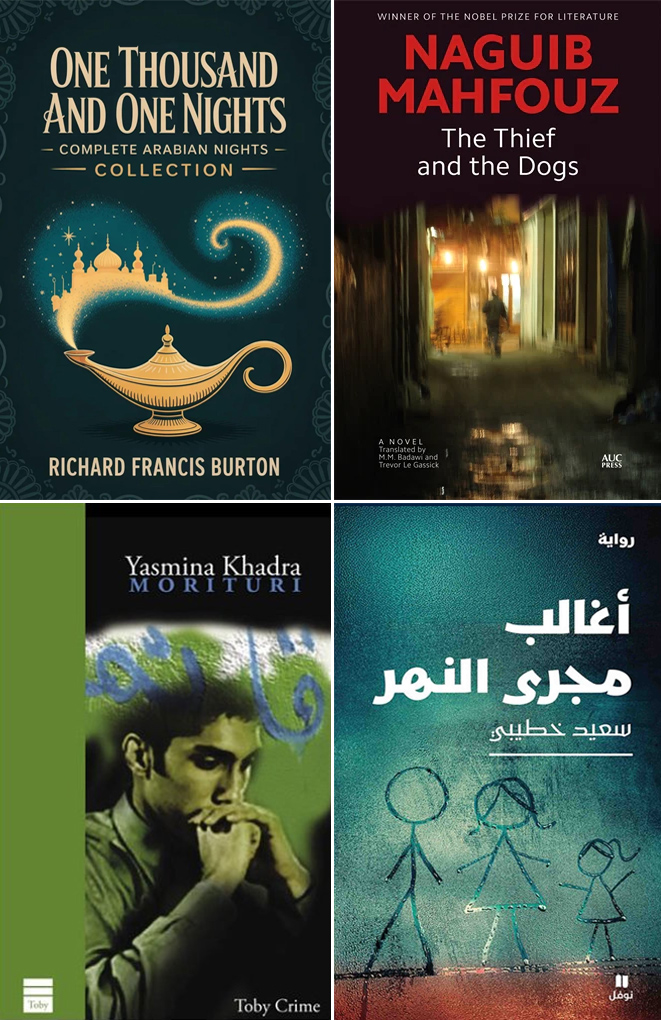
From left to right, top to bottom: “One Thousand and One Nights,” “The Thief and the Dogs” (1961) by Naguib Mahfouz, “Morituri” (1997) by Yasmina Khadra, from the “Inspector Llob” series, and “Swimming Against the Tide” (2025) by Said Khatibi.
Though the crime fiction genre has seen a rise in popularity among Arab writers in recent years, Arab criticism continues to treat the detective novel as inferior in the hierarchy of literary genres. Tales surrounding murder and mystery in Arab literature can be traced back to some renowned works of Arab literature — from classics like “One Thousand and One Nights” to more contemporary works like “The Thief and the Dogs” by Naguib Mahfouz or Yasmina Khadra’s “Inspector Llob” series. Yet it is not uncommon to hear the detective novel described by intellectuals as not "serious" enough or incapable of attaining the stature of novels that grapple with "serious" themes like identity, history, defeat, exile, and tyranny. Other sources state the genre has been treated as youth literature, dismissed by critics. For this reason, the genre has been sidelined as literature for entertainment rather than professional literature.
In his essay “The Novel We Are Wary Of: Why Does Arab Criticism Still Hesitate Before the Detective Novel?”, published in Al-Quds Al-Arabi, Iyad Shamasneh argues that the dismissive attitude towards the detective novel stems from a misconception about the genre.* He writes, "The detective novel is not simply a story about a murderer, an investigator, clues, and the unveiling of the culprit on the final page. That is a dangerously superficial definition. A deeper understanding sees it as a form that makes truth itself the subject of narration, and turns storytelling into a struggle against deception, obfuscation, corruption of power, and fraud."
According to Shamasneh, the Arab novel has come to bear several expectations since the Nahda: great works, in some way or another, must deal with subjects of reform, consciousness-raising, anti-colonial resistance, and representation of the collective, all the while deconstructing the grand questions of Arab history. As such, crime fiction novels, which thrive on suspense and excitement, drawing in wide readership without the "heavy scaffolding of critical tradition," are treated with suspicion within critical circles. He states, "It is as though 'good literature,' in the inherited Arab sensibility, must be slow, solemn, laden with reflection, grand themes, and profound philosophy."
Algerian writer Said Khatibi, whose crime fiction novel “Swimming Against the Tide” (Ughalib Majra al-Nahr, Dar Nofal, 2025) recently received the 2026 Arab Booker Prize (IPAF), comments on the on the stagnant state of the Arab novel in an interview with Alsayed Hussein in Al Majalla.** In his words, “Readers actively resist any attempt to rouse the Arab novel from its slumber or to break it free from repetitive, formulaic patterns.” He refers to certain readers on social media platforms who are “accustomed to a singular form of the novel — one characterized by narrative padding and emotional manipulation. Consequently, when they encounter a novel of a different nature, they place unreasonable demands upon the author; he becomes a figure of suspicion simply for having deviated from the established norm.”
Those who dismiss the detective novel tend to overlook its strengths. Shamasneh points out the irony surrounding the derision of the genre: "Here lies the paradox: a culture that laments declining readership looks down upon genres capable of creating readers; a critical tradition that complains about weak construction in the Arab novel hesitates to recognize a genre founded precisely on structural rigor." He praises the disciplined narration of crime fiction novels and contrasts it with the "certain laziness in some 'highbrow' novels," which "revel in dazzling language and dense reflection, yet whose events are tepid, conflicts fragile, and characters less alive than they are vehicles for the author's ideas." In his words, the detective novel is "a precise architecture that may falter if a single detail is added or misplaced." Such works are exercises in discipline, making every detail purposeful.
Crime fiction flourishes in Europe and America, but has been unable to thrive in Arab literature and criticism because “its fundamental condition — the belief in the possibility of uncovering truth within a coherent system — is often lacking,” writes Shamasneh. If the novel is a product of the “modern city,” then the detective novel is a product of “modern law” — that is, the settings of crime fiction novels deal directly with the police, courtroom, case file, testimony, and investigation. In many Arab contexts, especially since the Arab Spring, the police are not perceived as neutral, nor are investigations or the judicial system clear-cut or reliable. He states, “In the public imagination, the policeman is not necessarily a guardian of order but may be an arm of authority; investigation may become a means of coercion; and the case file an instrument of distorted power.”
However, Shamasneh suggests that when implemented correctly, this creates fertile ground for the makings of a successful detective novel, being that contemporary Arab societies are rife with "erased facts, forced disappearances, fabricated narratives, incomplete case files, and fluid boundaries between the criminal and the political, the security-related and the economic, war and crime."
Crime fiction novels may be more successfully widespread in Western literature than in the Arab literary library, but this genre is not as removed from Arab writing tradition as one may think. Said Khatibi explains in his interview that “crime fiction was, in fact, born within the Arabic literary tradition — specifically through “One Thousand and One Nights,” the foundational text of Arabic narrative.” He adds, “We must recognize that this genre possesses indigenous Arab origins, and that the Arab writer bears the responsibility for this subsequent hiatus.”
Continued debate surrounding the legitimacy of the detective novel in Arab criticism reflects a reluctance among critics to revise its old hierarchies, states Shamasneh. He clarifies that Arab criticism remains "captive to arbitrary separations" — serious vs. popular literature, idea vs. plot... "as though the great novel must choose between depth and suspense, thought and movement, linguistic brilliance and narrative flexibility. These are false dichotomies." As he explains, the genre found success in European and American literatures because it “compelled modern narrative to become more precise, more conscious of time, more economical with information, and more respectful of the reader.” Meanwhile, the hesitation to recognize crime fiction in Arab criticism “reveals not only a limitation in reception, but a limitation in the very conception of literature and the distribution of legitimacy among its forms."
This hesitation, Shamasneh adds, suggests weaknesses that Arab critics prefer not to confront — the strengths of the detective novel especially emphasize that many Arab novels “suffer not from a lack of thought or language, but from a lack of discipline." Weak narrative structure cannot hide behind ornate sentences or rhetorical flourish.
As Shamasneh suggests, the debate over the Arab crime novel can only be resolved by re-evaluating the concept of the novel, irrespective of its grand subject matter, ornate language, or the symbolic stature of the author, because "a novel is, above all, a structure. And when structure weakens, noble intentions — so often invoked — cannot save it."
*Iyad Shamasneh’s essay, “The Novel We Are Wary Of: Why Does Arab Criticism Still Hesitate Before the Detective Novel?”, was published Arabic in Al-Quds Al-Arabi.
**Alsayed Hussein’s interview with Said Khatibi, “Saïd Khatibi to Al-Majalla: Crime Fiction Was Born in Arabic,” was published in Arabic in Al Majalla.
This article appeared in Inside Al Jadid Reports, No. 167, 2026.
Copyright © 2026 AL JADID MAGAZINE