
Unraveling Said Khatibi’s Algerian Crime Fiction Novel
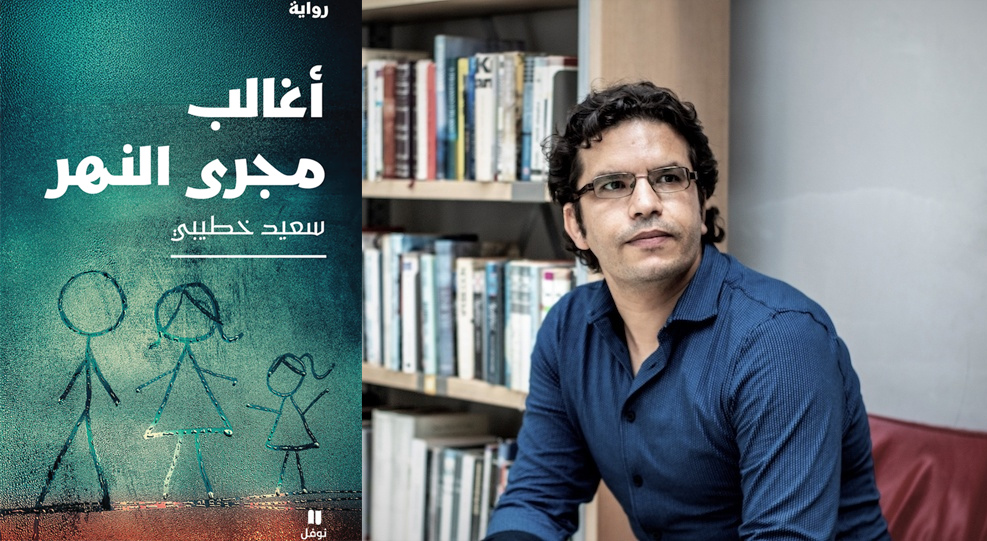
Algerian writer Said Khatibi and his novel, “Swimming Against the Tide” (Dar Nofal, 2025), winner of the 2026 International Prize for Arabic Fiction.
Algerian writer Said Khatibi’s novel “Swimming Against the Tide” (Ughalib Majra al-Nahr, Dar Nofal, 2025) was named the winner of the 2026 International Prize for Arabic Fiction (IPAF), otherwise known as the Arabic Booker. The novel competed against works by Egyptian novelist Ahmed Abdel-Latif, Algerian novelist Amin Zaoui, Egyptian author Doaa Ibrahim, Iraqi novelist and writer Diaa Jubaili, and Lebanese novelist and journalist Najwa Barakat. Khatibi’s prize-winning novel “Swimming Against the Tide” takes readers to his hometown of Bou-Saada, a small town in southern Algeria, in the early 1990s. Two narratives piece together a larger picture of Algeria on the cusp of the Black Decade (1992-2002), exploring prevailing cultural norms and the degrading reality women faced during that era. As Said Khatibi states in an interview with ArabLit, “In my novel, I am not concerned with recording or debating history; rather, I tell the story of how history affects individuals. I write about people on the margins, who were not heroes, yet who bore the consequences of broader historical events.”
Born in 1982, Said Khatibi grew up in Bou-Saada. He received a bachelor’s degree in French Literature from an Algerian university and completed his master’s degree in Cultural Studies from the Sorbonne University. Working in journalism since 2006, he currently resides in Slovenia. His works include “The Orbit of Absence” (2009), “The Blazing Gardens of the East” (2015), “The Book of Sins” (2013), “Sarajevo Firewood” (2018), and “The End of the Desert” (2022). His novel “Sarajevo Firewood” was shortlisted for the Booker Prize in 2020.
The judges for the 2026 Booker Prize included Tunisian critic Mohamed Elkadhi, Iraqi writer Shakir Nouri, Bahraini academic and critic Dr. Dheya Abdulla Al Kaabi, Palestinian writer Maya Abu Al-Hayyat, and South Korean academic Laila Hyewon Baek. This year’s chairperson, Mohamed Elkadhi, described Khatibi’s novel as “a captivating journey against the current of history, gliding seamlessly through the portents of the events that unfolded in Algeria just prior to the Black Decade,” as quoted in “Said Khatibi: All Roads Lead to the International Prize for Arabic Fiction 2026,” published in the New Arab.* Professor Yasir Suleiman-Malley, Chair of the Board of Trustees of the International Prize for Arabic Fiction, observed that the novel adopts “the deceptive guise of a detective story — a device the author employs to plumb the depths of modern Algerian history.”
Several of the shortlisted works for this year’s prize “harnessed ‘existential questions’ as a primary engine of curiosity,” suggesting that the choice in Khatibi’s novel as the 2026 winner indicates a "shift toward the 'contemplative novel of the self,' wherein experimentation is celebrated, often at the expense of rigid, traditional plotting. This shift reflects the juries' desire to champion texts that deconstruct certainty and delve into human fragility and a fragmented memory intertwined with history,” states the New Arab.
“Swimming Against the Tide” follows two overarching narratives. The novel begins like a detective story but quickly unravels into something far more layered and complex, evolving into an ontological inquiry. The story of Aqila al-Toumi, an ophthalmologist in Bou-Saada, spans the first 16 chapters. In the typical style of crime fiction, we meet Aqila as the accused, undergoing investigation. Her supposed crime — the murder, via poisoning, of her husband, Makhlouf al-Toumi, a forensic pathologist, a “man whose death she may have desired, yet for whom she lacked the audacity to kill,” writes Daad Deeb in her review of the book, ‘“Struggling Against the River’s Current’: An Open History of Loss, Fear, and Crime,” published in the New Arab.** The character of Jamal Darqin leads the investigation of the case, attempting to pry Aqila’s story apart to uncover the truth.
Much more lies beneath the surface of Aqila’s story than meets the eye. Both Aqila and her husband were involved in the trafficking of human organs, made possible by Makhlouf’s exploitation of his position as the one responsible for issuing death certificates at the morgue. Coercing Aqila into harvesting corneas from the deceased and transplanting them into the eyes of the living, Makhlouf holds the reins in their relationship, claiming the large payouts from these risky operations himself. Through memories and conversations with the investigator, Aqila’s history of alienation and humiliation in her marriage is uncovered. In the words of Deeb, “Despite being an educated professional — a physician — she [Aqila] endures physical beatings and psychological abuse in the presence of her father and brother, meeting with neither condemnation nor objection from them; it is treated as if such violence were simply the natural order of life.”
Author Said Khatibi alludes to the symbolism behind Aqila’s actions in Asharq al-Awsat: “What the character of Aqila undertakes in this novel is not merely saving patients from blindness; it is, rather, an attempt to save an entire society — to enable it to see things as they truly are. The concept of launching the narrative from the investigation of a single crime serves as a gateway to understanding the far greater crime that unfolded within society over the preceding decades.”*** The quest to identify the murderer becomes a narrative device used to expose the transgressions and moral failings in which all the actors on the stage of modern Algerian history — from the Second World War through the War of Liberation and its aftermath, up to the early 1990s — have become entangled, as suggested in the New Arab.
The novel’s latter half shifts focus from Aqila to her father, Azouz Khalidi, bringing a multigenerational dimension to the novel’s commentary on Algerian history and society. Azouz fought as a soldier in WWII alongside Italy and France, and later joined the Algerian War of Liberation (1954-1962). After receiving accusations of collaborating with the colonizer for his refusal to bomb the cafe owned by his brother, Azouz was stripped of his status as a Mujahid (freedom fighter) and branded as a Harki, a term referring to informers who betrayed their comrades. The militant figure Shahla al-Barq suspected him of betraying her. When Aqila performs a corneal transplant operation on Shahla and fails, Shahla, learning of the ophthalmologist’s connection to Azouz, believes it was premeditated. Deeb writes, “Through this narrative, Said Khatibi aims to shatter the blind veneration surrounding the puritanical interpretation of the Revolution. He seeks to deconstruct the very concepts of “victory” and “treachery” as defined by the leaders of the National Liberation Front (FLN) — an authoritarian entity that, in the name of religion, confiscated individual liberties and ultimately begot a society paralyzed by fear, in which everyone lives in dread of everyone else.”
“Swimming Against the Tide” may seem like a crime novel at first glance, but it does not shy away from heavier discussions of Algeria, especially themes of identity on multiple levels. As Hussein Gilad writes in his essay, “Struggling Against the River’s Current’ by Said Khatibi: The Fear Before the Storm,” published in Al Jazeera, the novel’s setting of Bou-Saada “cannot be divorced from its cultural connotations.”**** Bou-Saada and the capital are not mere geographical locations, but rather expressions of the ‘Self’s’ fragmentation — torn between the periphery and the center. The narrative’s oscillation between these spaces perhaps reveals the ‘ruralization’ of the city and the encroachment of radical values upon urban spaces that were once oases of pluralism." Gilad comments on how the relationship between the ‘self’ and the ‘Other’ is rendered in the novel, noting “they employ the language of the former colonizer in their administration and intellectual endeavors, while simultaneously adopting an insular, identity-centric discourse in their daily lives.” He identifies this contradiction as a “postcolonial personality in crisis — a state in which the nation-state fails to forge a cohesive identity.”
Gilad praises Khatibi’s engagement with the duality of history and memory, deconstructing national memory and re-examining it from cultural and social perspectives. Khatibi’s novel thus becomes an exploration of how identity is forged in moments of fracture, interrogating Algerian identity on the eve of its major transformations in the early 1990s, more formally known as the Black Decade. As Hussein Gilad aptly states, “Here, Khatibi is not writing a novel about war; rather, he internalizes the very spirit of the nation on the precipice of its violent eruption. He writes a novel about the latent culture of war — how it insidiously infiltrates language, the body, architecture, and official discourse.”
*”Said Khatibi: All Roads Lead to the International Prize for Arabic Fiction 2026” was published in Arabic in the New Arab.
**Daad Deeb’s essay, ‘“Struggling Against the River’s Current’: An Open History of Loss, Fear, and Crime,” was published in Arabic in the New Arab.
***’"Struggling Against the River's Current’ by Algerian writer Saïd Khatibi Wins the Arabic Novel Prize” was published in Arabic in Asharq al-Awsat.
****Hussein Gilad’s essay, ‘“Struggling Against the River’s Current’ by Said Khatibi: The Fear Before the Storm,” was published in Arabic in Al Jazeera.
This article appeared in Inside Al Jadid Reports, No. 165, 2026.
Copyright © 2026 AL JADID MAGAZINE