
The City in the Modern Arab Novel
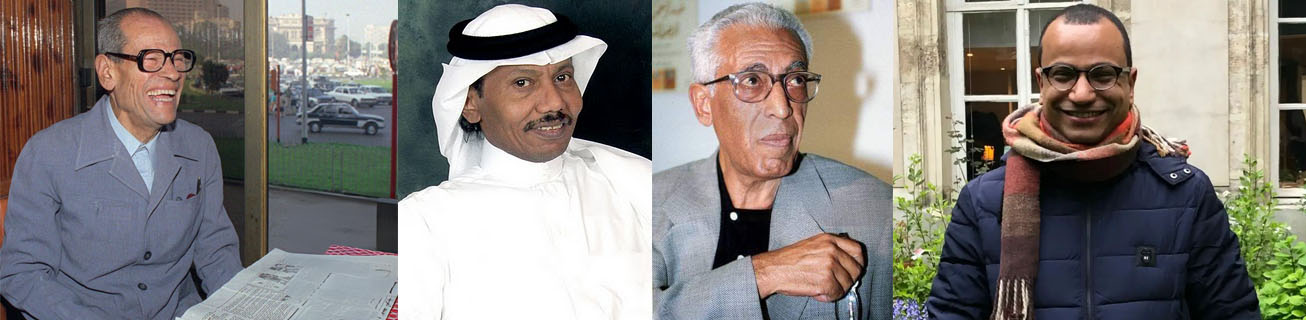
From left to right: Egyptian novelist Naguib Mahfouz, Arab novelist Abdo Khal, Arab novelist Abdelrahman Munif (photographed by Anwar Amro/Getty Images), and Egyptian novelist Muhammad Abdelnabi.
It was once true that the city was where everyone wanted to be, where those seeking change and connections would flock in hopes of realizing their dreams. Arab cities were the opportune nesting grounds for any kind of cultural activity, the birthplace of famed literary salons, social hubs, and creativity beyond the mind’s eye. Nostalgia may prompt many to fondly recall — even yearn for — the days when the Arab city was better known for its thriving, tightly knit communities rather than the cold, sterile environment, uncaring of its residents, that it has become today. Osama Safar examines how this development has manifested in Arab literature in his essay, “How Did the City Transform from a Haven to a Prison in Arab Novels?”, published in Al Jazeera.*
The role of cities in narratives has sharply changed in modern times. Once associated with growth, warmth, life, and a nurturing environment for creativity and strengthening community, Safar explains that cities used to be “an open space where social relationships flourish in its warmth, where identity takes root in its shade, and where a sense of belonging to the place grows,” characteristics of the cities described in pre-1950s works. In modern narratives, the city has been transformed into a “monstrous entity” that exerts oppressive control, subjugation, and class segregation. Safar notes that this change has emerged from shifts in urban life — changes in the public sphere and its relationship to the individual — rather than from any change in narrative techniques.
“The novel here does not lament the city, nor does it evoke it from the past, but rather documents this profound transformation in the individual’s relationship with place,” states Safar, who clarifies, “The city is no longer a benevolent protagonist, but it has not disappeared. It has become a ‘malevolent protagonist,’ and through it, the novel asks about ways to survive in cities that no longer resemble themselves.”
Many factors have influenced the change in the Arab city’s character, including the rise of consumerism, late-stage capitalism, the prioritization of productivity, stagnation, the shift toward a security state, and the encouragement of conformity, complacency, and the rejection of community. Safar analyzes the shift in the role of cities, particularly Cairo, as a once-transformative space into a hostile environment, showing these changes through four novels: Naguib Mahfouz’s “Cairo” series, Muhammad Abdelnabi’s “In the Spider’s Room” (American University in Cairo Press, 2018), Abdo Khal’s “Throwing Sparks” (Manshurat al-Jamal, 2009), and Abdelrahman Munif’s “Cities of Salt” (1984).
The loss of Arab cities as they were once known is keenly felt in Naguib Mahfouz’s “Cairo” series. As Safar writes, the Arab city has long been “a center for the production of social and political life, a starting point for the birth of social and political movements, and a space where individuals were nurtured and socialized within a framework of values.” Mahfouz highlights the roles of the neighborhood, the cafe, the shops, and the street itself — places that are being lost, leaving behind spaces that are cold and detached from the community. Perhaps most startling is the way Mahfouz’s novels depict how, with the expansion of the security state, cities are “transformed into centers whose role was limited to feeding their inhabitants, monitoring them, and suppressing them when necessary.”
According to Edward Said’s “Culture and Imperialism,” as cited by Safar, the city has transitioned from a space that fosters change into one that promotes stagnancy, withdrawal, and isolation. Muhammad Abdelnabi explores these elements in “In the Spider’s Room,” where the novel’s conflict is removed from the streets and experienced in the confines of a room. In the words of Safar, “The room becomes the primary narrative unit as a direct consequence of the city transforming into a hostile space.” Cairo, in this novel, is described as a “mechanism of exclusion. There are no vibrant streets, no public life, and no shared spaces among people. Nothing but a narrative space composed of closed rooms and suffocating interior spaces.” He explains that “this shift is not a withdrawal from politics, but rather a repositioning of the narrative in the face of a public sphere that is no longer usable.” Thus, the city becomes an “invisible control mechanism that forces individuals to disappear and flee instead of participating.”
In Abdo Khal’s “Throwing Sparks,” the city acts as a “closed stage of domination” that encourages private spaces that produce symbolic violence.” The novel examines the distribution of power in society, focusing on the city’s role in reinforcing class segregation as citizens are managed through control and symbolic terror, writes Safar. In his words, relationships are managed “vertically, not horizontally,” and “the city distributes oppression to everyone, but not equally. There is space for the power and another invisible space for the weak.”
Meanwhile, in Abdelrahman Munif’s “Cities of Salt,” cities are “managed rather than lived in, consumed rather than inhabited,” states Safar. He cites American critic Fredric Jameson’s “Postmodernism, or, the Cultural Logic of Late Capitalism,” in which Jameson argues that the modern city is no longer understood as a “lived experience, but as an operating system, where space is redefined according to the logic of production and control.” The city in “Cities of Salt” is an inorganic entity that has grown through economic structure rather than developed through the natural growth of society. In this environment, a person’s value is dependent on efficiency and productivity, with the city becoming a workplace rather than a space for life. In this setting, citizens become disposable and replaceable.
Osama Safar’s comparison of the Arab city, once a haven, to a prison seems all the more fitting as modern narratives continue to reinforce the image of the city as a cold, hostile space that aids in the state’s surveillance rather than the nurturing of community. However, this fascinating development also warrants concern, raising questions about how this continued state will affect not only novels but also reality.
*Osama Safar’s “How Did the City Transform from a Haven to a Prison in Arabic Novels?” was published in Arabic in Al Jazeera.
This article appeared in Inside Al Jadid Reports, No. 154, 2026.
Copyright © 2026 AL JADID MAGAZINE