
The Paradox of Humanism in a Colonial Landscape
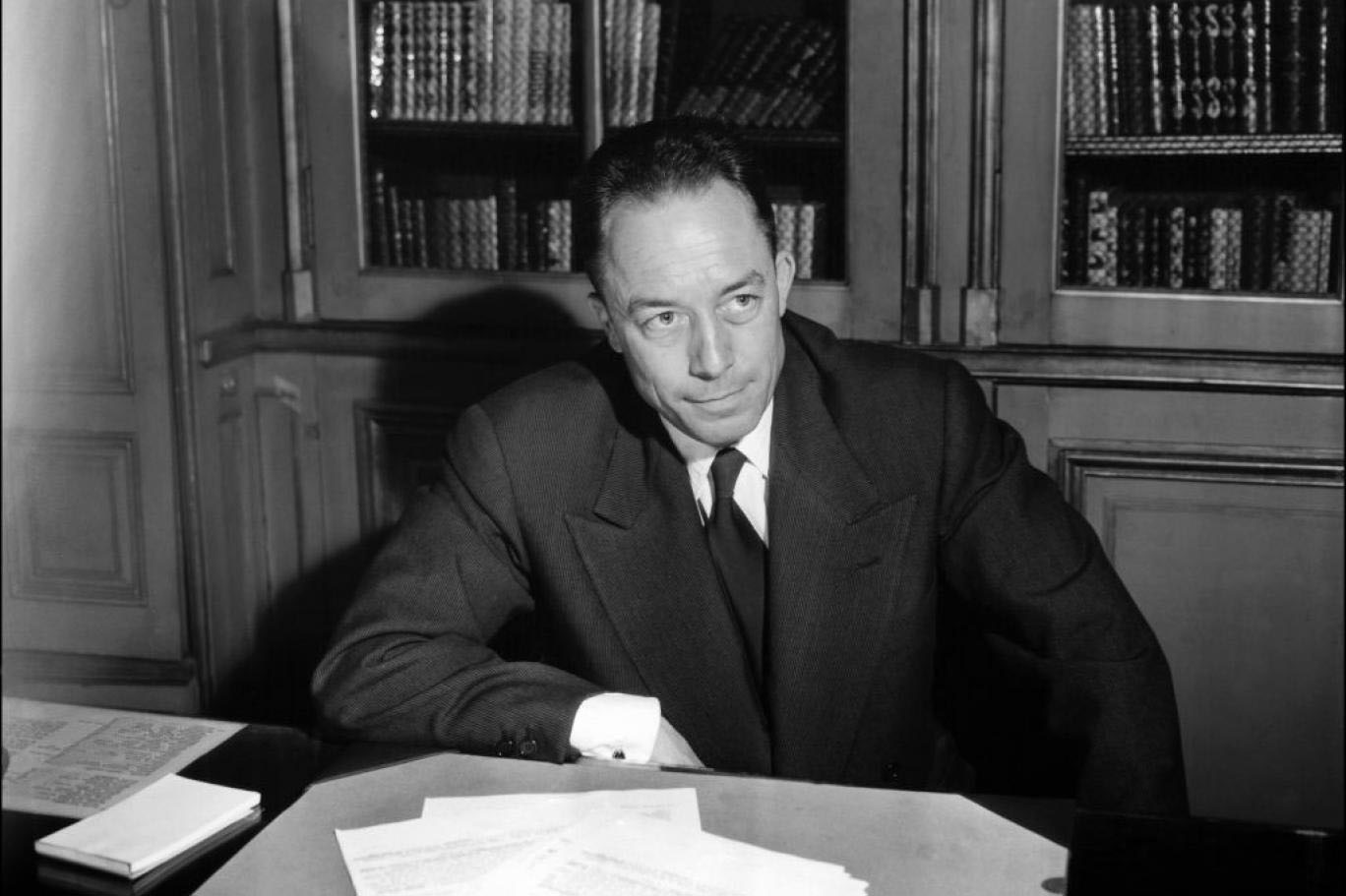
French-Algerian writer Albert Camus posing for a portrait in Paris, photograph credit AFP/Getty Images.
The Algerian Revolution and Albert Camus' legacy persist in Arab writings, primarily among extreme nationalists and moderate humanists. Algerian nationalists highlight Camus' silence during the Algerian War of Independence and his refusal to endorse anti-colonial struggle, which led critics to interpret his attitudes as constrained by his universalism. The discourse has featured the moderates or revisionists. I recall reading literature by revisionist Arab Algerians that identified numerous errors and corruption committed by the FLN (National Liberation Front) leadership; some of these are covered in Al Jadid Magazine, particularly in the book reviews by the late George Tarabishi.*
(Coincidentally, one of those revisionists is the historian Mohamed Harbi, who passed away a few days ago. Mohamed Harbi (1933-2026) was a revisionist who played a prominent role in the FLN from 1954-1962. He was placed under house arrest in 1971 and published "The FLN: Mirage and Reality" in 1975, offering an insider's perspective of the independence movement that the FLN did not welcome. Harbi analyzed the Algerian revolution and critiqued the national myths that sought to justify post-independence authoritarianism, emphasizing that any reading of history must be free of national mythology and that ignoring or sanitizing the past hinders the possibility of change.)
Albert Camus is a writer known for his commitment to justice, revolt, and moral responsibility, and is widely respected by Arab progressives. At the same time, the award-winning writer remains under scrutiny for what critics claim are contradictions between his philosophical humanism and political blind spots, suggesting an “incomplete humanism” that sympathizes with injustice against the poor yet stops short when the perpetrator is the French colonial system. The most recent account I read of this contradiction is “Albert Camus and Algeria in exile: An outstanding novelist and flawed human being,” by the Algerian author Mohammed Fatiline in Al Quds Al Araby.
Postcolonial scholarship critically examines the enduring impact of colonialism on societies, cultures, and literature, highlighting how colonial structures marginalize and render invisible the voices and experiences of colonized peoples. This field draws on thinkers such as Edward Said, who critiques Western literary production for perpetuating imperial ideologies, and Frantz Fanon, who explores the psychological and structural effects of colonialism on the colonized. It also engages with ethical debates, such as those in Arab literary circles, concerning writers' responsibilities in addressing oppression and the moral implications of narrative inclusion or erasure.
Postcolonial critiques of Albert Camus emphasize how colonial power structures influenced his literary imagination in French Algeria. This view places him not merely as an existentialist philosopher or modernist writer, but as a product of the colonial environment, thereby highlighting the ethical and political dimensions of his work.
Camus was a French-Algerian writer and philosopher, heavily influenced by his pied-noir background, who reflected themes of alienation and rebellion in a world he considered absurd. Although born in Algeria to European settlers, he didn't share the advantages of wealthy colonists. As a writer, he aligned more with Absurdism than Existentialism. His works, including “The Stranger” (1942) and “The Plague” (1947), examine the human condition and earned him the Nobel Prize in Literature in 1957.
Born in Algeria in 1913 and raised in its impoverished neighborhoods, Camus was shaped by the sun, sea, and working-class areas of Algeria. He belonged to a community of pieds-noirs — European settlers who were often poor and marginalized within the colonial hierarchy. However, marginality did not eliminate the fact that Camus was part of a system that gave him privileges unavailable to Indigenous Algerians. This ambiguous position — being both an Algerian child and an heir to the colonial order — pervades his literature and fuels the central critique of his legacy.
Camus' identity dilemma arose from his dual existence as a French citizen and an Algerian by geography. As a poor pied-noir, he was excluded from both French high society and Algerian society, fostering a deep sense of alienation. He identified as a Mediterranean humanist rather than a settler, which created a psychological and political contradiction: he could not morally support colonialism, yet he could not envision a future where the French community would lose Algeria. This tension shaped his advocacy for coexistence, reform, and compromise — positions that became untenable with the onset of the Algerian War.
Camus' artistic achievements emerged in a context in which his stylistic elegance and philosophical originality were both celebrated and critically examined. Yet there exists a conflict between the writer’s universal humanism and his oversights regarding French colonial violence, placing him in a morally complex position. Critics argue that Camus’ humanism has blind spots. Though he was deeply moved by poverty, injustice, and suffering, his ethical circle did not fully include Algerian Muslims, whose oppression under French colonial rule was severe and well documented.
While Camus’ early journalism advocated for Arab reforms — his journalism for Alger Républicain, the Arabic language Algerian newspaper published in Algeria, focused on documenting social suffering, including poverty, injustice, disease, and exploitation in Kabylia and Algiers — he avoided addressing structural issues such as sovereignty, land expropriation, legal apartheid, and political repression. He condemned the effects of colonialism, but refrained from directly criticizing colonialism itself, reflecting a selective and ambivalent approach to the political causes of the suffering he documented.
Albert Camus is one of the few canonical European writers whose life was deeply entangled with Algeria: he was born there, educated there, worked as a journalist there, and drew richly on its landscapes in his fiction and essays. Yet much of the scholarship — both in the Maghreb and internationally — argues that Camus maintained a profound emotional, political, and moral distance from the lived realities of the Algerian people, especially the Arab and Berber majority. This tension underpins the claim that Camus belonged to Algeria both geographically and aesthetically, but not historically or politically.
In Camus’s fiction, Algeria is portrayed as a vivid sensory landscape of blinding light, stark terrain, heat, and the sea. However, it lacks people, society, or historical struggles, present in his imagination but absent in its human and social dimensions. It functions as a metaphysical backdrop rather than a depiction of real political life, reflecting Camus' paradoxical relationship with his homeland and reinforcing his position as a European settler within a colonial hierarchy, where the humanity of the colonized is obscured despite his own marginality within the colonial structure. Critics observe that he "lived Algeria, then exiled it in literature," depicting it as an aesthetic vision that lacks ethical or societal aspects, with the Arab Muslim majority noticeably missing. The distinction between aesthetic Algeria and material Algeria lies in Camus’ romanticized view of Algeria as a space of childhood innocence, sensory experience, and existential reflection, in contrast to its reality as a colonized land marked by Indigenous dispossession and the struggle for liberation.
Camus faced criticism for the absence of "Arabism" in his work, particularly in his 1942 novella “The Stranger,” prompting a reassertion of the Arab voice he had ostensibly silenced, whether intentionally or not. The book has been criticized for its portrayal of the Arab character, who remains unnamed, voiceless, without family, history, or interiority. However, critics have argued that this depiction functions as a narrative device to emphasize Meursault’s emotional detachment and existential struggle, rather than to humanize the victim. The clinical description of the killing and the novel’s minimal focus on the Arab character contribute to one of the most notable silences in 20th-century literature.
Algerian author Kamel Daoud’s 2013 debut novel “The Meursault Investigation,” a retelling of “The Stranger,” identifies this absence as a significant flaw, highlighting how Camus' writing reflects the colonial structure he couldn't transcend. Daoud writes from post-independence Algeria, wrestling with its political and cultural contradictions, offering a perspective that challenges Camus' historical stance.
"Meursault" refers to the protagonist of Albert Camus' novel “The Stranger.” Portrayed as a character who embodies existential detachment, his actions, including the murder of an unnamed Arab, are central to the novel's exploration of absurdity and meaninglessness. However, critics highlight that the Arab's anonymity and lack of narrative importance reflect broader colonial dynamics, where Arabs were often made voiceless and marginalized in French cultural and political discourse.
Presented as unnamed, voiceless, and objectified, the Arab serves as a narrative device to advance Meursault’s existential journey rather than to assert his own humanity. This erasure reflects Camus' literary technique of emphasizing absurdity over political commentary. However, it also reveals his cultural inheritance of French colonial discourse, as the text fails to acknowledge colonial violence. Within a postcolonial framework, “The Stranger” can be seen as normalizing the Arab’s killing by denying him narrative personhood.
Camus's attitude toward victims varied greatly depending on their identity and the situation. While he showed sincere concern for the poor, justice, and the oppressed, his moral view often became narrower when the victims were Indigenous Algerians and the perpetrators were French authorities. Unlike the Indigenous Algerians who saw their struggle as a fight for liberation, Camus opposed both colonial repression and the FLN's revolutionary violence, instead advocating for coexistence. This universalist stance, though admirable in theory, was viewed by many Algerians as a denial of the legitimacy of their struggle, exposing a gap between his ideals and the realities of liberation politics.
In this way, critical readings of “The Stranger” examine how narrative erasure functions as a political tool, portraying the novel’s structure as a means of normalizing the disposability of Arabs. This perspective aligns with postcolonial critiques, including those of Edward Said.
Camus's thinking is constrained by his inability to fully engage with the human realities of colonial Algeria. While he vividly captured the country's physical beauty, his perspective was primarily aesthetic, neglecting the struggles of its people under colonial rule. This ethical and aesthetic shortcoming has made him a complex and controversial figure in Algerian history. His legacy exists in a space of productive discomfort, where his universalism is both celebrated and critiqued. His work is admired for its stylistic brilliance and philosophical depth, yet it also exposes significant omissions, especially his refusal to confront the political realities of his time. Reading Camus today means engaging with both his enlightening contributions to world literature and the blind spots he left unaddressed, particularly regarding Algeria.
Camus’ distance from the Algerian reality was not only felt in “The Stranger,” but in other works as well. In his 1947 novel “The Plague,” Oran is a metaphorical container for existential drama rather than a colonial city with stark racial hierarchies; in “Lyrical and Critical Essays” (1970), nature is exalted, but Algerian working-class and indigenous lives remain peripheral.
Camus' Algeria is an abstract, symbolic space in which the sun, sea, and heat reflect the absurd — yet these elements are muted by the absence of its people in his work. This absence reflects a conscious cultural and political choice, revealing his ethical ambiguity as a renowned literary figure who did not empathize with the struggles of colonized Algerians. At the same time, Daoud's Algeria in “The Meursault Investigation” is a real, historical place shaped by colonization, conflict, and collective memory.
Camus’ imagined Algeria is a Mediterranean paradise — bright, luminous, and politically innocent — anchored in French culture and universal philosophy. Meanwhile, Daoud depicts an Algeria that is Arab, scarred, and politically chaotic, influenced by its postcolonial battles and internal unrest, all while challenging the silences surrounding its history. Their novels reflect these opposing visions of the same land.
Daoud addresses Camus's silence by giving the murdered man the name Musa and creating a detailed identity for him. He gives Musa a grieving mother, a home, and a brother, Harun, who is the narrator and protagonist of “The Meursault Investigation.” From Harun's perspective, Daoud transforms the vague murder in Camus' “The Stranger” into a specific act of colonial violence, situating it within the historical and emotional context of a family and a nation. In this way, Daoud challenges Camus' erasure of the Arab, reclaiming the narrative to emphasize its deep personal and societal significance. As a counter-narrative, the work shifts the perspective to an Algerian narrator who critiques Camus’ portrayal and the Western audience’s acceptance of it.
“The Meursault Investigation” is described as an interrogation because it critically examines and challenges the power dynamics in storytelling. It questions who holds the authority to tell a story, whose voices are remembered, and whose are excluded from the literary archive. In doing so, it contrasts Camus' portrayal of the Arab as an object with Daoud's reclamation of the Arab as the central subject, redefining Meursault as a historical criminal stripped of his existentialist justification.
Camus and Daoud depict two contrasting moral worlds. Camus grounds his ethical view in the absurd, using Meursault's trial to examine themes of universal indifference, social pressure, the artificiality of morality, and the certainty of death. In this perspective, the murdered Arab is incidental, as the story centers entirely on Meursault's consciousness.
Daoud’s perspective diverges from Camus’ by emphasizing justice over absurdity. Through Harun, his protagonist, Daoud critiques the colonial privilege embedded in Camus’ universalism, arguing that Camus’ humanism falls short in colonized contexts. Unlike Camus, who employs absurdity to avoid moral responsibility, Daoud reintroduces a moral dimension by demanding acknowledgment of loss and rejecting absurdity as a reason for injustice.
Violence persists even after independence, as Daoud shows through Harun’s similar act of killing a Frenchman following Algeria’s liberation. The novels reflect each other: Camus’ Meursault kills an Arab in colonial Algeria, while Harun kills a Frenchman in post-independence Algeria. Camus emphasizes indifference and absurdity, whereas Daoud examines political rage and moral uncertainty. Harun’s lack of trial contrasts with Meursault’s, symbolizing how Algeria remains stuck in cycles of dominance. Harun inherits not only loss but also the burden of Camus’s story, reflecting Daoud’s critique of both colonial and post-colonial systems.
Daoud’s “The Meursault Investigation” does not merely criticize Camus or unjustly praise nationalist stories. Instead, it recognizes Camus’ brilliance and clarity of writing while highlighting the colonial blind spots in his work. Daoud’s critique is brilliant, as it both agrees with and rewrites Camus, providing a detailed view. He does not villainize Meursault but instead shows what Meursault’s perspective misses, giving the novel its literary strength as both a tribute and a critique. The book engages in a broader critique within Arab and Maghrebi intellectual history, echoing Fanon’s analysis of colonial psychology and Assia Djebar’s re-centering of Algerian voices. This critique intersects with Edward Said’s characterization of Camus as a “colonial humanist,” contributing to the ongoing debate about Camus’ place in Algerian memory. “The Meursault Investigation” crystallizes these tensions through the narrative act of reclaiming the silenced voice, offering a post-colonial counterpoint to Camus’ narrative.
Kamel Daoud reinterprets a classic European text from the margins, revealing its political unconscious. He restores humanity to what had been stripped away and reclaims Algeria from abstract philosophical abstractions. By staging a moral reckoning that Camus chose not to undertake, Daoud shows that literature can serve as a form of historical justice — not by reversing dominance but by rewriting the story from the ground up.
“The Stranger” may have been written for French and European readers rather than for Algerians. Camus’ philosophical vocabulary, existential themes, and literary style appeal to Western audiences, deeply rooted in Western thought. While acknowledging universality, the text stresses that it was achieved within a French cultural and political context rather than beyond it. This focus reflects a tension in his writing, as it marginalizes the Arab world, both as a subject and as an audience, despite its centrality to some of his themes. This marginalization highlights ethical blind spots in his universalist claims.
The 1957 Nobel Prize recognized Camus' literary talent while also reflecting the political tensions of the Algerian War. It reflected Western discomfort with anti-colonial struggles and a preference for voices that criticized injustice without endorsing revolution — a moment when Western institutions favored moderate colonial critics over radical anti-colonial thinkers.
While Camus’ global influence and aesthetic contributions were undeniable, the award’s timing — during Algeria’s struggle for independence — suggests an ideological dimension. While the prize highlighted his distinctive existential philosophy and precise prose, it also carried political implications. To many in the Arab world, the honor represented Europe's self-congratulation at a time when Algeria was fighting to gain independence from French colonial rule. Camus' message of moderation and anti-violence, although resonant in Western circles, seemed disconnected from the brutal realities of colonial oppression.
Camus portrayed Algeria as a land of aesthetic beauty, emphasizing its landscapes and scenery while largely overlooking its societal and historical complexities. His depiction reflected broader colonial literary patterns, focusing on Algeria's visual and emotional appeal rather than addressing its colonial struggles or the suffering of its people. This approach created a dual legacy, admired for its literary brilliance yet criticized for its limited engagement with Algeria's political and historical realities.
*George Tarabishi’s essay, “Deconstructing the Algerian Revolution,” was published in Al Jadid Magazine, Vol. 8, No. 41, Fall 2002. To read the article, click on the link below:
This article appeared in Inside Al Jadid Reports, No. 150, 2026.
Copyright © 2026 AL JADID MAGAZINE